


Example Of Back-Venting
Description
This section is from the book "Principles And Practice Of Plumbing", by John Joseph Cosgrove. Also available from Amazon: Principles and Practice of Plumbing.
Example Of Back-Venting
An example of back-venting the fixture traps in an ordinary bath room is shown in Fig. 32. The chief conditions to be here noted are: (1) The height of the vent pipe where it enters the vent stack. It is kept above the outlet to the highest fixture in the group so that the vent pipe cannot be used as a waste pipe by any of the fixtures in case the waste pipe becomes obstructed; (2) the vent pipe slopes from the vent stack toward the fixture traps to discharge into the waste pipes all water of condensation or any sewage that might back up in the vent pipes, should the waste pipe be obstructed; (3) the distance away from the seal of traps at which the vent pipes connect to the waste pipes. It should be further observed that the vent to the water closet does not connect to the closet trap above the floor, but to the lead bend below the floor, as a permanent and secure joint cannot be made to an earthenware closet trap. If the closet is either of the siphon jet or the wash-down type no vent will be necessary, providing fixtures do not discharge into the soil stack at a higher level, because siphonic action is necessary to operate either type of closet, and the after-wash from the flush cistern is depended upon to again seal the trap. Main-drain traps, leader traps, yard and area traps and stall drain traps do not require back-venting, because if they are emptied by siphonage their seals are soon replaced by drippings.
Non-siphon Traps are those in which the seal cannot be entirely destroyed by siphonic action under any reasonable condition of circumstances likely to prevail in a well installed drainage system. Part of the seal can be siphoned from a non-siphon trap, but sufficient water always remains to effect a seal.
Effect Of Back Pressure On Trap
The most common form of a non-siphon trap is a drum trap (Fig. 33). In this form of trap the area of the body usually is four times the area of the waste pipe, so that to force the seal by back pressure, sufficient pressure is required to sustain a column of water (b, Fig. 34) five times the depth of seal. The depth of seal generally is 4 inches, hence to force the seal by back pressure, a pressure sufficient to sustain a column of water 20 inches high is required. This column of water is equal to a pressure of .728 pound per square inch.
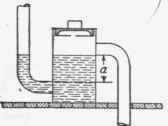
Fig. 33
The effect of siphonic action on a drum trap is shown in Fig. 35. When a partial vacuum is created in the waste pipe, atmospheric pressure forces part of the seal from the trap. When, however, the water in the trap reaches a certain level, no reasonable amount of siphonic influence can lower it more; air then breaks through the seal, dashing the water to all sides. After the vacuum is broken from all sides of the trap the water settles back in the bottom, thus maintaining the seal. Sufficient water always remains in the bottom of this form of trap to effect a perfect seal. All forms of non-siphon traps are made with enlarged bodies, some of which contain baffle plates to deflect the water from the outlet.
Evaporation from Non-siphon Traps is not more rapid than from an equal size siphon trap, and calculated by the constant of evaporation, .4 of an inch per week, it would take, under ordinary conditions, fifty weeks for a 3-inch body drum trap with 4-inch seal and 1 1/2-inch waste pipe to lose its seal.
Continue to:


My Books

