


Trap Ventilation
Description
This section is from the book "Principles And Practice Of Plumbing", by John Joseph Cosgrove. Also available from Amazon: Principles and Practice of Plumbing.
Trap Ventilation
Back-Venting Traps
Siphon traps, unprotected from siphonage by vent pipes, offer no security whatsoever against the passage of drain air into a building; therefore, any system of plumbing in which siphon traps are used should be properly back-vented. A vent pipe not only protects the seal of a trap from siphonage, but also relieves the seal from back pressure and affords ventilation for the short length of waste pipe from the soil or waste stack to the fixture trap. This last consideration is of but small importance, however, because the air in branch waste pipes is changed each time the fixture it connects to is flushed. Furthermore, the air in the short lengths is kept fairly pure by diffusion with the air in the soil or waste stack.
Vent Connections To Traps
The usual method of back-venting fixture traps is to connect the vent pipe to the crown of the trap, as at a, Fig. 31. A better practice, however, is to connect the vent pipe to the waste pipe several inches away from the trap, as at b. When a vent pipe is connected to the crown of a trap it increases the rate of evaporation of water from the trap; also, when much grease is emptied into a fixture the vent pipe, if connected to the crown, is liable to become entirely-stopped up with the grease.*
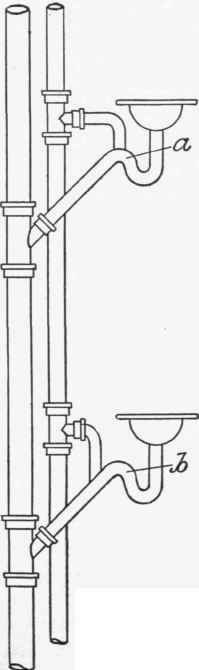
Fig. 31
Distance Of Back-Vent From Trap
The distance the back-vent can be placed from a trap without danger of the trap being siphoned depends entirely on the fall to the waste pipe from the trap to the stack. If the fall is slight, the vent pipe can connect to the waste pipe further away from the trap than when the fall is great. The rule is: Connect the back-vent to the waste pipe at such a point that the vent opening will be above the level of the water in the trap. There will then be no long unventilated leg to form a siphon. See Fig. 29.
Evaporation Of Water From Traps
From experiments made by Dr. Unna, Municipal Engineer of Cologne, to determine the length of time required to destroy the seal of traps by evaporation, it can be calculated that under ordinary conditions the seal of an unvented siphon trap with a 1 3/4-inch depth of seal will be destroyed in from four and a half to five weeks' time. It may be stated, as a general rule applicable to all types of unvented traps, that under ordinary conditions such as obtain in a well constructed drainage system, the rate of evaporation will average .4 of an inch per week, irrespective of size or shape of the surface exposed. No experimental data is available to show the rate of evaporation of water from ventilated traps, but it would be safe to assume a rate of .8 of an inch per week.

Fig. 32
* Inspector W. J. Freaney, of St. Paul, in an examination of vent pipes from fixture traps, found that out of twenty-three traps from kitchen sinks, twelve were completely obstructed with grease, ten partially obstructed, and only one perfectly clear. The latter, however, had been regularly inspected and cleaned.
Continue to:


My Books

