


House Drain
Description
This section is from the book "Principles And Practice Of Plumbing", by John Joseph Cosgrove. Also available from Amazon: Principles and Practice of Plumbing.
House Drain
Definition
A house drain is the system of horizontal piping inside of the cellar or basement of a building, that extends to and connects with the house sewer. It receives the discharge of sewage from all soil and waste lines, and sometimes rain water from rain leaders, yard, cellar, area and sub-soil drains.
House drains are generally located below the cellar or basement floor, where they are entirely out of the way.

Fig. 3

Fig. 4.
When properly installed with suitable materials and with clean-out plugs extending flush with the floor, there is no objection to this method of installation. In some buildings where the house drain is to be located below the floor, brick ducts with removable covers of iron or stone are provided to encase it.
In buildings where the basement floor is below the level of the street sewer, the house drain is of necessity located above the cellar floor. The only objection to this method of installation is the fact that the network of pipes forming the house drain interferes with the head room of the cellar.

Fig. 5
Materials
When buried in the earth, house drains should be constructed of cast-iron pipe coated with asphalt both inside and out. In buildings over two stories in height they should be made of extra heavy cast-iron pipe; in small cottages standard pipe may be used.
House drains located in ducts or suspended above floors may be of wrought-iron pipe with special cast-iron recessed drainage fittings (Fig. 4) that present a smooth, continuous inner surface to the flow of sewage. The wrought-iron pipe and cast-iron fittings should be coated with asphalt or galvanized both inside and out, and the ends of all pipes that screw into fittings should be reamed to remove the burr formed by cutting. Tile pipe should never be used in the construction of a house drain.
Connections
Connections to house drains should be made with Y fittings, a (Fig. 5); this fitting gives the branch b an angle of forty-five degrees, and if it is to be run parallel with the main drain or at right angles to it, the change of direction can be effected by using a 1/8 bend, c or d. A T fitting never should be used in a drainage system, and a TY fitting, e, never should be used in a horizontal drain. The end of a horizontal drain that turns up to form a soil or waste stack should terminate with a clean-out plug in the end of a Y fitting, as in view a (Fig. 6), and the branch of the Y should form the stack connection. If, however, the horizontal drain is but a short branch of the main drain, or is a rain leader, a heel rest quarter bend (view b) with a radius of four times the diameter of the pipe may be used. Saddle hubs never should be used for connecting to any part of the drainage system. Changes in the direction of horizontal drains should be made at angles of forty-five degrees, or with large radius quarter bends.
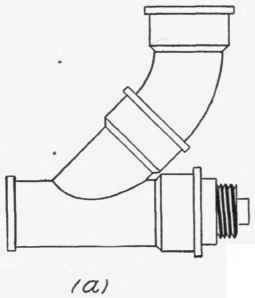

Fig. 6
Continue to:


My Books

