


Connection To Street Sewer
Description
This section is from the book "Principles And Practice Of Plumbing", by John Joseph Cosgrove. Also available from Amazon: Principles and Practice of Plumbing.
Connection To Street Sewer
House sewers should be connected to street sewers at an angle of about forty-five degrees, except in the case of large brick street sewers, when the house sewer may enter at right angles. Connections to brick sewers should be made at the side just over the spring of the arch. They should never be made below the water line in the sewer. In tile street sewers, Y branches are usually provided at intervals of about twenty-five feet, to which house sewers may be connected. When branch connections are omitted in the street sewer a length of pipe should be removed at the proper location and a Y branch substituted. A hole should never be cut in a tile street sewer for the house sewer to be connected into.
Connections between tile and iron pipes are usually made with cement joints. A better joint, however, can be had by using an iron and tile pipe connection (Fig. 2) which will stand a water pressure of forty to fifty pounds per square inch without leaking.
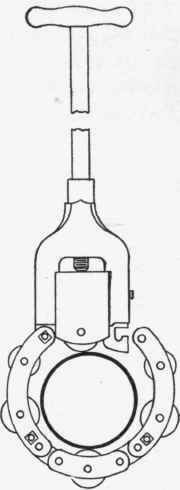
Fig. 1

Fig. 2
House sewers discharging into tide water should enter below the low water level, and a vent should be placed in the sewer above the high water level to prevent tide water from air locking the sewer. When a plumbing system that drains into tide water is at so low a level that high tide will overflow some of the fixtures or fill the house sewer, a tide water trap (Fig. 3) should be placed on the end of the sewer to prevent tide water entering the pipe. (In the figure the walls of the trap are broken away to show the interior.)
The usual practice is to make the house sewer one or two sizes larger than the house drain. A better practice, however, is to continue the house sewer the same size as the house drain. By so doing, a uniform velocity of flow is secured in both, and, when the house drain is rightly proportioned, a scouring action is assured.
Continue to:


My Books

