


Flow Of Water Through Pipes Formulas
Description
This section is from the book "Principles And Practice Of Plumbing", by John Joseph Cosgrove. Also available from Amazon: Principles and Practice of Plumbing.
Flow Of Water Through Pipes Formulas
Velocity Of Flow
When water flows through a pipe of uniform cross section, the quantity of water passing any point in a given interval of time depends upon the velocity with which the water flows and the area of cross section of the pipe. It is evident that the quantity of water will equal a column whose cross section is the area of the pipe and whose length is equal to the velocity.
The velocity with which water moves through a pipe is not uniform throughout its cross section. It is least near the wetted perimeter of the pipe where the friction of the pipe retards the flow, and is greatest at the center of the cross section where having to overcome only the friction of its own flowing layers, it attains the maximum velocity. It is assumed in practice, however, that all particles of the water have the same velocity, and the mean of all the velocities in the cross section is taken as the velocity of flow.
Formulas For Velocity
When the size of a pipe and the quantity of water it will discharge in a given time are known, the mean velocity of efflux can be found by the formula: v=q.
a In which V = velocity of flow in feet per minute q = quantity of water in cubic feet per minute a = area of cross section of pipe in square feet.*
Example
What must be the velocity of flow in a 2-inch pipe to discharge 6.3 cubic feet of water per minute ?
Solution
Area of pipe = .0213 square feet. Then 6.3/ .0213 - 300 feet per minute. - Answer.
When the hydrostatic head, length and diameter of a pipe are known, the mean velocity of discharge can be found by the formula:

In which V = mean velocity in feet per second m = coefficient from Table XXVIII d = diameter of pipe in feet h = hydrostatic head in feet 1 = total length of pipe in feet
Table XXVIII - Values Of Coefficient
| Diameter of Pipe in | |||||||
Feet | Feet | Feet | Feet | Feet | Feet | Feet | Feet | |
.05 | .10 | .50 | 1 | 1.5 | 2 | 3 | 4 | |
Ins | Ins. | Ins. | Ins. | Ins. | Ins. | Ins. | Ins. | |
5/8 | 1 1/4 | 6 | 12 | 18 | 24 | 36 | 48 | |
m | m | m | m | m | m | m | m | |
.005 | 29 | 31 | 33 | 35 | 37 | 40 | 44 | 47 |
.01 | 34 | 35 | 37 | 39 | 42 | 45 | 49 | 53 |
.02 | 39 | 40 | 42 | 45 | 49 | 52 | 56 | 59 |
.03 | 41 | 43 | 47 | 50 | 54 | 57 | 60 | 63 |
.05 | 44 | 47 | 52 | 54 | 56 | 60 | 64 | 67 |
.10 | 47 | 50 | 54 | 56 | 58 | 62 | 66 | 70 |
.20 | 48 | 51 | 55 | 58 | 60 | 64 | 67 | 70 |

Example
What will be the velocity of discharge from a 6-inch pipe 500 feet long under a head of 60 feet?
*Table of square inches in decimals of a square foot in appendix.

In column 1 of Table XXVIII will be found that the nearest value corresponding to .238 is .20, and following that line to where it intersects the column headed 6 inches, the value of coefficient m will be found to be 55, which multiplied by the square root .238 gives the velocity sought for. Where great accuracy of calculation is not required, the constant 48, which is an average value of coefficients for small sizes of pipes, can be used, and will give results sufficiently accurate for most practical purposes.
Formula For Head
When the length and diameter of a pipe are known, the head required to discharge a certain quantity of water per second can be found by the formula: h=.000704q21
d5
In which h=head in feet l=length of pipe in feet d=diameter of pipe in feet q=quantity of water in cubic feet per second.
Example
What head will be required to discharge from a 4-inch pipe 500 feet long 2 cubic feet of water per second ?
Solution
Substituting values in the formula h=0.000704X4X500=333 feet head. Answer.
0.00422
Formula For Diameter
When the length of a pipe, the hydrostatic head, and the quantity of water required to be delivered per second are. known, the diameter of pipe that will safely take care of that quantity can be found by the formula:

In which d=diameter of pipe in feet q=cubic feet per second to be delivered l=length of pipe in feet h=head in feet Example - What diameter of pipe will be required to deliver .5 cubic foot of water per second through a pipe 2,000 feet long with a head of 400 feet?

Formulas For Quantity
When the mean velocity and the area of a pipe are known, the quantity of water discharged in a given interval of time can be determined by the formula: q=va In which q=quantity of water in cubic feet per minute v=velocity of flow in feet per minute a=area of cross section of pipe in square feet
Example
How many cubic feet of water will be discharged per minute by a 2-inch pipe when the velocity of efflux is 300 feet per minute?
Solution
Area of 2-inch pipe=.021 square feet. Then .021x300 =6.3 cubic feet. Answer.
When the diameter, head and length of a pipe are known, the quantity of water it will deliver in a given time can be found by the formula:

In which q=quantity in cubic feet per minute d=diameter of pipe in inches h=head in feet l=length of pipe in feet
Example
What quantity of water can be delivered per minute through a 3-inch pipe 2,000 feet long with a head of 400 feet?

The velocity of flow in drains or pipes running partly full can be found by the formula:
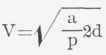
In which V=velocity in feet per second a=area of water in square feet P=wetted perimeter in feet 2d=twice the slope in feet per mile
Example
What is the velocity of flow in a 6-inch drain laid at a grade of 1/4 inch per foot when running half full?
Solution
There is a 110-foot fall in a mile of drain laid at a grade of 1/4 inch per foot.

Continue to:


My Books

