


Floor Drains
Description
This section is from the book "Principles And Practice Of Plumbing", by John Joseph Cosgrove. Also available from Amazon: Principles and Practice of Plumbing.
Floor Drains
In breweries, stables, washrooms, bottling establishments, hotel kitchens or other places where sufficient water is poured or splashed on the floor to maintain the seal of a trap, floor drains (Fig. 15) are permissible. (In the figure the walls are shown broken away to show the interior.) These fixtures should be provided with heavy brass or iron removable strainers and water seal and tide water traps. Floor drains should never be used in cellars or basements of buildings unless they connect to the leader side of a rain leader trap; even then they are objectionable, and,

Fig. 14 if used, should be provided with a tide water trap to prevent an overflow of sewage should the main drain become stopped up.
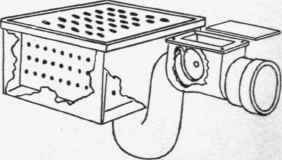
Fig. 15
Velocity Of Flow In Drains
House drains should be given such an inclination that the sewage will have a velocity of from 180 to 360 feet per minute. With a velocity much less than 180 feet per minute, the water will fail to carry along the solids held in suspension, and with a greater velocity than 360 feet per minute, the water will run away from the more slowly moving solids. The best velocity for sewage is about 270 feet per minute, and drain pipes should be run at the proper inclination to produce this velocity. Pipes of small diameter offer greater frictional resistance than those of large diameter. Therefore, they must be given a greater fall to produce the required velocity. The proper inclination for drains of any diameter and length to produce a velocity of 270 feet per minute, can be found by the formula: f =l/10d when f = fall in feet
1 = length of drain in feet d = diameter of pipe in inches Example - What fall should a 6-inch drain, 40 feet long, have to give to the sewage a velocity of 270 feet per minute ?
Solution
In this case, 1 = 40 feet, d = 6 inches. Therefore,
_40_ f = = 66 feet or 8 inches fall per 40 feet of drain.
10 X 6 Expressed in the form of a rule, the foregoing formula reads :
Rule
To one foot of fall in the drain, allow a length of ten feet of pipe for each inch in the diameter of the pipe.
From the foregoing formula and rule the following table is obtained:
Table II
Diameter of pipe in inches | 2 | 3 | 4 | 5 | 6 | 7 | 8 | 9 | 10 |
Length of drain in feet | 20 | 30 | 40 | 50 | 60 | 70 | 80 | 90 | 100 |
Total fall to drain in inches | 12 | 12 | 12 | 12 | 12 | 12 | 12 | 12 | 12 |
Fall per foot in inches (approximate) ..... | 3/5 | 2/5 | 3/10 | 1/4 | 1/5 | 1/6 | 1/7 | 1/8 | 1/9 |
Continue to:


My Books

