


Size Of House Drains
Description
This section is from the book "Principles And Practice Of Plumbing", by John Joseph Cosgrove. Also available from Amazon: Principles and Practice of Plumbing.
Size Of House Drains
A house drain should be large enough to carry off the greatest probable amount of water or sewage that will be discharged into it, without being too large to be self-cleaning. It should never be smaller than the outlet to the largest fixture discharging into the drainage system, and as traps of syphon jet and other improved forms of water closets range in size from 2 1/2 to 3 inches in diameter, a house drain into which a water closet discharges never should be smaller than 3 inches in diameter.
The size of a house drain is determined by the amount of water or sewage it must conduct.
In drainage systems that receive the rain water from roof, yard and areas, the amount of impervious surface to be drained and the rate of precipitation, generally determine the size of the pipe. It has been found from measurements that the total amount of sewage passing a given point in the house drain in a certain period of time is less than one-fortieth the amount of rain water that during excessive rain storms will pass the same point in an equal period of time. In small buildings, therefore, if the house drain is made sufficiently large to carry off all rain water from the projected roof, yard and area surface during excessive and prolonged storms, no extra provision need be made for the small amount of sewage that will be discharged into the drain during short periods of excessive precipitation, which seldom exceed five minutes in duration.
In buildings where the rain water and a large volume of sewage discharge into the same drainage system, the quantity of rain water to be removed should be added to the sewage, and the drain made large enough to carry them both.
The maximum intensity of rainfall, for periods of five, ten and sixty minutes, at weather bureau stations equipped with self-registering gauges, compiled from all available records, can be found in the following table:
Table III - Intensity Of Rainfalls
Stations | Max. Rate in Feet per Hour | Rate of Downfall per Hour for | |||||||
6666 | |||||||||
5 Min. | 5 Min. | 10 Min. | 60 Min. | ||||||
Feet | Inches | Inches | Inches | ||||||
Bismarck..... | .75 | 9.00 | 6.00 | 2.00 | |||||
St. Paul | .. | .. | .... | .. | .70 | 8.40 | 6.00 | 1.30 | |
New Orleans | .. | .. | .. | .. | .68 | 8.16 | 4.86 | 2.18 | |
Milwaukee | ... | .. | ... | .. | .65 | 7.80 | 4.20 | 1.25 | |
Kansas City | ... | ... | ... | .. | .65 | 7.80 | 6.60 | 2.40 | |
Washington | ... | ... | ... | .. | .63 | 7.50 | 5.10 | 1.78 | |
Jacksonville | ... | ... | ... | ... | .62 | 7.44 | 7.08 | 2.20 | |
Detroit | ... | ... | ... | ... | .60 | 7.20 | 6.00 | 2.15 | |
N. Y. City | ... | ... | ... | ... | .60 | 7.20 | 4.92 | 1.60 | |
... | ... | ... | ... | .56 | 6.72 | 4.98 | 1.68 | ||
Savannah | ... | ... | ... | ... | .55 | 6.60 | 6.00 | 2.21 | |
Indianapolis | ... | ... | ... | ... | .55 | 6.60 | 3.90 | 1.60 | |
Memphis | ... | ... | ... | ... | .55 | 6.60 | 4.80 | 1.86 | |
Chicago | ... | ... | ... | ... | .55 | 6.60 | 5.92 | 1.60 | |
Galveston | ... | ... | .. | ... | .54 | 6.48 | 5.58 | 2.55 | |
Omaha | ... | ... | ... | ... | .50 | 6.00 | 4.80 | 1.55 | |
Dodge City | ... | ... | ... | ... | .50 | 6.00 | 4.20 | 1.34 | |
Norfolk | ... | .... | ... | ... | .48 | 5.76 | 5.46 | 1.55 | |
Cleveland | ... | ... | ... | ... | .47 | 5.64 | 3.66 | 1.12 | |
Atlanta | ... | ... | ... | ... | .46 | 5.46 | 5.46 | 1.50 | |
Key West | ... | ... | ... | ... | .45 | 5.40 | 4.80 | 2.25 | |
Philadelphia | ... | .. | ... | ... | .45 | 5.40 | 4.02 | 1.50 | |
St. Louis | ... | ... | ... | ... | .40 | 4.80 | 3.84 | 2.25 | |
Cincinnati | ... | ... | ... | ... | .38 | 4.56 | 4.20 | 1.70 | |
Denver | ... | ... | ... | ... | .30 ' | 3.60 | 3.30 | 1.18 | |
Duluth Grand totals | ... | ... | ... | ... | .30 | 3.60 | 2.40 | 1.35 | |
13.8726 | 166.32 | 128.18 | 45.65 | ||||||
Averages | ... | ... | ... | .. | .53 | 6.4 | 4.54 | 1.76 | |
*Report of the Chief of the Weather Bureau, 1896-97. A table of lineal inches in decimal fractions of a lineal foot is given in Appendix I.
From the foregoing table it will be seen that the maximum rate of precipitation varies greatly in different parts of the country, therefore when designing a drainage system for a certain locality to take care of the rain water, the maximum rate of precipitation for five minutes in that locality must be taken into consideration in determining its size. When the rate for any particular neighborhood is unknown, the maximum precipitation at the nearest known station may be taken, or a rate of six inches per hour assumed.
The method of calculating the diameter of a drain for any locality is as follows:
Multiply the area in square feet of the surface to be drained by the maximum rate of precipitation in feet per hour in that locality, and divide by 60; this will give the number of cubic feet of water to be removed per minute. Having determined this quantity, the diameter in inches of the pipe required can be found by dividing by 212, extracting the square root and multiplying by 12. This can be expressed by the formula:
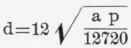
In which d=diameter of pipe in inches a=square feet of area to be drained p=maximum rate of precipitation in feet per hour
12720=212X60
Example
What size of drain will be required in Kansas City to drain a roof and other impervious surfaces 50x200 feet, the drain being laid at such a grade as to produce a velocity of 270 feet per minute.
Solution
The area a to be drained=50X200 =10,000 square feet. The maximum rate of precipitation for Kansas City (see
Table III) is 7.8 inches= 7.8/12 or .65 foot per hour. Therefore, d=12
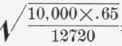 =12.51=8.5 inches, the diameter of the pipe required to drain 10,000 square feet impervious surface in Kansas City. There is no 8.5-inch pipe made, so the nearest size should be used.
Drains are sometimes laid at grades that produce greater or less velocities than 270 feet per minute; when so laid the capacities of the pipes can be easily ascertained by referring to the following table, which gives the velocity of flow and the number of cubic feet discharged per minute by specified sizes of pipes when laid at different grades. When the area of impervious surface to be drained, the maximum rate of precipitation, and the grade at which drain is to be laid, are known the quantity of storm water to be removed can be calculated and the size of pipe required to remove it can then be found by Table IV on following page.
Table IV Velocity in feet per minute (as determined by the formula v=3,000 √h/1 X d and discharge in cubic feet per minute (by the formula Q=V A) of drains laid at different grades when running full.
In which V=velocity in feet per minute A= area of pipe in feet h= head in feet l=length of the pipe in feet = diameter of the pipe in feet
Diameter | 2 Inches | 2 1/2 Inches | 3 Inches | 4 Inches | 5 Inches | 6 Inches | ||||||
Fall Ft in Ft. | Velocity Feet per Minute | Discharge Cubic Feet pe rMinute | Velocity Feet per Minute | Discharge Cubic Feet per Minute | Velocity Feet per Minute | Discharge Cubic Feet per Minute | Velocity Feet per Minute | Discharge Cubic Feet per Minute | Velocity Feet per Minute | Discharge Cubic Feet per Minute | Velocity Feet per Minute | Discharge Cubic Feet per Minute |
1 in 20 | 273 | 5.46 | 297 | 8.91 | 335 | 13.40 | 390 | 32.40 | 432 | 58.32 | 480 | 93.60 |
1 in 25 | 246 | 4.92 | 273 | 8.19 | 300 | 12.00 | 345 | 28.64 | 387 | 42.25 | 450 | 87.75 |
1 in 30 | 220 | 4.40 | 249 | 7.49 | 270 | 10.80 | 312 | 25.89 | 351 | 47.39 | 390 | 77.65 |
1 in 35 | 264 | 4.08 | 228 | 6.84 | 250 | 10.00 | 288 | 23.80 | 324 | 43.74 | 360 | 70.20 |
l in 40 | 192 | 3.84 | 216 | 6.48 | 237 | 9.48 | 272 | 22.68 | 306 | 41.31 | 330 | 64.35 |
l in 45 | 180 | 3.60 | 201 | 6.03 | 222 | 8.88 | 255 | 21.16 | 288 | 38.88 | 315 | 61.42 |
1 in 50 | 174 | 3.48 | 192 | 5.76 | 210 | 8.40 | 243 | 20.17 | 272 | 36.72 | 300 | 58.50 |
l in 60 | 153 | 3.06 | 174 | 5.22 | 190 | 7.60 | 216 | 17.93 | 245 | 33.07 | 270 | 52.65 |
1 in 70 | 144 | 2.88 | 162 | 4.86 | 177 | 7.08 | 204 | 16.93 | 229 | 30.91 | 252 | 49.14 |
1 in 80 | 135 | 2.70 | 150 | 4.50 | 165 | 6.60 | 198 | 16.43 | 210 | 28.35 | 214 | 45.63 |
1 in 90 | 129 | 2.50 | 144 | 4.32 | 156 | 6.24 | 180 | 14.94 | 201 | 27.13 | 222 | 43.29 |
1 in 100 | 120 | 2.40 | 135 | 4.05 | 150 | 6.00 | 170 | 14.11 | 192 | 25.92 | 210 | 41.16 |
Diameter | 7 Inches | 8 Inches | 9 Inches | 10 Inches | 11 Inches | 12 Inches | ||||||
Fall Ft. in Ft. | Velocity | Discharge | Velocity | Discharge | Velocity | Discharge | Velocity | Discharge | Velocity | Discharge | Velocity | Discharge |
1 in 20 | 510 | 135.15 | 540 | 189 | 573 | 252 | 620 | 335 | 690 | 455 | 750 | 585 |
1 in 25 | 480 | 127.20 | 480 | 168 | 510 | 224 | 540 | 292 | 570 | 376 | 600 | ' 468 |
1 in 30 | 438 | 116.07 | 450 | 158 | 471 | 207 | 510 | 275 | 520 | 343 | 540 | 420 |
1 in 35 | 390 | 103.35 | 408 | 143 | 441 | 194 | 456 | 246 | 480 | 316 | 510 | 397 |
1 in 40 | 363 | 96.19 | 390 | 137 | 411 | 180 | 432 | 233 | 450 | 297 | 480 | 374 |
1 in 45 | 342 | 90.63 | 360 | 126 | 390 | 172 | 405 | 218 | 430 | 283 | 450 | 351 |
1 in 50 | 327 | 86.65 | 345 | 120 | 363 | 160 | 390 | 210 | 410 | 270 | 420 | 327 |
1 in 60 | 288 | 76.32 | 309 | 108 | 330 | 145 | 345 | 186 | 360 | 238 | 390 | 304 |
1 in 70 | 270 | 71.55 | 280 | 98 | 306 | 135 | 324 | 175 | 340 | 224 | 360 | 280 |
1 in 80 | 252 | 66.78 | 270 | 94 | 294 | 123 | 309 | 167 | 325 | 214 | 330 | 257 |
1 in 90 | 240 | 63.60 | 258 | 90 | 273 | 120 | 285 | 154 | 300 | 198 | 315 | 245 |
1 in 100 | 221 | 58.56 | 245 | 86 | 258 | 114 | 270 | 146 | 288 | 190 | 300 | 234 |
Note
To determine discharge in U. S. gallons multiply cubic feet by 7.5.
Example
What size of drain will be required in Kansas City to drain a roof and other impervious surfaces, 50 X 200 feet, with the drain laid at a grade to produce a velocity of about 270 feet per minute?
Solution
Area to be drained, 10,000 square feet X maximum rate of precipitation, .65 foot per hour = 6,500 cubic feet per hour = 108 cubic feet per minute. From Table IV is found that an 8-inch pipe laid at a grade of 1 to 60 will discharge 108 cubic feet of water per minute, at a velocity of 309 feet per minute. As this rate of flow is well within the permissible range of velocity, an 8-inch pipe may be used if laid at a grade of 1 to 60.
The size of house drains in systems from which rain water is excluded, is determined by the number of inmates in the building and the per capita consumption of water. It is obvious that the amount of sewage flowing through a house drain cannot exceed the amount of water used in the building, therefore the house drain need only be large enough to carry off the greatest probable amount of water that will be used at any hour of the day.
Continue to:


My Books

