


Laving Fixtures Lavatories
Description
This section is from the book "Principles And Practice Of Plumbing", by John Joseph Cosgrove. Also available from Amazon: Principles and Practice of Plumbing.
Laving Fixtures Lavatories
Sanitary Requirements
The principal sanitary requirements of lavatories are a smooth, impervious service, large unobstructed outlet, an overflow channel accessible for cleaning and no crevices for the retention of dirt. Porcelain-lined iron and porcelain lavatories fulfill all of the requirements, and being made in one piece are the highest types of sanitary fixtures.
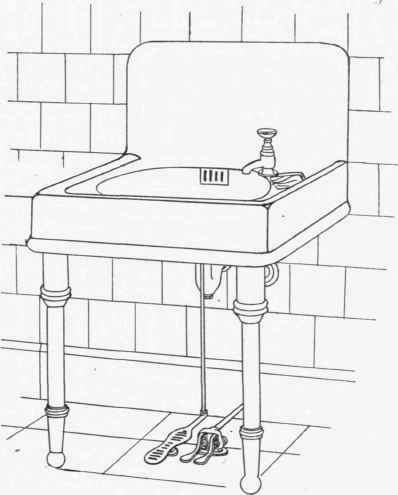
Fig. 159
A one-piece porcelain enameled iron lavatory is shown in Fig. 158. There are no joints or crevices to a fixture of this kind where filth can lodge, as is possible with a marble top lavatory.

Fig. 160.
Hospital Lavatory
A lavatory suitable for hospital operating rooms is shown in Fig. 159. A hospital lavatory differs from a common type only in the manner of operating the supply and waste valves. This is accomplished by means of levers attached to the floor and operated by foot. A hospital lavatory should be supplied with hot and cold water through a combination cock so that water of any desired temperature can be drawn.
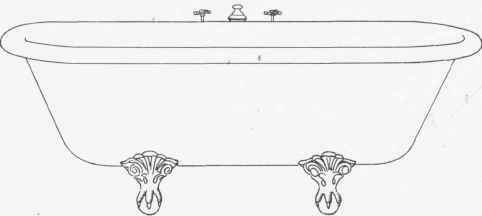
Fig. 161
Bath Tubs
The most extensively used and most serviceable bath tub is the porcelain enameled tub. They are made in two designs, known as French pattern, Fig. 160, and as Roman pattern, Fig. 161. The differences in shape are clearly shown in the illustrations. Bath tubs are not suitable for general use in barracks, hospitals and like institutions, on account of the length of time required to prepare the tub for use and the liability of spreading contagion if cleanliness is not strictly observed.
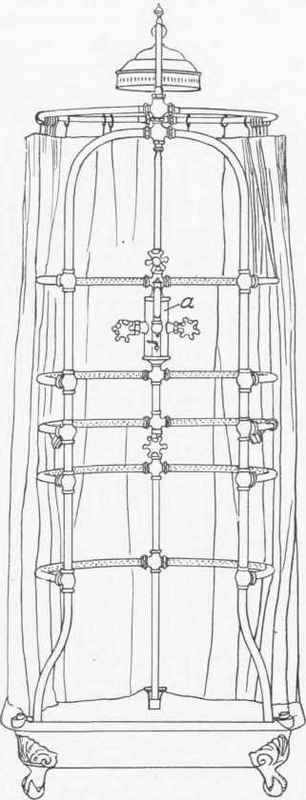
Fig. 162
Shower And Rain Baths
For use in public and semi-public bathing establishments, shower and spray baths, Fig. 162, are the most suitable. They are always ready and permit the bather to wash in running water. Many designs of rain, shower and needle-shower and spray baths are made, some simple and some elaborate. Stock fixtures can be supplied to fill most any requirement. Mixing chambers, a, should be used with shower baths so the water can be heated to the required temperature before using. When a mixing chamber is omitted, the supply valves should be so arranged that hot water cannot be turned on without also turning on the cold water. This arrangement of valves will prevent bathers from being scalded by hot water.
Seat Baths
For the administration of injections, treatment of hemorrhoids and other like purposes, seat baths, Fig. 163, are particularly useful. They are almost indispensable in a well equipped bath room.

Fig. 163
Drinking Fountains
Stationary drinking fountains are required in the lobby or main corridor of hotels, large institutions, school buildings, etc. A common type of drinking fountain is shown in Fig. 164. It is open to the objection, however, that many persons drinking from a common cup might spread contagious diseases. A better type of fountain is shown in Fig. 165. With this fountain no cup is used, and the drinker partakes of running water by bending over and drinking from the fount.

Fig. 164
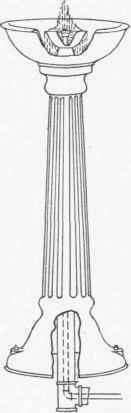
Fig. 165
Continue to:


My Books

