


Meter Accessories
Description
This section is from the book "Principles And Practice Of Plumbing", by John Joseph Cosgrove. Also available from Amazon: Principles and Practice of Plumbing.
Meter Accessories
Fish Traps
In localities where the water supply is obtained from rivers, lakes, reservoirs or other surface sources, fish traps should be used to prevent the introduction of fish, algae, weeds or objects that might interfere with the operation of the meter. Some meters have a strainer covering the inlet and forming part of the meter. Such a strainer is shown at b, in Fig. 70.
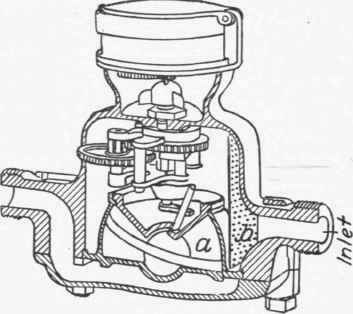
Fig. 70
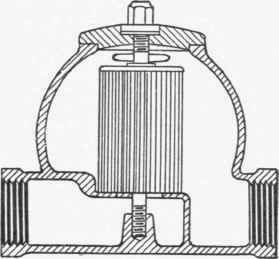
Fig. 71
When a strainer does not form part of the meter, a separate strainer or fish trap should be used. In localities where the water is extremely dirty or carries large quantities of matter in suspension, a strainer, Fig. 71, formed of hinged brass strips, will be found more satisfactory than a perforated strainer, Fig. 72, owing to the ease with which the hinged strainer can be removed and cleaned.
Water meters should be located in an accessible place safe from frost; where there is danger of hot water being forced backward through a meter a check valve should be placed in the supply pipe to protect the indurated rubber parts from being damaged by the hot water.
Special water meters, the working parts of which are made of bronze metal, are made for metering hot water. Venturi tube meters have no parts that can be affected by the action of hot water, and may also be used for that purpose.
Continue to:


My Books

