


Water Heaters
Description
This section is from the book "Principles And Practice Of Plumbing", by John Joseph Cosgrove. Also available from Amazon: Principles and Practice of Plumbing.
Water Heaters
A magazine feeding water heater, such as is used for heating large quantities of water in apartment houses, barber shops, bathing establishments, etc., is shown in section in Fig. 119. It consists simply of a combustion chamber surrounded by an annular space through which water circulates and is heated from the flames and hot gases within. Heaters of this type are made having capacities of from 50 to 600 gallons per hour, and larger sectional heaters of different types are made with capacities up to several thousand gallons per hour. The heater shown in the illustration has a magazine feed. This consists simply of a tube in the center of the heater that holds several hours' supply of coal and automatically feeds it to the fire. It can be made into a hand-fired heater by removing the magazine.
Capacity Of Water Heaters
The capacity of a water heater depends upon the amount of coal it can efficiently burn during a given period of time, and the conductivity and thickness of the walls of the fire-box. Boiler iron is a better conductor of heat than cast iron, therefore a boiler iron heater of given surface will heat more water in an hour than will a cast iron heater of equal surface, the amount of coal burned and the intensity of the fire in both cases being equal. The amount of coal economically burned in a heater depends upon the area of grate and size of the smoke flue. Heaters burn from 3 to 6 pounds and will probably average 4 pounds of coal per hour per square foot of grate surface. The total heat of combustion of a pound of coal of average composition is 14.133 B. T. U. Of this amount, however, a large percentage passes up the chimney as hot gases, so that under ordinary conditions only about 8000 B. T. U. are actually transmitted to the water. Therefore, in calculating the capacity of a heater, the area of grate surface, amount of coal efficiently burned and the available B. T. U. in a pound of coal are the limiting factors. Architects and plumbers should determine for themselves, by calculation, the heating capacity of a heater, and not rely upon manufacturers' ratings. This is made necessary by the lack of uniformity among manufacturers in the rating of their heaters, which differ from one another in some cases over 100 per cent, for equal area of grates. Some part of that percentage might be accounted for by the difference of construction, which gives some heaters greater heating surface than others, but, making due allowance for the improved design of some heaters, they will invariably be found overrated, while the run of heaters are overrated from 20 to 50 per cent. The capacity of heaters can be calculated by means of the rule or formulas following:
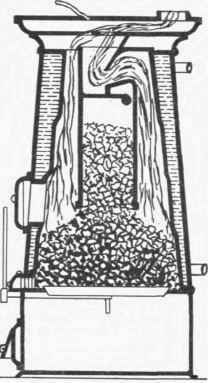
Fig. 119
When the quantity of water to be heated per hour is known, the size of grate required can be found by the following rule:
Rule
Multiply the weight of water in pounds by the number of degrees rise in temperature and divide the product by the number of pounds of coal burned per hour per square foot of grate surface, by the number of heat units transmitted to the water from 1 pound of coal. The result will be the area in square feet of grate required.
Expressed as a formula: g=Wt
C u In which W=weight in pounds of water to be heated t=degrees Fahr. water is to be raised
C=pounds of coal burned per hour per square foot of grate u=units of heat absorbed by water from each pound coal g=area of grate in feet.
Example
What size of grate will be required to heat 300 gallons of water per hour from 62 to 212 degrees Fahr., 1 gallon weighing 8.3 pounds?
Solution
300X8.3X(212-62)=7.7 sq. ft. grate surface. Ans.
6x8000
In the above solution 6 pounds of coal was assumed as the consumption per square foot of grate surface because the maximum rating of the heater is desired.
The capacity of a water heater of known dimensions can be ascertained by the following rule:
Rule
Multiply the consumption of coal per square foot of grate surface by the number of B. T. U. transmitted to the water from each pound of coal, by the number of square feet of surface in the grate, and divide the product by the weight of 1 gallon of water times the degrees of temperature the water is raised.
Expressed as a formula: q= (g c u)/ pt
In which g=size of grate in square feet c=pounds of coal burned per hour per square foot of grate surface u=units of heat absorbed by the water from each pound of coal p=8.3 weight of 1 pound of water t=degrees Fahr. water is raised q=quantity of water in gallons heated per hour Example - How many gallons of water can be heated from 62 to 212 degrees Fahr. in a heater with 7.7 square feet of grate surface?
Solution
(7.7 X 6 X 8000)/ {8.3 X (212-62)} = 296. Answer.
Garbage Burning Water Heaters are sometimes used in large institutions where they serve the double purpose of destroying refuse and heating water for domestic supply. A type of such water heater is shown in Fig. 120. Its distinguishing features are two grates, one an ordinary grate to burn coal or other fuel on, and the other a pipe coil through which water circulates and on which the garbage to be burned is placed. Where large quantities of combustible materials must be disposed of, such heaters are both efficient and economical.
Continue to:


My Books

