


Waterbacks
Description
This section is from the book "Principles And Practice Of Plumbing", by John Joseph Cosgrove. Also available from Amazon: Principles and Practice of Plumbing.
Waterbacks
The hollow casting forming part of the fire-box lining of kitchen ranges, and through which water circulates and is heated for storage in the range boiler, is commonly known as a water-back. In most waterbacks a horizontal partition, a, Fig. 118, gives the water a posi-
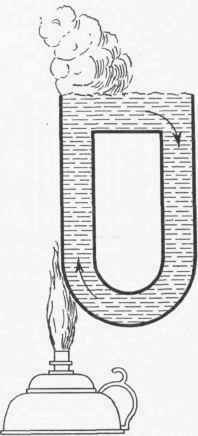
Fig. 117 tive circulation through the casting and prevents a commingling of waters of different temperatures, as is the case where waterbacks without this partition are used. It is quite important that the opening for the flow pipe, b, e drilled close to the top wall of the casting, so that the hottest water can flow from the waterback and not cause a rattling sound by being retained in the waterback to form steam.
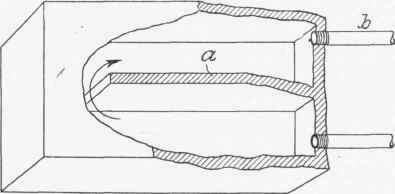
Fig. 118
Water Heating Coils
In ranges that are not provided with waterbacks, heating coils are sometimes made to supply the deficiency. Usually they consist of two pieces of one-inch black iron pipe joined at one end by a return bend. The free ends are then extended through the wall of the fire-box, so they can be connected to the boiler. The chief objection to the use of water heating coils is the fact that their effect on the draft of the stove or on the heating capacity of the oven can never be pre-determined, consequently ovens are often spoiled for baking purposes by placing a water coil in a range not designed to accommodate one.
Capacity Of Waterbacks And Coils
The capacity of waterbacks and coils depends upon the materials of which they are made, the thickness of metal forming their walls, the location of the waterback or coil in the fireplace, their freedom from soot, ashes or incrustation of lime or magnesia, and the intensity of the fire to which they are exposed. Under favorable conditions a coil made of copper pipe will transmit 300 B. T. U. per hour, a wrought iron or steel pipe, 200 B. T. U. per hour, and a cast iron water-back, 80 B. T. U. per hour per square foot, for each degree Fahr. difference in temperature between the flames or hot gases in contact with the waterback or coil and the water inside. As a matter of fact, however, waterbacks and coils transmit only about 25 per cent, of their possible capacity. This is due to the fact that they are placed in the fire-box in the position least likely to affect the stove for other purposes, and therefore are not exposed to the hottest coals and gases of the fire. Furthermore, they are partly covered by ashes, soot and dying coals, and in the case of cast iron waterbacks, the walls usually are of too great thickness to transmit the maximum amount of heat. In many cases waterbacks and coils are coated with incrustations of lime or magnesia that still further reduce their transmitting capacities. Cast iron waterbacks, under ordinary conditions, will heat from ordinary temperature to 212 degrees Fahr. from 25 to 35 gallons of water per hour for each square foot of exposed surface. With an ordinary fire, one square foot of exposed waterback surface will heat about 25 gallons of water per hour, while with a fire such as is used for baking or roasting, one square foot of surface will heat about 35 gallons of water per hour.
However, the average size of waterback contains only 110 square inches or about 2/3 square foot of exposed surface, and water for domestic uses is seldom heated to above the temperature of 180 degrees Fahr., therefore an ordinary waterback with an average fire will heat from ordinary temperature to boiling point about 17 gallons of water per hour, or from ordinary temperature to 180 degrees Fahr. about 21 gallons of water per hour, while with a fire such as is used for cooking or baking it will heat 23 gallons of water to the boiling point, or 27 gallons of water to a temperature of 180 degrees Fahr. Wrought iron pipes will heat from 30 to 40 gallons of water under the same conditions, and copper pipes will heat from 45 to 60 gallons per hour for each square foot of surface exposed to the fire. In calculating the heating capacity of a waterback or coil, the average temperature of the water is taken; thus, if water at 60 degrees Fahr. is heated to 200 degrees Fahr., the average temperature of the water would be 60 + 200/ 2 = 130 degrees Fahr., and the range of temperature through which it is heated would be 200-60 = 140 degrees Fahr.
Continue to:


My Books

