


Chapter XXXI. Water-Closets (Continued)
Description
This section is from the book "Principles And Practice Of Plumbing", by S. Stevens Hellyer. Also available from Amazon: Principles and practice of plumbing.
Chapter XXXI. Water-Closets (Continued)
TO make a reliable connection of an earthenware closet or an earthenware closet-trap to a lead soil-pipe is generally a work of great difficulty; and if the thousands of such connections which have been made in the last ten years were tested to-day, a large number would be found defective.
The difficulty is increased when the closet and trap are made in one piece, and the outlet of the trap is formed upon the underside of the closet base, as shown by the arrows in fig. 126. In fact such a connection cannot be relied upon even for a year. In the many examinations I have made, out of hundreds of such connections, I have only found a few that could be considered both air-tight and water-tight; and even of those it would have been impossible to have said how long they would have remained sound. If earthenware closets or earthenware traps are to be connected to soil-pipes, whether of lead or iron, the connection should be so made that it may be readily seen and examined, without any disturbance of the surroundings, to see that it is sound and good.
2. On referring to the first edition of my work " Dulce Domum," published fourteen years ago, I find that I called special attention to the connection of earthenware closets to soil-pipes, and what is there said is so important, that I think it well to make some extracts.
"All traps fixed inside a house should be separate and independent of the ' fitting,' be that what it may, which is to be fixed upon them, and be made ' fixtures ' in a very complete way with the soil or waste-pipe to which they are to be attached.
" And then when the ' fitting' gets out of order, whether water-closet, urinal, slop-sink, or whatever the fitting may be, it can be removed for repairs without interfering with the trap or exposing the house to the waste-pipe, soil-pipe, or drain.
" But when the trap forms a part of the ' fitting,' and is in one piece with it, it cannot be removed for repairs (or for renewal in case of breakage) without exposing the soil-pipe, and perhaps drain as well, to the house, leaving it, in fact, in free and open communication with the soil or waste-pipe on which the ' fitting' was fixed.
" But there is another and stronger reason why the trap should be independent of the fitting. The connection of the appliance with the trap - whether closet, slop-sink, bath, urinal, sink, or lavatory basin - is not so important as the connection of the trap with the soil-pipe or waste-pipe; for the latter being on the drain side (sewer side) of the water-seal of the trap would allow any bad air or noxious gases in the soil-pipe or waste-pipe to escape through a defective joint into the house, as shown by the arrows at a, fig. 137, whereas the former - the connection of the closet with the trap - being on the house side of the trap (d, fig. 137), would still, in case of a defect, leave the house protected by the water-seal of its trap. The jointing of a trap with a soil-pipe or waste-pipe is therefore of the utmost importance."
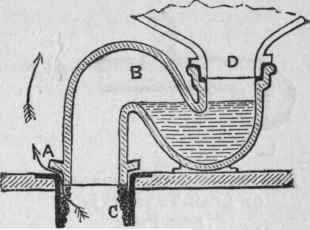
Fig. 137. - Showing Defective Joint of Earthenware Trap to Soil-Pipe.
3. I am still of the opinion which I gave fourteen years ago, that a connection of earthenware to lead or iron is inferior to that of lead to lead, for - apart from the risk of exposing the house to the soil-pipe, during the time a broken trap, or a fractured part of an earthenware closet, was being changed for a new one, a not infrequent occurrence - I know of no means of connecting earthenware to lead, or earthenware to iron, so absolutely reliable as the union of a lead trap to a lead soil-pipe by a wiped soldered joint, as shown at s, fig. 138.
4. Where the closets are to be connected to a stoneware or a cast-iron drain, where they would have a very solid base, and the surroundings would be very rigid, there is no stronger way of making the connection than by a Portland cement joint; but the joint should be kept above the floor, as shown in fig. 128, where it can be readily seen, and the cement should be of the best kind. I have tested such joints many years after they have been made, and found them quite sound and good. In some trial tests with such connections, I have found a Portland cement joint to stand 30 lbs. to the square inch.
5. But where earthenware closets or earthenware traps are fixed " upstairs," for connection to a lead or cast-iron soil-pipe, the conditions are different; for in the latter case there is not only the vibration of the floors, which in some buildings is very great, and the sinking of the walls, which in newly-built houses of good height is often sufficient to cause a fracture in the earthenware closet (where it is connected to an iron pipe by a Portland cement joint), or to break the connection, but there is also the unequal expansion and contraction of the different materials. And though a brass socket soldered to a lead soil-pipe would enable a more rigid joint being made to an earthenware closet, viz., by a Portland cement joint, it would increase the numbers of the different materials to be incorporated in the connection - earthenware, Portland cement, brass, solder, and lead.
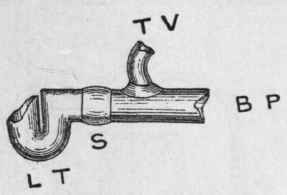
Fig. 138. - Showing Connection of Lead Trap to Lead Soil-Pipe.
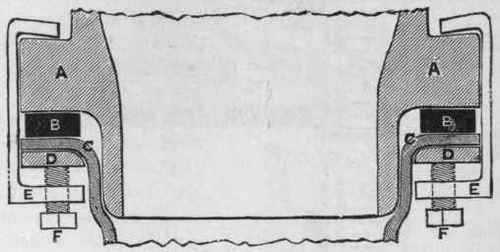
Fig. 139.
6. For connecting earthenware traps or earthenware closets to lead horizontal branches, for years past I have had strong flanges formed upon the outlets of my closets, as shown at A, fig. 139, for bolting to the soil-pipe, where the joint can at all times readily be got at, as shown at f, fig. 140; using a flange (b, fig. 139) made of the best india-rubber between the two faces. There is also another advantage gained by such an arrangement, viz., that the anti-syphoning pipe can be soldered to the lead soil-pipe, as shown in fig. 140.
I have had such joints tested up to 25 ft. head of water, and found them to stand that pressure without leaking. To prevent the india-rubber from deteriorating and losing its elasticity, I have had some rings of the best india-rubber covered with asbestos, and I have found that a connection made with such a packing, as shown in fig. 139, to stand a pressure of 7 lbs. to the square inch without leaking. The surface of the asbestos covering being rougher than that of the plain india-rubber, the connection requires to be screwed up tighter, and as I can see an element of danger in this, the asbestos india-rubber packing is abandoned for the present.
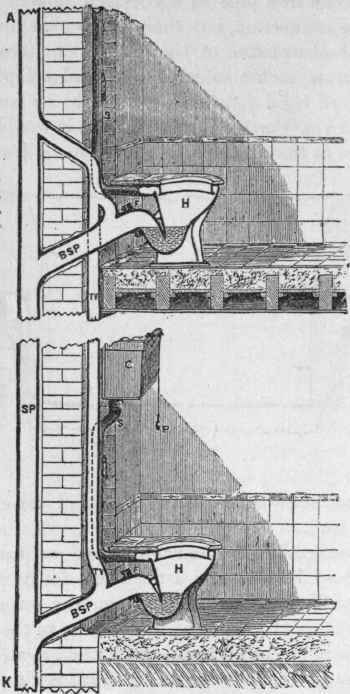
Fig. 140. - Showing Connections of Earthenware Closets with a Lead Soil-Pipe.
Although I have never come across a defective connection made as shown in figs. 139 and 140, I have heard of two cases where some plumbers in the country showed poor skill in tafting back the end of the lead soil-pipe to fit to and correspond with the face of the earthenware flange, and then endeavoured to correct their errors by screwing up the clips (e, fig. 139) and breaking the flanges.
7. As a spigot-and-socket connection admits of a little adjustment, and when the socket stands upright, a good filling in can be made with an elastic cement which is fluidal when heated, I have had many kinds of such " cement" tested, and have found that some compositions, which had been considered good for such joints, would not stand 3 ft. head of water.
Some joints, similar to that shown in fig. 141, made with a strong adhesive cement, and which I have named the " Elastic Closet Cement," stood a pressure equal to 30 ft. head of water without leaking. To prevent the cement, when in a hot fluidal state, running through the connection into the interior of the pipe, a ring or two of spun yarn is caulked into the socket, and the composition is melted into the socket by the aid of a lamp (fig. 3 or 4), great care being taken to well warm both the socket and spigot before melting in the cement.
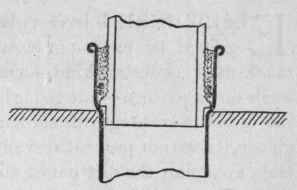
Fig. 141. - Showing Joint made with Elastic Closet Cement.
Continue to:


My Books

