


The Dado
Description
This section is from the book "Our Homes And Their Adornments", by Almon C. Varney. Also available from Amazon: Our Homes and Their Adornments.
The Dado
The use of the dado in the sitting-room, dining-room, and library, answers to some extent the purpose of wainscoting. It forms a lower bordering to the paper, and may extend to any height desirable, from two feet to five feet, though its height is usually from thirty to forty inches. It often forms a more suitable background for the display of the furniture and other furnishings of the room, and affords place for a richer and more elaborate display than the wall-papers proper.

Fig. 38.
We present three designs of Friezes, of the very latest pattern. Fig. 38 was designed by Mr. John Leighton, F. S. A.. London.
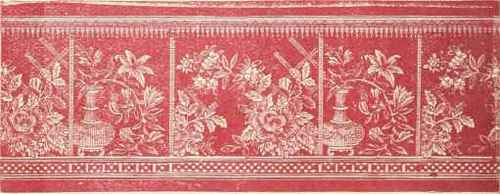
Fig 39.
The second design is by Mr. Fred Beck, of New York, the manufacturer of wail-papers.
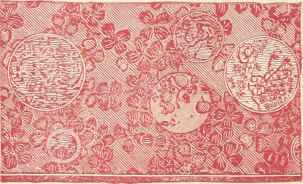
Fig. 40.
And the last, by Mr. Lewis C. Tiffany, of New York, the distinguished decorative artist and painter. The designs of Messrs. Leighton and Tiffany have been kindly furnished the publishers of this work by Messrs. Warren, Fuller & Co., New York, the largest manufacturers of wall-papers in the United States.
The designs upon dados are often very rich and high-colored, while the wall-paper above has a quiet tone, and is of medium light or dark color according to the size or light of the room. The dado is almost always of a darker shade than the wall-paper, and patterns of high-colored and large flowers or birds are not uncommon.
The Frieze is the top border next to the ceiling. - It is now usually from six to eighteen inches in width, the width used depending principally upon the height of the room. The custom formerly was to have the frieze darker than the paper on the main wall, but of late years the frieze is somewhat lighter than the paper, with a dark line or beading at the point where they unite. A gilt molding at the corner above the frieze produces a good effect.
A roll of paper will cover from thirty-six to forty-four square feet, and by ascertaining the number of square feet on the walls to be covered, and dividing it by thirty-six, the number of rolls of paper needed will be ascertained. In measuring the walls, of course the windows and doors are not to be taken into consideration.
Paper is sold by the roll, and ranges in price according to texture, style, finish, and color, from ten cents upward, some of the most elaborate styles selling as high as twenty-five dollars per roll.
Continue to:


My Books

