


Chapter VIII. Glass
Description
This section is from the "Historic Ornament - Treatise On Decorative Art And Architectural Ornament" book, by James Ward. Also see Amazon: Historic Ornament - Treatise On Decorative Art And Architectural Ornament.
Chapter VIII. Glass
The manufacture of glass is of great antiquity. The invention has been ascribed to the Phoenicians, but specimens of glass beads, amulets, plaques, vases, and small phials or bottles have been found in some of the oldest Egyptian tombs. In the British Museum there is a small piece of blue opaque glass in the form of a lion's head, which bears the prenomen of the Egyptian monarch Nuntef IV., belonging to the Fourth Dynasty (B.C. 2423-2380). There are also paintings on the walls of early tombs representing bottles with red wine, as well as figures engaged in glass-blowing.
A number of glass bowls, vases, and bottles from Nimroud may be seen in the British Museum, the earliest specimen of which is an Assyrian transparent glass vase with two handles, and is inscribed with the name of the monarch Sargon (B.C. 722-705). This is supposed to be the oldest known specimen of transparent glass (Fig. 294). Many long-shaped little bottles - alabastron - of pale greenish, and others of brilliant colours, with slightly varied shapes, have been dug up from the ruins of Assyrian palaces, and have been found in most of the ancient tombs in Greece, Italy, and in the islands of Cyprus, Sardinia, and Rhodes. These little bottles have been made by the Egyptians, Assyrians, Phoenicians, and Greeks, and their shape, being consecrated by use, remained unchanged for many centuries; they were portable objects of barter, as glass beads also were with the Phoenicians, who distributed them in trade to all parts of the countries bordering on the Mediterranean (Figs. 295, 296).
Common Forms Of The Phoenician Glass Bottles
Common Forms Of The Phoenician Glass Bottles were small vessels in the shapes of heads, and of dates, grapes, and other fruits, which were blown in moulds. These vessels probably came from the great workshops of Tyre and Sidon; some of them bear the names of their makers - Eugenes, Ennion, and "Artas the Sidonian." The shapes of many of these vessels are decidedly Greek, and if not Greek in manufacture, have been copied from the shapes of Greek pottery.
The colours used were yellow, turquoise, and white on blue, green, or brown, and a common arrangement of these was in zigzag or wavy alternating lines; in other examples the surface was reeded, as may be seen in the alabastron, Fig. 295, Ancient Roman glass is of great variety in colour, and many specimens show the highest technical skill combined with great artistic beauty. The lovely iridescent effect on Roman and other antique glass is due to the chemical changes of the surface decomposition, and in other instances to the minute flaking of the glass, which reflects the light at various angles, and thus producing the prismatic hues.
At the time of the Roman occupation of Egypt, during the period of rule under the Ptolemies, glass making was a great industry in the latter country. It is said that the Romans learnt the art from the Egyptians, and it is known that many of the latter were brought to Rome to practise their art as glass-blowers.
The Making Of The Glass
The Making Of The Glass known as mille-fiori was taught to the Romans by the. Egyptians, and was extensively employed in vase and bottle making by the former; the Venetians from the fourteenth century have imitated the Romans in their uses of mille-fiori glass for bead making and other purposes, with great success.
The method of making this variety of glass consists in arranging a number of thin rods or threads of glass of the required variety of colours, gold being sometimes used; these united rods were then fused together by heat, and drawn out or twisted, so that when transverse sections were cut the pattern would always be the same.
Fig. 294. Glass Vase or Bottle; height, 3« ins. (B. M).
Fig. 295. Phoenician Alabastron.
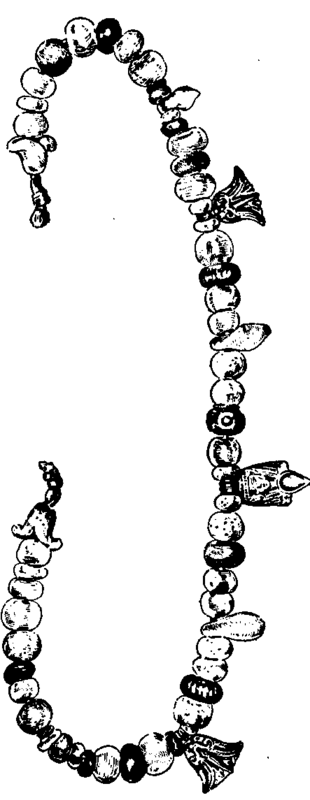
Fig. 296. Necklace of Glass and Gold, Phoenician. (B. M).
Another way of mixing the colour in glass, which was employed by the Egyptians, Romans, and later by the Venetians, was in the making of regular patterns of mosaic-like designs of the various colours, and another was in imitating the precious stones and marbles, such as onyx, agate, serpentine, porphyry, and murrhine; the latter is supposed to be a variety of agate, with red and purple shades. The murrhine glass examples of Roman manufacture are very rare.
The Romans used these glass imitations of the precious stones and marbles to line their walls and floors, as in mosaic work.
Egyptian And Roman Glass
Egyptian And Roman Glass in their transparent varieties have such colours as yellow, purple, blue, green, and pink; opaque colours are generally found in shades of yellow, blue, green, and black. The most valuable kind of glass was that of the clearest white or crystal; this, it would appear, was the most difficult to make, as the commoner clear variety had usually a slight greenish or bluish hue.
The Romans made a special variety of glass ware which consisted of interlaced bands of opaque white or coloured glass, ingeniously made to form a pattern by twisting them with clear or coloured transparent glass, like that of the elegant lace-glass variety known as the "vitro di trina" of the Venetians (Fig. 302).
In the arts of glass cameo and intagiio engraving, and in the imitation of gems, the Romans were exceedingly skilful.
The Cameo Engraved Glass
The Cameo Engraved Glass was produced by placing a layer of white opaque glass on a ground of transparent blue, the design being formed by cutting away the white surface to the blue ground, leaving the blue as the background; the remaining white which formed the design was then carefully finished by engraving. Light and shade was produced according to the thicknesses of the cameo left by the engraver.
Continue to:


My Books

