


Glass. Part 5
Description
This section is from the "Historic Ornament - Treatise On Decorative Art And Architectural Ornament" book, by James Ward. Also see Amazon: Historic Ornament - Treatise On Decorative Art And Architectural Ornament.
Glass. Part 5
Many relics of glass vessels and beads have been found in Roman tombs, and in various parts of England, of a greenish or blue colour. These may have been imported or may have been made in England, but there is no certain evidence of this. Glass vessels for drinking purposes have been found which are believed to have belonged to the Anglo-Saxon period (Fig. 306).
The material of these is thin, the colour is generally of a pale straw tint, and strips of thickened glass ornament the outside, arranged in the nature of parallel lines, or wound spirally to produce a kind of network decoration.
Venetian glass found its way to England in the sixteenth century; in the inventories of Henry VIII. (1529) and of Robert, Earl of Leicester (1588), large quantities of Venetian glasses are mentioned as belonging to the above.
Some Muranese glass workers were engaged at this time (1550) in the service of the King of England. The name of an Italian - Jacob Vessaline - is mentioned as a glass maker who worked at Crutched Friars in the beginning of Elizabeth's reign (1557), and in the year 1589 there were supposed to be fifteen glass houses in England.
Sir Robert Mansel was a prominent glass maker of the seventeenth century; he obtained patents in the year 1616 for the making of window glass and all kinds of vessels, and from the remains of glass objects that were found on the site of Princes Hall, in Broad Street, London, it is believed that his works were on that spot.
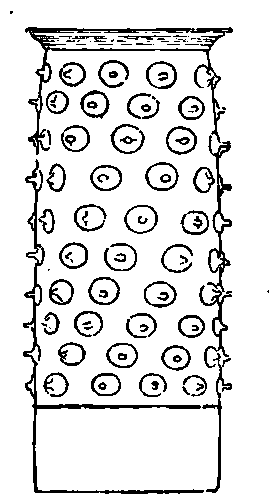
Fig. 304. German Glasses. (S. K. M).
Fig. 305. Decorated German Vases; Seventeenth Century. (S. K. M).
Fig. 306. Anglo-Saxon Drinking Cup. (S. K. M).
Mansel employed Italian workmen in the first instance, and it appears that prior to 1623 he had set up works in Milford Haven, at Newcastle-on-Tyne, in Scotland, and other places. The Newcastle furnaces were the most successful, the others being practically failures. Mr. Nesbitt thinks that the success of the Newcastle-on-Tyne works was due to the new system of flint-glass making, which must be credited as an English invention.
Flint Or Crystal Glass
Flint Or Crystal Glass is made of a mixture of silicate of potash and lead. It was known but imperfectly made by the Romans in their clear glass variety, which contained a small portion of lead. In the Middle Ages the glass which contained lead was called "Jewish glass," and was generally used for painting on, as it was more fusible' than other varieties which did not contain lead. But all authorities agree that the English invented a new product in their flint glass, which was made after many experiments at Lambeth in 1673, as "clear, ponderous, and thick as crystal".
Mr. Nesbitt infers that it was the use of coal in the furnaces instead of wood that led to the development of the process. When using coal the melting-pots had to be covered in the furnace, which lessened the heating powers and thus made the fusing more difficult. To put more alkali in the mixture would have helped it to fuse at a much lower heat, but it would have injured the colour and quality of the glass, so lead was added in certain proportions, which gave the requisite clearness and strength.
All kinds of glass vessels and plate glass for carriage windows were made at Lambeth, under the management or patronage of the Duke of Buckingham.
Though there are no records of glass making in Ireland of a very early date, the glass beads and glass bosses which decorate the objects of Irish art, such as the crosses, croziers, brooches, book-covers, and the celebrated Ardagh Chalice, prove that the art was known in Ireland at least in the ninth century, if not earlier. Mention has also been made in old writings of this period of glass vessels for use in Irish churches.
Painted Or Stained Window Glass
Painted Or Stained Window Glass is the glory of our Mediaeval churches. The earliest coloured windows were doubtless made from mosaic-like arrangements of different bits of coloured glass. The mosaic window led to the representation of pictorial subjects in stained glass, the latter being formed of pieces of self-coloured glass, or that kind having each piece stained in one colour throughout, cut in the requisite shapes, and fastened together by an arrangement of lead lines which form the main lines of the design; to help out the drawing and expression the stained glass is shaded in hatchings, stippling, and bold lines, usually in a brown colour. Painted glass, as distinguished from stained glass, is that which is painted on clear or tinted grounds with various enamel colours made from metallic oxides. After the painting is finished the piece of glass is fired, and the enamel colours become fused with the glass surface, and really become part of the glass itself. More finish, a wider range of colouring, greater detail, and generally a more pictorial effect is produced by the artist being able to use freely the enamel colours; but a corresponding loss of depth and brilliancy of colour and of bold decorative effect which belonged to older examples of stained glass must be set against any advantages the painted variety may possess from its pictorial point of view.
The earliest instance in the use of stained glass for church windows is supposed to have been in those that were given by Count Arnold to the Abbey of Tegernsee in Bavaria in the year 999. The thirteenth and fourteenth century were the finest periods for the stained-glass windows of the Gothic cathedrals both in England and on the Continent. About the middle of the sixteenth century enamel colours began to be used, and, as before observed, the designs showed a striving after pictorial effects.
The Revival Of Classic Art In The Renaissance Period
The Revival Of Classic Art In The Renaissance Period has also a great deal to do with this change in the style and method of execution in painted glass, and we find that the greatest painters - but not always the greatest decorators - of the period supplied cartoons and designs for this class of work.
Glass making has been known in China and Japan from very early times, but it appears to be difficult to obtain anything like authentic information as to its history from our present imperfect knowledge or acquaintance with the native records.
There are stories of ancient Chinese glass vessels that are said to have been seen by the French missionaries of the last century, one of which vessels was so large that "a mule could have been put into it," and that the Chinese made a kind of glass called "lieou-li" that was sufficiently elastic as to bend easily.
The Vitreous Enamels Of The Chinese
The Vitreous Enamels Of The Chinese were of course used as glazes on their porcelain wares and pottery, but it seems that formerly they only made glass objects in the imitation of precious stones, gems, and in their enamels. Chinese glass is often made to simulate rock crystal and jade carvings; their glass snuff-boxes and other small objects are usually well coloured, and are decorated with relief work of ornament, landscapes or figure subjects, the objects generally being of a massive character (Fig. 309).
Fig. 307. Stained Glass; Fifteenth Century.
Fig. 308. Window Glass; English, Fifteenth Century.
Fig. 309. Chinese Glass Bowl. (S. K. M).
Continue to:


My Books

