


Indian Jewellery
Description
This section is from the "Historic Ornament - Treatise On Decorative Art And Architectural Ornament" book, by James Ward. Also see Amazon: Historic Ornament - Treatise On Decorative Art And Architectural Ornament.
Indian Jewellery
The jewellery of India is one of the most important art industries of that country, and the trade of the gold and silver smith is an established institution in every village and district. The variation in style and method of fabrication has very marked features, according to the fashion that finds favour in each locality. The extreme love for trinkets of a brilliant and dazzling nature amongst all grades of the people has in a great measure directed the fabrication of Indian jewellery, which tends to make the most of the precious metals by using them in thin plates or in a fili-grain work, and in order to get the flashing effect and rich colouring, scales or flakes of diamonds are more often used than the more valuable and solid gems, and inferior gems, or even coloured glass, are set to the best advantage, and used indiscriminately: anything, in fact, is used in order to get the gorgeous variety of brilliant colouring and dazzling effect. Much of the Indian jewellery is of a flimsy character as regards its lightness and thin nature of the material; but the latter is generally of the best quality, and the artistic workmanship lavished on most of the jewellery more than makes up for its want of inherent solidity.
Jewellery ought to be light in character and of good design and workmanship if it is intended to fuifil its use in decorating the person, as nothing is uglier than heavy jewellery, which can only be valuable in the light of representing the wealth of the owner.
Some of the Indian jewellery is, however, fairly solid and heavy, as in the chopped gold form of cubical, octahedron, and oblong shapes of the metal which are strung on silk cord as necklaces, and the nail-head variety of earrings made at Ahmedabad and Surat in Western India.
Girdles, Torques Or Neck Collars, Bracelets, And Anklets
Girdles, Torques Or Neck Collars, Bracelets, And Anklets are made of twisted gold wire, which are common throughout India, and in the western provinces are made in the twisted form of the Matheran knotted and woven grass collars.
Some of the native jewellery in many parts of India still keeps its primitive character and bears a great likeness to the very early Celtic jewellery found in Ireland and in other countries of Europe, which would probably suggest the same Celtic origin for all (Fig. 193).
The Silver Filigrain Work Of India
The Silver Filigrain Work Of India, especially the designs of the Sindh jewellery and that made at Cuttack, Trichi-nopoly, and Travancore, recalls the methods of fabrication and design of the ancient Etruscan jewellery. (See Figs. 194, 195, 197).
A certain analogy may also be noticed in the native jewellery from the above places to the Phoenician, primitive Grecian, and even Scandinavian, which goes a long way to prove the intercourse between, and the migrations of, the people of India, Thibet, Turkestan to Asia Minor and the continent of Europe.
Some Indian jewellery, though possessing shapes common to other countries, has very distinctive national characteristics in the decoration, which may be seen in the illustration (Fig. 198) of the gold plate from Bombay. In these cases the design is usually symbolical.
The Indian Jewellers Of The Mogul Period
The Indian Jewellers Of The Mogul Period have produced some exquisite work in the setting of gems on jade carvings and on small vases of jade.
The deftness and cunning of the Indian jeweller may have been equalled by the Etruscans and ancient Greeks, but he has not been surpassed in his delicate workmanship by any nation of modern times.
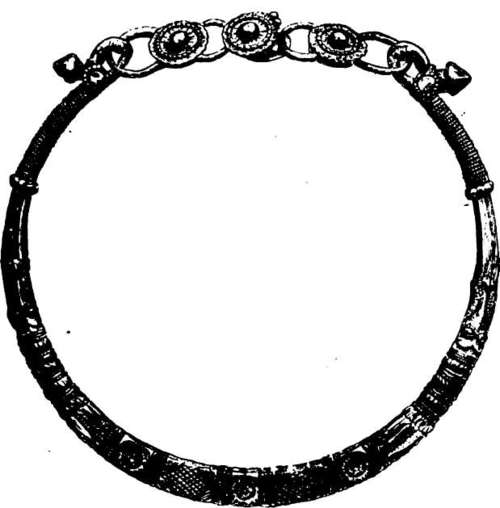
Fig. 193. Primitive Silver Bracelet; Dinajpur, Bengal. (B).
Fig. 194. Silver Neck Ornament, from Sindh. (B).
Fig. 195. Native Silver Jewellery of Cuttack. (B).
Fig. 196. Filigrain Jewellery of Cuttack. (B).
Fig. 197. Native Jewellery of Trichinopoly, Madras. (B).
>Fig. 198. Native Gold Jewellery of Bombay. (B).
Continue to:


My Books

