


The Drawing-Room, Boudoir, And Morning-Room. Part 3
Description
This section is from the book "The Decoration Of Houses", by Edith Wharton, Ogden Codman Jr. Also available from Amazon: The Decoration of Houses.
The Drawing-Room, Boudoir, And Morning-Room. Part 3
The same may be said of the old French tables - from desks, card and work-tables, to the small gueridon just large enough to hold a book and candlestick. All these tables were simple and practical in design: even in the Louis XV period, when more variety of outline and ornament was permitted, the strong structural lines were carefully maintained, and it is unusual to see an old table that does not stand firmly on its legs and appear capable of supporting as much weight as its size will permit (see Louis XV writing-table in Plate XLVI).
The French tables, cabinets and commodes used in the family apartments were usually of inlaid wood, with little ornamentation save the design of the marquetry - elaborate mounts of chiselled bronze being reserved for the furniture of gala rooms (see Plate X). Old French marquetry was exquisitely delicate in color and design, while Italian inlaying of the same period, though coarser, was admirable in composition. Old Italian furniture of the seventeenth and eighteenth centuries was always either inlaid or carved and painted in gay colors: chiselled mounts are virtually unknown in Italy.
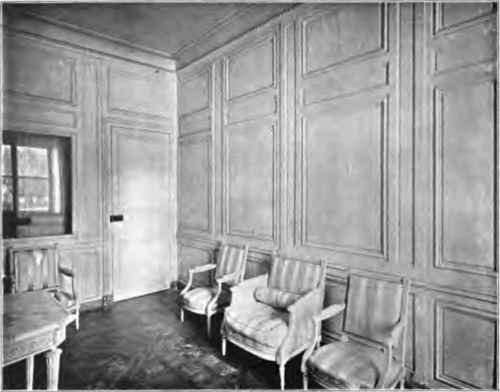
PLATE XXXVII. ROOM IN THE PALACE OF FONTAINEBLEAU.
LOUIS XV PANELLING, LOUIS XVI FURNITURE.
The furniture of the eighteenth century in England, while not comparable in design to the best French models, was well made and dignified; and its angularity of outline is not out of place against the somewhat cold and formal background of an Adam room.
English marquetry suffered from the poverty of ornament marking the wall-decoration of the period. There was a certain timidity about the decorative compositions of the school of Adam and Sheraton, and in their scanty repertoire the laurel-wreath, the velarium and the cornucopia reappear with tiresome frequency.
The use to which the family drawing-room is put should indicate the character of its decoration. Since it is a room in which many hours of the day are spent, and in which people are at leisure, it should contain what is best worth looking at in the way of pictures, prints, and other objects of art; while there should be nothing about its decoration so striking or eccentric as to become tiresome when continually seen. A fanciful style may be pleasing in apartments used only for stated purposes, such as the saloon or gallery; but in a living-room, decoration should be subordinate to the individual, forming merely a harmonious but unobtrusive background (see Plates XXXVI and XXXVII). Such a setting also brings out the full decorative value of all the drawing-room accessories - screens, andirons, appliques, and door and window-fastenings. A study of any old French interior will show how much these details contributed to the general effect of the room.

PLATE XXXVI. SALON, PALACE OF FONTAINEBLEAU.
Those who really care for books are seldom content to restrict them to the library, for nothing adds more to the charm of a drawing-room than a well-designed bookcase: an expanse of beautiful bindings is as decorative as a fine tapestry.
The boudoir is, properly speaking, a part of the bedroom suite, and as such is described in the chapter on the Bedroom. Sometimes, however, a small sitting-room adjoins the family drawing-room, and this, if given up to the mistress of the house, is virtually the boudoir.
The modern boudoir is a very different apartment from its eighteenth-century prototype. Though it may preserve the delicate decorations and furniture suggested by its name, such a room is now generally used for the prosaic purpose of interviewing servants, going over accounts and similar occupations. The appointments should therefore comprise a writing-desk, with pigeon-holes, drawers, and cupboards, and a comfortable lounge, or lit de repos, for resting and reading.
The lit de repos, which, except in France, has been replaced by the clumsy upholstered lounge, was one of the most useful pieces of eighteenth-century furniture (see Plate XXXVIII). As its name implies, it is shaped somewhat like a bed, or rather like a cradle that stands on four legs instead of swinging. It is made of carved wood, sometimes upholstered, but often seated with cane (see Plate XXXIX). In the latter case it is fitted with a mattress and with a pillow-like cushion covered with some material in keeping with the hangings of the room. Sometimes the ducbesse, or upholstered bergire with removable foot-rest in the shape of a square bench, is preferred to the lit de repos; but the latter is the more elegant and graceful, and it is strange that it should have been discarded in favor of the modern lounge, which is not only ugly, but far less comfortable.

PLATE XXXVIII. LIT DE REPOS, EARLY LOUIS XV PERIOD.
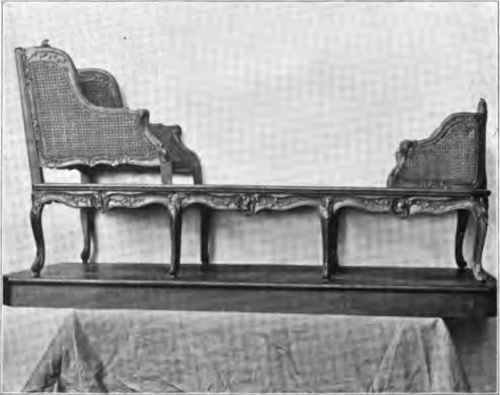
PLATE XXXIX. LIT DE REPOS, LOUIS XV PERIOD.
As the boudoir is generally a small room, it is peculiarly suited to the more delicate styles of painting or stucco ornamentation described in the third chapter. A study of boudoir-decoration in the last century, especially in France, will show the admirable sense of proportion regulating the treatment of these little rooms (see Plate XL). Their adornment was naturally studied with special care by the painters and decorators of an age in which women played so important a part.
It is sometimes thought that the eighteenth-century boudoir was always decorated and furnished in a very elaborate manner. This idea originates in the fact, already pointed out, that the rooms usually seen by tourists are those in royal palaces, or in such princely houses as are thrown open to the public on account of their exceptional magnificence. The same type of boudoir is continually reproduced in books on architecture and decoration; and what is really a small private sitting-room for the lady of the house, corresponding with her husband's "den," has thus come to be regarded as one of the luxuries of a great establishment.
The prints of Eisen, Marillier, Moreau le Jeune, and other book-illustrators of the eighteenth century, show that the boudoir in the average private house was, in fact, a simple room, gay and graceful in decoration, but as a rule neither rich nor elaborate (see Plate XLI). As it usually adjoined the bedroom, it was decorated in the same manner, and even when its appointments were expensive all appearance of costliness was avoided.1
1The omate boudoir seen in many XVIIIth-century prints is that of the femmegalants.
The boudoir is the room in which small objects of art - prints, mezzotints and gouaches - show to the best advantage. No detail is wasted, and all manner of delicate effects in wood-carving, marquetry, and other ornamentation, such as would be lost upon the walls and furniture of a larger room, here acquire their full value. One or two well-chosen prints hung on a background of plain color will give more pleasure than a medley of photographs, colored photogravures, and other decorations of the cotillon-favor type. Not only do mediocre ornaments become tiresome when seen day after day, but the mere crowding of furniture and gimcracks into a small room intended for work and repose will soon be found fatiguing.
Many English houses, especially in the country, contain a useful room called the "morning-room," which is well defined by Robert Kerr, in The English Gentleman's House, as "the drawing-room in ordinary." It is, in fact, a kind of undress drawing- . room, where the family may gather informally at all hours of the day. The out-of-door life led in England makes it specially necessary to provide a sitting-room which people are not afraid to enter in muddy boots and wet clothes. Even if the drawing-room be not, as Mr. Kerr quaintly puts it, "preserved" - that is, used exclusively for company - it is still likely to contain the best furniture in th$ house; and though that "best" is not too fine for every-day use, yet in a large family an informal, wet-weather room of this kind is almost indispensable.
No matter how elaborately the rest of the house is furnished, the appointments of the morning-room should be plain, comfortable, and capable of resisting hard usage. It is a good plan to cover the floor with a straw matting, and common sense at once suggests the furniture best suited to such a room: two or three good-sized tables with lamps, a comfortable sofa, and chairs covered with chintz, leather, or one of the bright-colored horsehairs now manufactured in France.
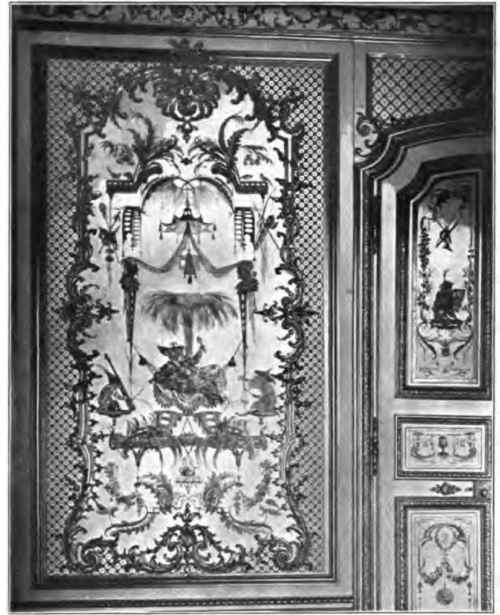
PLATE XL. PAINTED WALL-PANEL AND DOOR, CHATEAU OF CHANTILLY. LOUIS XV.
(EXAMPLE OF CHINOISERLE DFCORATION)
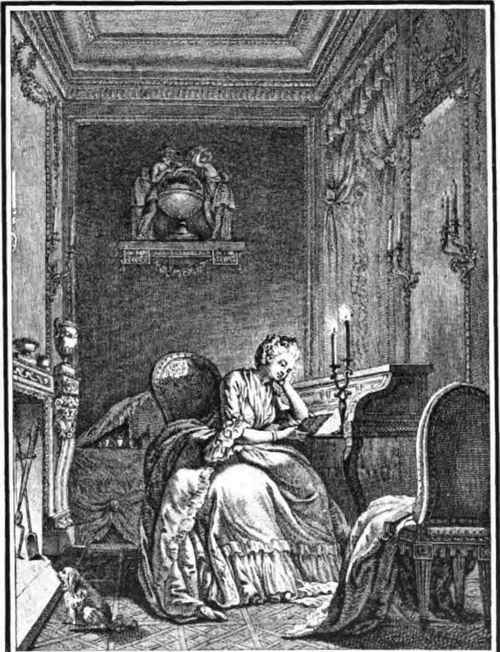
PLATE XLI. Sa trifte amante abandouee pleure ses mauxel et scs plaifirs .
FRENCH BOUDOIR, LOUIS XVI PERIOD.
(FROM A PRINT BY LE DOUTEUX,).
Continue to:


My Books

