


Chapter VII. Treatment Of Pictures And Picture Frames
Description
This section is from the book "The Art Of Interior Decoration", by Grace Wood, Emily Burbank. Also available from Amazon: The Art of Interior Decoration.
Chapter VII. Treatment Of Pictures And Picture Frames
STRIVE to have the subject of your pictures appropriate to the room in which they are to be hung. It is impossible to state a rule for this, however, because while there are many styles of pictures which all are able to classify, such as old paintings which are antique in colouring, method and subject, portraits, figure pictures, architectural pictures, flower and fruit pictures, modern oil paintings of various subjects (modern in subject, method and colouring), water colours, etchings, sporting prints, fashion prints, etc., there is, also, a subtle relationship between them seen and felt only by the connoisseur, which leads him to hang in the same room, portraits, architectural pictures and flower pictures, with beautiful and successful results. Often the relationship hangs on similarity in period, style of painting or colour scheme. Your expert will see decorative value in a painting which has no individual beauty nor intrinsic worth when taken out of a particular setting.
The selecting of pictures for a room hinges first on their decorative value. That is, their colour and size, and whether the subjects are appropriate and sympathetic.
Always avoid heavy gold frames on paintings, for, unless they are real objects of art, one gets far more distinction by using a narrow black moulding. When in doubt always err on the side of simplicity.
If your object is economy as well as simplicity, and you are by chance just beginning to furnish your house and own no pictures, we would suggest good photographs of your favourite old masters, framed close, without a margin, in the passepartout method (glass with a narrow black paper tape binding).
Old coloured prints need narrow black passepartout, while broad passepartout in pink, blue or pale green to match the leading tone in wall paper makes your quaint, old black-and-white prints very decorative.
Never use white margins on any pictures unless your walls are white.
The decorative value of any picture when hung, is dependent upon its background, the height at which it is hung, its position with regard to the light, its juxtaposition to other pictures, and the character of those other pictures -that is, their subjects, colour and line.
If you are buying pictures to hang in a picture gallery, there is nothing to consider beyond the attraction of the individual picture in mind. But if you are buying a picture to hang on the walls of a room which you are furnishing, you have first to consider it as pure decoration; that is, to ask yourself if in colour, period and subject it carries out the idea of your room.
A modern picture is usually out of place in a room furnished with antiques. In the same way a strictly modern room is not a good setting for an old picture, if toned by time.
If you own or would own a modern portrait or landscape and it is the work of an artist, and beautiful in colour, why not "star" it,-build your room up to it? If you decide to do this, see that everything else representing colour in a New York Apartment either subservient to the picture, or if of equal value as to colour, that they harmonise perfectly with the picture in mind.
From a studio one enters a smaller room, one side of which is shown here, a veritable Italian Louis XVI salon.
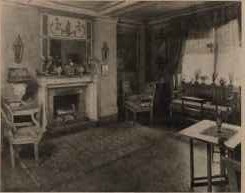
Art Italian Louis XVI Salon
We were recently shown a painting giving a view of Central Park from the Plaza Hotel, New York, under a heavy fall of snow, in the late afternoon, when the daylight still lingered, although the electric lights had begun to spangle the scene. The prevailing tone was a delicate, opalescent white, shading from blue to mauve, and we were told that one of our leading decorators intended to hang it in a blue room which he was furnishing for a New York client.
Etchings are at their best with other etchings, engravings or water colours, and should be hung in rooms flooded with light and delicately furnished.
The crowding of walls with pictures is always bad; hang only as many as furnish the walls, and have these on a line with the eye and when the pictures vary but slightly in size make a point of having either the tops of the frames or the bottoms on the same line,-that is, an equal distance from floor or ceiling. If this rule is observed a sense of order and restfulness is communicated to the observer.
If one picture is hung over the other uniformity and balance must be preserved.
One large picture may be balanced by two smaller ones.
Hang your miniatures in a straight line across your wall, under a large picture or in a straight line - one under the other, down a narrow wall panel.
man who has made a study of the decorations on old spinets in palaces, private mansions and museums. Some artists have been very successful in converting what was an inartistic piece of furniture as to size, outline and colour, into an object which became a pleasing portion of the colour scheme because in proper relation to the whole.
You can always make an ebony or mahogany piano case more in harmony with its setting by covering it, when not in use, with a piece of beautiful old brocade, or a modern reproduction.
Another side of same Italian Louis XVI salon. The tea-table is a modern painted convenience, the two vases are Italian pharmacy jars and the standard for electric lights is a modern-painted piece.
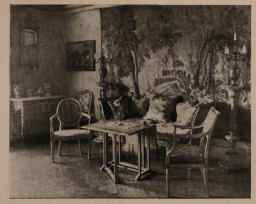
Another Side of Same Italian Louis XVI Salon
Continue to:


My Books

