


Chapter XXVI. Treatment Of An Inexpensive Bedroom
Description
This section is from the book "The Art Of Interior Decoration", by Grace Wood, Emily Burbank. Also available from Amazon: The Art of Interior Decoration.
Chapter XXVI. Treatment Of An Inexpensive Bedroom
THE experience of the author is that the most attractive, inexpensive furniture is that made by the Leavens factory in Boston. This furniture is so popular with all interior decorators that it needs no further advertising. Order for each single iron bed two foot boards, instead of a head and a foot-board. This the factory will supply upon demand. Then have your bed painted one of the colours you have chosen as in the colour scheme for your room. Say, the prevailing note of your chintz. Have two rolls made, to use at the head and foot (which are now of equal height) and cover these and the bed with chintz, or, if preferred, with sun-proof material in one of the other colours in your chintz. By this treatment your cheap iron bed of ungainly proportions, has attained the quality of an interesting, as well as unique, "day-bed."
Two designs for day-beds which are done in colours to suit the scheme of any room.
These beds are fitted with box springs and a luxurious mattress of feathers or down, covered with silk or chintz, coverlet and cushions of similar material, in colours harmonising with beds. If desired, these lounges can be made higher from the floor.
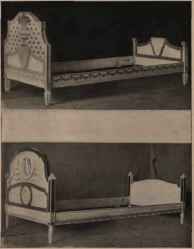
Two Styles of Day-beds
The most attractive cheap bureau is one ordered "in the plain" from the factory, and painted like the bed. If you would entirely remove the factory look, have the mirror taken off the bureau and hang it on the wall over what, by your operation, has become a chest of drawers. If you want a long mirror in your rooms, the cheapest variety is mirror glass, fastened to the back of doors with picture moulding to match woodwork. This is also the cheapest variety of over-mantel mirrors. We have seen it used with great success, let into walls of narrow halls and bedrooms and framed with a dull-gold moulding in the style of room.
For chairs, use the straight wooden ones which are made to match the bureau, and paint them like the bed and bureau.
For comfortable arm-chairs, wicker ones with chintz-covered pads for seat and back are best for the price, and these can also be painted.
Cheap tables, which match the bureau, when painted will do nicely as a small writing-table or a night-table for water, clock, book, etc.
If the floors are new and of hard wood, wax them and use a square of plain velvet carpet in a dark tone of your dominant colour. Or if economy is your aim, use attractive rag rugs which are very cheap and will wash.
If your floors are old and you intend using a large velvet square, paint the edges of the floor white, or some pale shade to match the colour of the walls. Or, use filling all over the floor. If you cannot afford either and must use small rugs, stain or paint your floors a dark colour, to be practical, and use only necessary rugs; that is, one before bed, bureau and fireplace.
Sofas are always expensive. That is one reason for advising that beds be treated like "day-beds."
Wall papers, at ten cents a roll, come in charming colours and designs, and with a few cheap French coloured prints, framed in passepartout, your room is attractive at once.
If your prints are black and white use broad passepartout in same colour as the wall paper, only a tone deeper. If you use favourite photographs, suppress all margins and frame with narrow black passepartout.
For curtains use one of the sixty- or seventy-cent chintzes which come in attractive designs and colours, or what is still cheaper, sun-proof material, fifty inches wide (from $1.10 to $1.50 a yard), and split it in half for curtains, edging them with a narrow fringe of a contrasting colour which appears in the chintz of chair-pads. Another variety of cheap curtains is heavy cream scrim with straps (for looping back) and valance of chintz. These come cheaper than all chintz curtains and are very effective, suggesting the now popular and expensive combination of plain toned taffetas combined with chintz.
Use for sash curtains plain scrim or mar-quesette.
Let your lamps be made of inexpensive one-toned pottery vases, choosing for these still another colour which appears in the chintz. The lamp shades can be made of a pretty near-silk, in a plain colour, with a fringe made up of one, two or three of the colours in the chintz.
If you happen to have your heart set on deep rose walls and your bedroom furniture is mahogany, find a chintz with rose and French blue, and then cover your arm-chair pads and bed with chintz, but make your curtains of blue sunproof material, having a narrow fringe of rose, tain type of mind, which works best when there is a tax on the imagination.
When reclaiming attic rooms, one of the problems is how to get wall space, especially if there are dormer windows and very slanting ceilings. One way, is to place a dressing table in the dormer, under windows, covering the sides of the dormer recess with mirror glass, edged with narrow moulding. The dressing-table is not stationary, therefore it can be easily moved by a maid, when the rooms are cleaned.
Continue to:


My Books

