


Chapter XXVII. Treatment Of A Guest Room (Where Economy Is Not An Item Of Importance)
Description
This section is from the book "The Art Of Interior Decoration", by Grace Wood, Emily Burbank. Also available from Amazon: The Art of Interior Decoration.
Chapter XXVII. Treatment Of A Guest Room (Where Economy Is Not An Item Of Importance)
HERE we can indulge our tastes for beautiful quality of materials and fine workmanship, as well as good line and colour, so we describe a room which has elegant distinction and atmosphere, yet is not a so-called period room - rather a modern room, in the sense that it combines beautiful lines and exquisite colouring with every modern development for genuine comfort and convenience.
The walls are panelled and painted a soft taupe - there are no pictures; simply one very beautiful mirror in a dull-gold frame, a Louis XVI reproduction.
The carpet made of dark taupe velvet covers the entire floor. The furniture is Louis XV, of the wonderful painted sort, the beautiful bed with its low head and foot boards exactly the same height, curving backward; the edges a waved line, the ground-colour a lovely pistache green, and the decoration gay old-fashioned garden flowers in every possible shade. The bureau has three or four drawers and a bowed front with clambering flowers. These two pieces, and a delightful night-table are exact copies of the Clyde Fitch set in the Cooper Hewitt Museum, at New York; the originals are genuine antiques, and their colour soft from age.
In another suite we have a boudoir done in sage greens and soft browns. The curtains of taffeta, in stripes of the two colours. Two tiers of creme net form gash curtains.
The carpet is a rich mulberry brown, day-bed a reproduction of an antique, painted in faded greens with punier fleuri design on back, in lovely faded colours, taffeta cushions of sage green and an occasional note about the room of mulberry and dull blue. Electric light shades are of decorated parchment paper.
Really an enchanting nest, and as it is in a New York apartment, and occasionally used as a bedroom, a piece of furniture has been designed for it similar to the wardrobe shown in picture, only not so high. The glass door, when open, discloses a toilet table, completely fitted out, the presence of which one would never suspect.
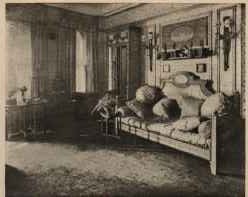
Boudoir in New York Apartment. Painted Furniture, Antique and Reproductions
A graceful dressing-table, with winged mirrors, has been designed to go with this set, and is painted like the bureau. The glass is a modern reproduction of the lovely old eighteenth century mirror glass which has designs cut into it, forming a frame.
For chairs, all-over upholstered ones are used, of good lines and proportions; two or three for comfort, and a low slipper-chair for convenience. These are covered in a chintz with a light green ground, like the furniture, and flowered in roses and violets, green foliage and lovely blue sprays.
The window curtains are of soft, apple-green taffeta, trimmed with a broad puffing of the same silk, edged on each side by black moss-trimming, two inches wide. These curtains hang from dull-gold cornices of wood, with open carving, through which one gets glimpses of the green taffeta of the curtains.
The sash-curtains are of the very finest cream net, and the window shades are of glazed linen, a deep cream ground, with a pattern showing a green lattice over which climb pink roses. The shades are edged at the bottom with a narrow pink fringe.
The bed has a cover of green taffeta exactly like curtains, with the same trimming of puffed taffeta, edged with a black moss-trimming.
The mantelpiece is true to artistic standards and realises the responsibility of its position as keynote to the room. Placed upon it are a beautiful old clock and two vases, correct as to line and colour.
Always be careful not to spoil a beautiful mantel or beautiful ornaments by having them out of proportion one with the other. Plate XXIV shows a mantel which fails as a composition because the bust, an original by Behnes, beautiful in itself, is too heavy for the mantel it stands on and too large for the mirror which reflects it and serves as its background.
Keep everything in correct proportion to the whole. We have in mind the instance of some rarely beautiful walls taken from an ancient monastery in Parma, Italy. They were ideal in their original setting, but since they have been transported to America, no setting seems right. They belonged in a building where there were a succession of small rooms with low ceilings, each room perfect like so many pearls on a string. Here in America their only suitable place would be a museum, or to frame the tiny "devotional" of some precieuse Flower of Modernity.
Continue to:


My Books

