


Chapter XXXIX. Wedgwood Pottery, Old And Modern
Description
This section is from the book "The Art Of Interior Decoration", by Grace Wood, Emily Burbank. Also available from Amazon: The Art of Interior Decoration.
Chapter XXXIX. Wedgwood Pottery, Old And Modern
MANY of our museums have interesting collections of old Wedgwood. Altogether the most complete collection we have ever seen is in the museum adjoining the Wedgwood factories in Staffordshire, England. The curator there, an old man of about seventy, loves to tell the story of its founding and growth. He began as a labourer in the potteries and has worked his way up to be guardian of the veterans in perfected types. Many of the rare and beautiful specimens he has himself dug up in the grounds, where from time to time, since 1750, they were thrown out as broken, useless debris. The recovery of these bits, their preservation and classification, together with valuable donations made by English families who have inherited rare specimens, have not only placed at the disposal of those interested, the fascinating history of Wedgwood, in a thrilling object lesson, but has made the modern Wedgwood what it is: - one of the most beautiful varieties of tableware in the market to-day.
Josiah Wedgwood is said to have been the first English potter, counting from the Roman time to the first quarter of the eighteenth century, who made vases to be used for mere decoration. Chelsea, Worcester and Derby were just then beginning to make fine porcelain. In Wedgwood's day it was the rule for young men of title and wealth to go abroad, and the souvenirs which they brought back with them, such as pictures and vases, helped to form a taste for the antique, in England. Then, too, books on Greek art were being written by English travellers. Josiah Wedgwood had a natural bent for the pure line and classic subjects, but he was, also, possessed with the keen businessman's intuition as to what his particular market demanded. So he sat about copying the line and decorations of the antique Greek vases. He reproduced lines and designs in decoration, but invented the "bodies," that is to say, the materials from which the potters moulded his wares. He is said to have invented in all, twenty varieties.
We say that he reproduced Greek designs, and so he did, but John Flaxman, his chief decorator, who lived in Rome, where he had a studio and clever assistants, studied the classics, imbibed their spirit and originated the large majority of Wedgwood's so-called "Greek" designs, - those exquisite cameo-like compositions in white, on backgrounds of pastel colours, which appeared as miniatures mounted for jewellery, medallions let into wall panels, and on furniture and Carrara marble mantelpieces, wonderful works of art wrought of his "Jasper" paste, which make Josiah Wedgwood outrank any producer of ceramics who has ever lived in any age.
Wedgwood's first vases were for use, although they were ornamental, too. Those were the pots he made in which to grow bulbs or roots, and the "bough pots" which were filled with cut flowers and used to ornament the hearth in summer.
Mr. Frederick Rathbone, compiler of the Wedgwood catalogue in 1909, a memorial to Josiah Wedgwood made possible by his great-granddaughter, says that during his thirty-five years' study of Wedgwood's work, he had yet to learn of a single vase which was ever made by him, or sent out from his factory at Etruria, which was lacking in grace or beauty.
The Etrurian Museum, Staffordshire, shows Josiah Wedgwood's life work from the early Whieldon ware to his perfected Jasper paste. Josiah's "trials" or experiments, are the most interesting specimens in the museum, and prove that the effort of his life was "converting a rude and inconsiderable manufactory into an elegant art and an important part of national commerce." Yet, although he is acknowledged by all the world to have been the greatest artist in ceramics of his or any period, remember pottery was only one of his interests. He was by no means a man who concentrated day and night on one line of production. He occupied himself with politics, and planned and carried through great engineering feats and was, also, deeply interested in the education of his children.
When Wedgwood began his work, all tea and coffee pots were "salt-glazed," plain, or, if decorated, copies of Oriental patterns, which were the only available models, imported for the use of the rich. Wedgwood invented in turn his tortoise shell, agate, mottled and other coloured wares, and finally his beautiful pale-cream, known as "Queen's" ware, in honour of Queen Charlotte, his patron. It is the "C. C." (cream colour) which is so popular to-day, either plain or decorated. He invented colours, as well as bodies, for the manufacture of his earthenware, both for use and for decoration, and built up a business employing 15,000 persons in his factories, - and 30,000 in all the branches of his business.
In 1896 the census showed 45,914 persons employed in the factories, and at that time the annual amount paid in wages was over two million pounds (ten million dollars).
We must remember that in 1760, the only way of transporting goods to and from the Wedgwood factory was by means of pack-horses. Therefore Josiah Wedgwood had to turn his attention to the construction of roads and canals. As Mr. Gladstone put it in his address at the opening of the Wedgwood Institute at Burslem, Staffordshire, "Wedgwood made the raw material of his industry abundant and cheap, which supplied a vent for the manufactured article and which opened for it materially a way to what we may term the conquest of the outer world." Yet he never travelled outside his own country; always employed English workmen to carry out his ideas, and succeeded entirely by his own efforts, unaided by the state. His first patroness was Catherine II of Russia, for whom he made a wonderful table service, and his best customers were the court and aristocracy of France, during that country's greatest art periods (Louis XV and XVI). In fact Wedgwood ware became so fashionable in Paris that the Sevres, Royal Porcelain factory, copied the colour and relief of his Jasper plaques and vases. It is claimed by connoisseurs, that the Wedgwood useful decorative pottery is the only ceramic art in which England is supreme and unassailable.
It has been said at the Wedgwood works, and with great pride, that the copying of Wedgwood by the Sevres factories, and the preservation of many rare examples of his work to-day, in French museums, to serve as models for French designers and craftsman, is a neat compliment to the English - "those rude islanders with three hundred religions and only one sauce"!
In the illustration five of the four vases, four with covers and one without, are reproductions of old pharmacy jars, once used by all Italian druggists to keep their drugs in.
The really old ones with artistic worth are vanishing from the open market into knowing dealers' or collectors' hands, or the museums have them, but with true Latin perspicuity, when the supply ceased to meet the demand, the great modern Italian potters turned out lovely reproductions, so lovely that they bring high prices in Italy as well as abroad, and are frequently offered to collectors when in Italy as genuine antiques.
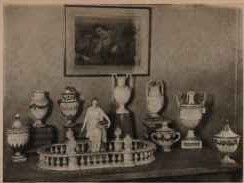
Italian Reproductions in Pottery after Classic Models
Continue to:


My Books

