


Chapter XXXVIII. Fads In Collecting
Description
This section is from the book "The Art Of Interior Decoration", by Grace Wood, Emily Burbank. Also available from Amazon: The Art of Interior Decoration.
Chapter XXXVIII. Fads In Collecting
IN a New York home one room is devoted to a so-called panier fleuri collection which in this case means that each article shows the design of a basket holding flowers or fruit. The collection is today so unique and therefore so valuable, that it has been willed to a museum, but its creation as a collection, was entirely a chance occurrence. The design of a basket trimmed with flowers happened to appeal to the owner, and if we are not mistaken, the now large collection had its beginning in the casual purchase of a little old pendant found in a forgotten corner of Europe. The owner wore it, her friends saw it, and gradually associated the panier fleuri with her, which resulted in many beautiful specimens of this design being sought out for her by wanderers at home and abroad. To-day this collection includes old silks, laces, jewellery, wax pictures, old prints, some pieces of antique furniture, snuffboxes and ornaments in glass, china, silver, etc.
Every museum is the result of fads in collecting, and when one considers all that is meant by this heading, which sounds so trifling and unimportant to the layman, it will not seem strange that we strongly recommend it as a dissipation!
At first, quite naturally, the collector makes mistakes; but it is through his mistakes that he learns, and absolutely nothing gives such a zest to a stroll in the city, a tramp in the country, or an unexpected delay in an out-of-the-way town, as to have this collecting bee in your bonnet. How often when travelling we have rejoiced when the loss of a train or a mistake in timetable, meant an unexpected opportunity to explore for junk in some old shop, or, perhaps, to bargain with a pretty peasant girl who hoarded a beloved heirloom, of entrancing interest to us (and worth a pile of money really), while she lived happily on cider and cheese!
It is doubtless the experience of every lover of the old and the curious, that one never regrets the expenses incurred in this quest of the antique, but one does eternally regret one's economies. The writer suffers now, after years have elapsed, in some cases, at the memory of treasures resisted when chanced upon in Russia, Poland, Hungary, Bohemia - where not! Always one says, "Oh, well, I shall come back again!" But there are so many "pastures green," and it is often difficult to retrace one's steps.
Then, too, these fads open our eyes and ears, so that in passing along a street on foot, in a cab or on a bus, or in glancing through a book, or, perhaps, in an odd corner of an otherwise colourless town, where fate has taken us, we find "grist for our mill" - just the right piece of furniture for the waiting place.
Know what you want, really want it, and you will find it some time, somewhere, somehow!
As a stimulus to beginners in collecting, as well as an illustration of that perseverance required of every keen collector, we cite the case of running down an Empire dressing-table.
It was our desire to complete a small collection of Empire furniture for a suite of rooms, by adding to it as a supplement to the bureau, a certain type of Empire dressing-table. It is no exaggeration to say that Paris was dragged for what we wanted - the large well-known antique shops and the smaller ones of the Latin Quarter being both ransacked. Time was flying, the date of our sailing was approaching, and as yet the coveted piece had not been found. Three days before we left, a fat, red-faced, jolly cabby, after making a vain tour of the junk shops in his quarter, demanded to know exactly what it was we sought. When told, he looked triumphant, bade us get into his cab, lashed his horse and after several rapidly made turns, dashed into an out-of-the-way street and drew up before a sort of junk store-house, full of rickety, dusty odds and ends of furniture, presided over by a stupid old woman who sat outside the door, knitting, - wrapped head and all in a shawl. We entered and, there, to our immense relief, stood the dressing table! It was grey with dust, the original Empire green silk, a rusty grey and hanging in shreds on the back of the original glass. There was a marble top set into the wood and grooved in a curious way. The whole was intact except for a loose back leg, which gave it a swaying, tottering appearance. We passed it in silence - being experienced traders! Then, after buying several little old picture frames, while Madame continued her knitting, we wandered close to the coveted table and asked what was wanted for that broken bit "of no use as it stands."
"Thirty francs" (six dollars) was the answer.
Later a well-known New York dealer offered seventy-five dollars for the table in the condition in which we found it, and repaired as it is to-day it would easily bring a hundred and fifty, anywhere I
As it happened, the money we went out with had been spent on unexpected finds, and neither we nor our good-natured cabby were in possession of thirty francs. In fact, cabby was rather staggered to hear the price, having offered to advance what we needed. He suggested sending it home "collect" but Madame would not even consider such an idea. However, at last our resourceful jehu came to the rescue. If the ladies would seat themselves in the cab, he could place the table in front of them, with the cover of the cab raised, and Madame of the shop could lock her door and mounting the box by the side of our cocker, she might drive with us to our destination and collect the money herself! He promised to bring her home safely again.
As we had only the next day for boxing and shipping, there was no alternative. Before we had even taken in our grotesque appearance, the horse was galloping, as only a Paris cab horse can gallop, toward our abode in Avenue Henri Martin, past carriages and autos returning from the Bois, while inside the cab we sat, elated by our success and in that whirl of triumphant absorbing joy which only the real collector knows.
This same modest little Empire collection had a treasure recently added to it, found by chance, in an antique shop in Pennsylvania. It was a mirror. The dealer, an Italian, said that he had got it from an old house in Bordentown, New Jersey.
"It's genuine English," he said, certain he was playing his winning card.
It has the original glass and a heavy, squarely made, mahogany frame. Strange to say it corresponds exactly with the bed and bureau in the collection, having pilasters surmounted by, women's heads of gilded wood with small gilded feet showing at base.
An end of a room containing genuine Empire furniture, Empire ornaments and a rare collection of Empire cups, which appear in a vitrine seen near the dull-blue brocade curtains drawn over windows.
We would especially call attention to the mantelpiece, which was originally the Empire frame of a mirror, and to a book shelf made interesting by having the upper shelf supported by a charming pair of antique bronze cupids.
This plate is reproduced to show as many Empire pieces as possible; it is not an ideal example of arrangement, either as to furniture in room or certain details. There is too much crowding.
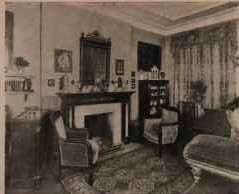
A Collection of Empire Furniture, Ornaments and China
As the brother of the great Napoleon, Joseph Bonaparte, king of Spain and Rome, passed many years of his self-imposed exile in Borden-town, in a house made beautiful with furnishings he brought from France, it is possible this old mirror has an interesting story, if only it could talk! Then, too, it was Bordentown that sheltered a Prince Murat, the relative of Joseph Bonaparte. If it was he who conveyed our mirror to these shores, a very different, but as highly romantic a tale might unfold!
For fear the precious ancient glass should be broken or the frame destroyed, we bribed a Pullman-car porter to let us bring its six by four feet of antiquity with us, in the train.
When you see a find always take it with you, or the next man may, and above all, always be on the lookout.
It was from a French novel by one of the living French writers that we first got a clue to a certain obscure Etruscan museum, hidden away in the Carrara Mountains, in Italy. That wonderful little museum and its adjacent potteries, which cover the face of Italy like ant-hills, are to-day contributors to innumerable beautiful interiors in every part of America.
We recall a dining-room in Grosvenor Square, London, where a world-renowned collection of "powder-blue" vases (the property of Mr. J. B. Joel) is made to contribute to a decorative scheme by placing the almost priceless vases of old Chinese blue and white porcelain, in niches made for them, high up on the black oak panelling. There are no pictures nor other decorations on the walls, hence each vase has the distinction it deserves, placed as it were, in a shrine.
In the Peter Hewitt Museum, New York, you may see an antique Italian china cabinet, made of gilded carved wood, which shows on its undulating front, row after row of small niches, lined with red velvet. When each deep niche held its porcelain chef d'oeuvre, the effect must have been that of a gold screen set with gems!
Speaking of red velvet backgrounds, in the same museum, standing near the Italian cabinet, is an ancient Spanish one; its elaborate steel hinges, locks and ornaments have each a bit of red velvet between them and the oak of the cabinet. One sees this on Gothic chests in England and occasionally on the antique furniture of other countries. The red material stretched back of the metal fret-work, is said to be a souvenir of the gruesome custom prevailing in ancient times, of warning off invaders by posting on the doors of public buildings, the skin of prisoners of war, and holding it in place with openwork metal, through which the red skin was plainly seen !
At Cornwall Lodge, in Regents Park, London, the town house of Lady de Bathe (Lily Lang-try) the dining-room ceiling is a deep sky-blue, while the sidewalls of black, serve as a background for her valuable collection of old, coloured glass, for the most part English, The collection is the result of the owner's eternal vigilance, when travelling or at home.
A well-known Paris collector, now dead, found in Spain a bust which had been painted black. Its good lines led him to buy it, and, when cleaned, it proved to be a genuine Canova, and was sold by this dealer, a reliable expert, to an American for five thousand dollars! It had been painted during a Revolution, to save it from destruction.
The same dealer on another occasion, when in Spain, found an old silk gown of lovely flowered brocade, but with one breadth missing. Several years later, in an antique shop in Italy, he found that missing gore and had it put back in the gown, thus completing the treasure which some ruthless hand had destroyed.
Continue to:


My Books

