


Chapter XXXVII. What To Avoid In Interior Decoration: Rules For Beginners
Description
This section is from the book "The Art Of Interior Decoration", by Grace Wood, Emily Burbank. Also available from Amazon: The Art of Interior Decoration.
Chapter XXXVII. What To Avoid In Interior Decoration: Rules For Beginners
WE all know the saying that it is only those who have mastered the steps in dancing who can afford to forget them. It is the same in every art Therefore let us state at once, that all rules may be broken by the educated - the masters of their respective arts. For beginners we give the following rules as a guide, until they get their bearings in this fascinating game of making pictures by manipulating lines and colours, as expressed in necessary furnishings.
Avoid crowding your rooms, walls or tables, for in creating a home one must produce the quality of restfulness by order and space.
As to walls, do not use a cold colour in a north or shaded room. Make your ceilings lighter in tone than the side walls, using a very pale shade of the same colour as the side walls.
Do not put a spotted (figured) surface on other spotted (figured) surfaces. A plain wall paper is the proper, because most effective, back-ground for pictures.
Avoid the mistake of forgetting that table decoration includes all china, glass, silver and linen used in serving any meal.
In attempting the decoration of your dining-room table avoid anything inappropriate to the particular meal to be served and the scale of service. Do not have too many flowers on your table, or flowers not in harmony with the rest of the setting, in variety or colour.
Do not use peasant china, no matter how decorative in itself, on fine damask or rare lace. By so doing you strike a false note. The background it demands is crash or peasant laces.
Avoid crowding your dining-table or giving it an air of confusion by the number of things on it, thus destroying the laws of simplicity, line and balance in decoration.
Avoid using on your walls as mere decorations articles such as rugs or priests' vestments primarily intended for other purposes. Avoid the misuse of anything in furnishing.
It needs only knowledge and patience to find the correct thing for each need. Better do without than employ a makeshift in decorating.
Inappropriateness and elaboration can defeat artistic beauty - but intelligent elimination never can.
Beware of having about too many vases, or china meant for domestic use. The proper place for table china, no matter how rare it is, is in the dining-room. If very valuable, one can keep it in cabinets.
Useless bric-a-brac in a dining-room looks worse than it does anywhere else.
Your dining-room is the best place for any brasses, copper or pewter you may own.
If sitting-room and dining-room connect by a wide opening, keep the same colour scheme in both, or, in any case, the same depth of colour. This gives an effect of space. It is not uncommon when a house is very small, to keep all of the walls and woodwork, and all of the carpets, in exactly the same colour and tone. If variety in the colour-scheme is desired, it may be introduced by means of cretonnes or silks used for hangings and furniture covers.
Avoid the use of thin, old silks on sofas or chair seats.
Avoid too cheap materials for curtains or chair covers, as they will surely fade.
Avoid too many small rugs in a room. This gives an impression of restless disorder and interferes with the architect's lines. Do not place your rugs at strange angles; but let them follow the lines of the walls.
Avoid placing ornaments or photographs on a piano which is in sufficiently good condition to be used.
Avoid the chance of ludicrous effects. For example, keep a plain background behind your piano. Make sure that, when listening to music you are not distracted by seeing a bewildering section of a picture above the pianist's head, or a silly little vase dodging, as he moves, in front of, above, or below his nose!
Avoid placing vases, or a clock, against a chimney piece already elaborately decorated by the architect, as a part of his scheme in using the moulding of panel to frame a painting over the mantel. In the old palaces one sees that a bit of undecorated background is provided between mantel and the architect's decoration.
If your room has a long wall space, furnish it with a large cabinet or console, or a sofa and two chairs.
Avoid blotting out your architect's cleverest points by thoughtlessly misplacing hangings. Whoever decorates should always keep the architect's intention in mind.
Avoid having an antique clock which does not go, and is used merely as an ornament. Make your rooms alive by having all the clocks running. This is one of the subtleties which marks the difference between an antique shop, or museum, and a home.
Avoid the desecration of the few good antiques you own, by the use of a too modern colour scheme. Have the necessary modern pieces you have bought to supplement your treasures, stained or painted a dull dark colour in harmony with the antiques, and then use dull colours in the floor coverings, curtains and cushions. If you have no good old ornaments, try to get a few good shapes and colours in inexpensive reproductions of the period to which your antiques belong,
Avoid the mistake of forgetting that ever) room is a "stage setting," and must be a becoming and harmonious background for its occupants.
Avoid arranging a Louis XVI bedroom, with fragile antiques and delicate tones, for your husband of athletic proportions and elemental tastes. He will not only feel, but look out of place. It he happens to be fond of artistic things, give him these in durable shades and shapes.
Avoid the omission of a thoroughly masculine sitting-room, library, smoking-room or billiard-room for the man, or men, of the house.
Avoid the use of white linen when eating out of doors. Saxe-blue, red or taupe linen are restful to the eyes. In fact, after one has used coloured linen, white seems glaring and unsympathetic even indoors, and one instinctively chooses the old deep-cream laces. Granting this to be a bit precieuse, we must admit that the traditional white damask, under crystal and silver, or gold plate with rare porcelains, has its place and its distinction in certain houses, and with certain people.
Shows a man's library, masculine gender written all over it - strength, comfort, usefulness and simplicity.
The mantel is arranged in accordance with rules already stated. It will be noticed that the ornaments on mantel in no way interfere with design of the large architectural picture.
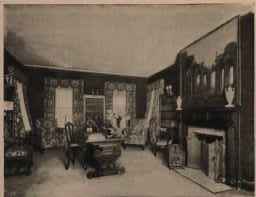
A Man's Library
Avoid in a studio, bungalow or a small flat, where the living-room and dining-room are the same, all evidences of dining-room (china, silver and glass for use). Let the table be covered with a piece of old or modern brocade when not set for use. A lamp and books further emphasises the note of living-room.
Avoid the use of light-absorbing colours in wall papers if you are anxious to create sympathetic cheerfulness in your rooms, and an appearance of winning comfort. Almost all dark colours are light-absorbing; greens, dull reds, dark greys and mahogany browns will make a room dull in character no matter how much sunlight comes in, or how many electric lights you use. Perhaps the only dark colour which is not light-absorbing is a dark yellow.
Avoid the permanent tea-table. We are glad to record that one seldom happens upon one, these days. How the English used to revile them. In the simplest homes it is always possible at the tea hour, to have a table placed before whoever is to "pour" and a tray on which are cups, tea, cream, sugar, lemon, toast, cake or what you will, brought in from the pantry or kitchen. There was a time when in America one shuddered at the possibility of dusty cup and those countless faults of a seldom-rehearses tea-table!
Avoid serving a lunch in an artificially lightec room. This, like a permanent tea-table, is an almost extinct fashion. Neither was sensible because inappropriate, and therefore bad form The only possible reason for shutting out God's sunlight and using artificial lights, is when the function is to begin by daylight and continus until after nightfall.
If in doubt as to what is good, go often to mu seums and compare what you own, or have seen and think of owning, with objects in museum collections.
Continue to:


My Books

