


Colour And Its Relation To The Decorative Idea. Part 9
Description
This section is from the book "Interior Decoration: Its Principles And Practice", by Frank Alvah Parsons. Also available from Amazon: Interior Decoration: Its Principles and Practice.
Colour And Its Relation To The Decorative Idea. Part 9
The same is true of orange and blue and purple and yellow, though, perhaps, in a somewhat lesser degree because of the luminosity quality of colour which is to be considered later.
Neutralization, or the use of neutralized colour tones in complements, is the method by which harmony is obtained. One-half neutral green and one-half neutral red are harmonious because each has introduced into it one-half of the other colour qualities of the spectrum. The one-half neutral colours may be supplemented with other tones of the same colours, more or less neutralized, and the harmony remains. It is a question of the degree of inter-relationships in the number of tones used, their relative areas, and the juxtaposition of tones appearing in the composition. Full intense colours should not be brought near each other. The less intense are more harmonious when closely associated. Those still less intense are the best backgrounds for the exploitation of the more intense ones. The small areas of intense colour show best and are strongest in their emphasis against the more neutralized ones of the complementary colour.
Concrete instances of the application of the complementary scheme to specific rooms will be given during the discussion of such rooms in later chapters. As a working basis, however, it is essential to know the terms employed, and to recognize the use and misuse of these fundamental methods of creating colour harmonies.
A third type, still under the head of harmony of contrast, is called the triad scheme. This scheme involves the choice and use of three colour tones selected from the spectrum based on the equilateral triangle and it requires an intricate knowledge of neutralization, localization of areas, and emphasis distribution. It is a scheme too difficult to explain clearly in this fundamental treatment of colour. The two types of harmony first discussed are those most generally in use and are sufficient for all ordinary problems if understood and applied.
All are not alike sensitive to colour appeal. Each one of us differs from all others in how much or what will give us just sufficient stimulation. It is a constant source of psychological interest to adjust to each person's taste and needs the colours used. This is an individual problem and can be solved successfully only when the decorator sees first the person whose tastes and needs are to be consulted. The question of materials must next be considered, and then the decorator must bring into use all his knowledge of colour forces. In this way he will arrive at the best result both as regards the pleasure and comfort of his client and the further growth of his own colour appreciation.
There is still one element of power which a colour tone possesses that it may be well to consider at this point. By the arrangement of the spectrum circuit, yellow, being the nearest to light or white, is the lightest normal colour in value. It is the first colour tone in sequence of values running from yellow to green, blue and purple on one side, and from yellow, orange and red to purple on the other.
Purple is the darkest in value of the normal colour tones and the nearest to black. Black, being the absence of light and the absence of colour, is darkness, while purple approaches this blackness more nearly than any other.
Light is the opposite element of darkness or shadow; therefore, yellow contains the greatest lighting power of any normal spectrum colour. While orange and green are of the same value in the spectrum circuit, orange has a greater lighting power because of the introduction of red, which is a greater light producer than blue.
The order, then, of this light-giving quality, which I shall call luminosity, may be stated as follows: yellow, orange, green, red, blue, and purple.
The luminosity of a colour is worthy of consideration in interior decoration where the amount of light which the room receives is a matter for conservation. This would also be important when a light room is so glaringly bright that it is impossible to obtain desired results in colour keying.
At the normal maturity point the relative luminosity of colours runs approximately as follows: yellow 12; orange 9; green 7; red 5; blue 3; and purple 1. While these numbers are not exact, they are near enough for practical purposes in determining what effect luminosity has on the choice of colour.
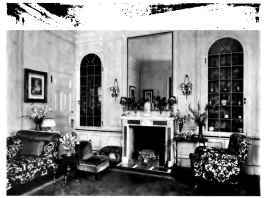

Artificial light, shining through a yellow shade lined with white, has a much more penetrating and far-reaching effect than the same light shining through a green shade lined with white, the textures of the material being the same. If blue or purple were used, the lighting effect would be greatly lessened, in fact it would be in the above mentioned ratio, were the colours of normal hue and intensity. If purple is used, particularly blue purple, with artificial light, representing nearly a yellow orange, the light not only fails to do its work as an illuminating agent, but it becomes neutralized, grayed, softened and destroyed.
Any one interested in seeing results of this quality power should experiment with different full intense colours and the same light, noticing the effect of each upon adjacent objects in the room. It must also be observed that the quality of the light filtered through these different colour tones is changed or modified greatly in hue and value, and also frequently in intensity, thereby creating a new light which will in turn modify the colours of all objects upon which it shines.
Far too little care is given to the selection and use of colour as it is affected by lighting.
A knowledge of the principles of relationship, resulting from a study of hue, value and intensity is the key to a right choice of colour schemes. It will insure the production of any colour effect desired.
Continue to:


My Books

