


Furniture. Part 5
Description
This section is from the book "Principles Of Home Decoration With Practical Examples", by Candace Wheeler. Also available from Amazon: Principles of Home Decoration.
Furniture. Part 5
But one may say, "It requires knowledge to do this; much knowledge in the selection of the comparatively few things which are to make up such an interior," and that is true - and the knowledge is to be proved every time we come to the test of buying. Yet it is a curious fact that the really good thing, the thing which is good in art as well as construction, will inevitably be chosen by an intelligent buyer, instead of the thing which is bad in art and in construction. Fortunately, one can see good examples in the shops of to-day, where twenty years ago at best only honest and respectable furniture was on exhibition. One must rely somewhat on the character of the places from which one buys, and not expect good styles and reliable manufacture where commercial success is the dominant note of the business. In truth the careful buyer is not so apt to fail in quality as in harmony, because grade as well as style in different articles and manufactures is to be considered. What is perfectly good in one grade of manufacture will not be in harmony with a higher or lower grade in another. Just as we choose our grade of floor-covering from ingrain to Aubusson, we must choose the grade of other furnishings. Even an inexperienced buyer would be apt to feel this, and would know that if she found a simple ingrain-filling appropriate to a bed-chamber, maple or enamelled furniture would belong to it, instead of more costly inlaid or carved pieces.
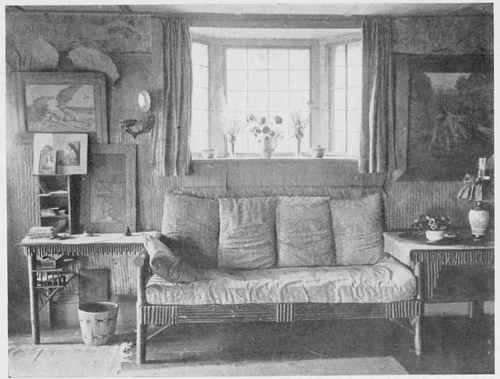
RUSTIC SOFA AND TABLES IN "PENNYROYAL" (IN MRS. BOUDINOT KEITH'S COTTAGE, ONTEORA).
It may be well to reiterate the fact that the predominant use of each room in a house gives the clew to the best rules of treatment in decoration and furniture. For instance, the hall, being an intermediate space between in and out of doors, should be coloured and furnished in direct reference to this, and to its common use as a thoroughfare by all members of the family. It is not a place of prolonged occupation, and may therefore properly be without the luxury and ease of lounges and lounging-chairs. But as long as it serves both as entrance-room to the house and for carrying the stairways to the upper floors, it should be treated in such a way as to lead up to and prepare the mind for whatever of inner luxury there may be in the house. At the same time it should preserve something of the simplicity and freedom from all attempt at effect which belong to out-of-door life. The difference between its decoration and furniture and that of other divisions of the house should be principally in surface, and not in colour. Difference of surface is secured by the use of materials which are permanent and durable in effect, such as wood, plaster, and leather. These may all be coloured without injury to their impression of permanency, although it is generally preferable to take advantage of indigenous or "inherent colour" like the natural yellows and russets of wood and leather. When these are used for both walls and ceiling, it will be found that, to give the necessary variation, and prevent an impression of monotony and dul-ness, some tint must be added in the ornament of the surface, which could be gained by a forcible deepening or variation of the general tone, like a deep golden brown, which is the lowest tone of the scale of yellow, or a red which would be only a variant of the prevailing tint. The introduction of an opposing or contrasting tint, like pale blue in small masses as compared with the general tint, even if it is in so small a space as that of a water-colour on the wall, adds the necessary contrast, and enlivens and invigorates a harmony.
No colour carries with it a more appropriate influence at the entrance of a house than red in its different values. Certain tints of it which are known both as Pompeiian and Damascus red have sufficient yellow in their composition to fall in with the yellows of oiled wood, and give the charm of a variant but related colour. In its stronger and deeper tones it is in direct contrast to the green of abundant foliage, and therefore a good colour for the entrance-hall or vestibule of a country-house; while the paler tones, which run into pinks, hold the same opposing relation to the gray and blue of the sea-shore.
If walls and ceiling are of wood, a rug of which the prevailing colour is red will often give the exact note which is needed to preserve the room from monotony and insipidity. A stair-carpet is a valuable point to make in a hall, and it is well to reserve all opposing colour for this one place, which, as it rises, meets all sight on a level, and makes its contrast directly and unmistakably. A stair-carpet has other reasons for use in a country-house than aesthetic ones, as the stairs are conductors of sound to all parts of the house, and should therefore be muffled, and because a carpeted stair furnishes much safer footing for the two family extremes of childhood and age.
The furniture of the hall should not be fantastic, as some cabinetmakers seem to imagine. Impossible twists in the supports of tables and chairs are perhaps more objectionable in this first vestibule or entrance to the house than elsewhere, because the mind is not quite free from out-of-door influences, or ready to take pleasure in the vagaries of the human fancy. Simple chairs, settles, and tables, more solid perhaps than is desirable in other parts of the house, are what the best natural, as well as the best cultivated, taste demands. If there is one place more than another where a picture performs its full work of suggestion and decoration, it is in a hall which is otherwise bare of ornament. Pictures in dining-rooms make very little impression as pictures, because the mind is engrossed with the first and natural purpose of the room, and consequently not in a waiting and easily impressible mood; but in a hall, if one stops for even a moment, the thoughts are at leisure, and waiting to be interested. Aside from the colour effect, which may be so managed as to be very valuable, pictures hung in a hall are full of suggestion of wider mental and physical life, and, like books, are indications of the tastes and experiences of the family. Of course there are country-houses where the halls are built with fireplaces, and windows commanding favourite views, and are really intended for family sitting-rooms and gathering-places; in this case it is generally preceded by a vestibule which carries the character of an entrance-hall, leaving the large room to be furnished more luxuriously, as is proper to a sitting-room.
Continue to:


My Books

