


Furniture. Part 8
Description
This section is from the book "Principles Of Home Decoration With Practical Examples", by Candace Wheeler. Also available from Amazon: Principles of Home Decoration.
Furniture. Part 8
The lesson is in the use of yellow and white, accented with touches of blue, which converts a dark and perfectly cheerless room into a glitter of light and warmth.
The third example I shall give is of a dining-room which may be called palatial in size and effect, occupying the whole square wing of a well-known New York house. There are many things in this house in the way of furniture, pictures, historic bits of art in different lines, which would distinguish it among fine houses, but one particular room is, perhaps, as perfectly successful in richness of detail, picturesqueness of effect, and at the same time perfect appropriateness to time, place, and circumstances as is possible for any achievement of its kind. The dining-room, and its art, taken in detail, belongs to the Venetian school, but if its colour-effect were concentrated upon canvas, it would be known as a Rembrandt. There is the same rich shadow, covering a thousand gradations, - the same concentration of light, and the same liberal diffusion of warm and rich tones of colour. It is a grand room in space, as New York interiors go, being perhaps forty to fifty feet in breadth and length, with a height exactly proportioned to the space. It has had the advantage of separate creation - being "thought out" years after the early period of the house, and is, consequently, a concrete result of study, travel, and opportunities, such as few families are privileged to experience. Aside from the perfect proportions of the room, it is not difficult to analyse the art which makes it so distinguished an example of decoration of space, and decide wherein lies its especial charm. It is undoubtedly that of colour, although this is based upon a detail so perfect, that one hesitates to give it predominant credit. The whole, or nearly the whole west end of the room is thrown into one vast, slightly projecting window of clear leaded glass, the lines of which stand against the light like a weaving of spiders' webs. There is a border of various tints at its edge, which softens it into the brown shadow of the room, and the centre of each large sash is marked by a shield-like ornament glowing with colour like a jewel. The long ceiling and high wainscoting melt away from this leaded window in a perspective of wonderfully carved planes of antique oak, catching the light on lines and points of projection and quenching it in hollows of relief. These perpendicular wall panels were scaled from a room in a Venetian palace, carved when the art and the fortunes of that sea-city were at their best, and the alternately repeating squares of the ceiling were fashioned to carry out and supplement the ancient carvings. If this were a small room, there would be a sense of unrest in so lavish a use of broken surface, but in one large enough to have it felt as a whole, and not in detail, it simply gives a quality of preciousness. The soft browns of the wood spread a mystery of surface, from the edge of the polished floor until it meets a frieze of painted canvas filled with large reclining figures clad in draperies of red, and blue, and yellow - separating the walls from the ceiling by an illumination of colour. This colour-decoration belongs to the past, and it is a question if any modern painting could have adapted itself so perfectly to the spirit of the room, although in itself it might be far more beautiful. It is a bit of antique imagination, its cherub-borne plates of fruit, and golden flagons, and brown-green of foliage and turquoise of sky, and crimson and gold of garments, all softened to meet the shadows of the room. The door-spaces in the wainscot are hung with draperies of crimson velvet, the surface frayed and flattened by time into variations of red, impossible to newer weavings, while the great floor-space is spread with an enormous rug of the same colour - the gift of a Sultan. A carved table stands in the centre, surrounded with high-backed carved chairs, the seats covered with the same antique velvet which shows in the portieres. A fall of thin crimson silk tints the sides of the window-frame, and on the two ends of the broad step or platform which leads to the window stand two tall pedestals and globe-shaped jars of red and blue-green pottery. The deep, rubylike red of the one and the mixed indefinite tint of the other seem to have curdled into the exact shade for each particular spot, their fitness is so perfect.
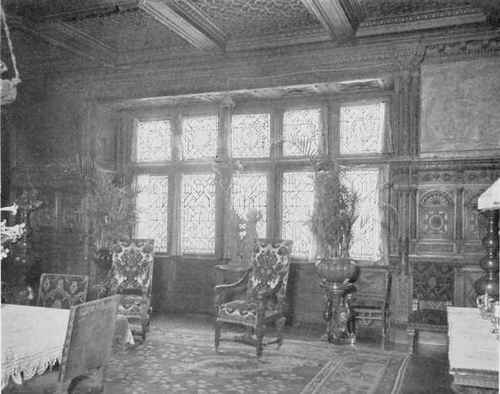
DINING-ROOM IN NEW YORK HOUSE SHOWING LEADED-GLASS WINDOWS.
The very sufficient knowledge which has gone to the making of this superb room has kept the draperies unbroken by design or device, giving colour only and leaving to the carved walls the privilege of ornament.
It will be seen that there are but two noticeable colour-tones in the room - brown with infinite variations, and red in rugs and draperies.
There is no real affinity between these two tints, but they are here so well balanced in mass, that the two form a complete harmony, like the brown waves of a landscape at even-, ing tipped with the fire of a sunset sky.
Much is to be learned from a room like this, in the lesson of unity and concentration of effect. The strongest, and in fact the only, mass of vital colour is in the carpet, which is allowed to play upwards, as it were, into draperies, and furniture, and frieze, none of which show the same depth and intensity. To the concentration of light in the one great window we must give the credit of the Rembrandt-like effect of the whole interior. If the walls were less rich, this single flood of light would be a defect, because it would be difficult to treat a plain surface with colour alone, which should be equally good in strong light and deep shadow.
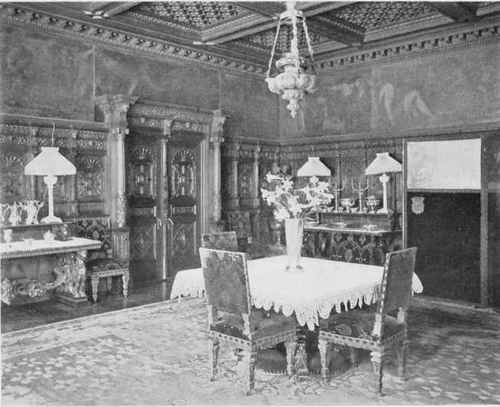
DINING-ROOM IN NEW YORK HOME SHOWING CARVED WAINSCOTTING AND PAINTED FRIEZE.
Continue to:


My Books

