


How to Make Octagon Nursery Table
Description
This section is from the book "Box Furniture", by Louise Brigham. Also available from Amazon: Box Furniture.
How to Make Octagon Nursery Table
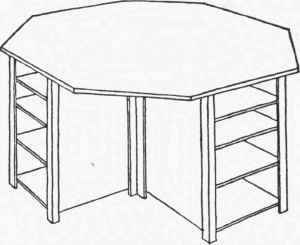
Four children may sit at the table while at play, each having a shelved compartment to hold his toys. The table may be set at meal-time for the little ones.
Requirements
Body. 4 Soap Boxes (about 10 3/4 in. deep, 14 1/4 in. wide, 20 in. long).
Shelves. 12 Pieces 1/2 in. thick, width equal to the inside width of the box, and length equal to the inside depth of the box.
Legs. 12 Pieces 3/8 in. thick, 13/8 in. wide, 2 in. longer than the outside length of the box. 12 Pieces 3/8 in. thick, 1 3/4 in. wide, 2 in. longer than the outside length of the box.
Top. 1 Piece 3/4 in. thick, octagon shape 42 in. across from side to side (six boards wide. See Fig. 2).
Construction
Make the legs 2 inches longer than the outside length of the box. Remove the covers. Fit and nail three shelves in each box, placing the first one 6 inches from one end of the box, the next one 11 inches from the same end, and divide the balance of the space equally with the third shelf. Fasten the shelves with l 1/4 inch wire brads driven from the outside through into the ends of the shelves. Nail two legs on each box at the corners of the open side, allowing them to project 2 inches over the end having the largest compartment. Stand each box on its legs so placed as to form a hollow square in the center, having the open sides face out. (See outline of the boxes in dotted lines in Fig. 2 of the illustration.) Place a small block 2 inches high under the rear end of each box to make it stand level. Move the boxes together until the corners touch and match. Place the inner legs in a reverse position to fit in each angle, and nail to both boxes forming the angle, using the try-square. Make the top of octagon shape, 42 inches across from side to side. Use seasoned, grooved and tongued material 3/4 inch thick, 7 inches wide, planed on both sides. Draw the octagon full size on the floor. Divide the space across in six equal spaces and draw the lines representing the boards as shown in Fig. 2. Lay the boards between the lines and mark and cut them to the proper angle. Place them across the tops of the boxes and nail firmly, driving each tightly against the other, allowing each side edge to project about 1 inch over the outside face of the legs. Set the nail-heads slightly below the top surface, and then finish the top face with the smooth-ing-plane.

If preferable, the boards forming the top may be joined with hot glue instead of the groove-and-tongue joint, but the edges must be held tightly together about thirty-six hours, or until the glue becomes hard, before nailing the top in place.
Continue to:


My Books

