


Chapter III. A Few Easy Ones-To Start With
Description
This section is from the book "It's Fun To Build Things", by W. T. R. Price. Also available from Amazon: It's Fun To Build Things.
Chapter III. A Few Easy Ones-To Start With
Already we have had a sort of dress rehearsal of the building of a simple set of bookshelves in a recess. One advantage of a recess is that its sides support the whole structure of the shelves, and keep them from the tendency to sway sideways.
This tendency is most serious in the case of standing bookshelves, so we will first consider those that are nailed in place. Standing shelves between two doors or window trims are easily anchored by driving no more than two nails sideways through the side board into the trim, and near the top. If there is no such nailing, there's nothing to do but provide a 2" wide cross-brace directly under the top shelf, and nail this into the wall. By taking soundings with a hammer, tapping lightly on the plaster, you may, with a little luck, locate a "stud," one of the 2"x 4* uprights which are spaced about 18" on centers as the structure of the wall. Otherwise, your nail is going into a lath, which is too springy to afford a good nailing. If you are fastening into lath, you have to drive a few careful holes with a thin finishing nail, until you strike a lath (through the 1/2" of plaster), then fasten the bookshelf cleat into the lath with two long, thin screws. This will provide a perfectly secure anchorage.
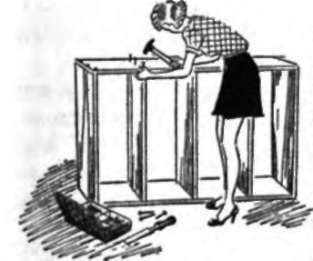
If, on the other hand, driving nails or screws into the wall is streng verboten, as in many apartments, you must build standing shelves, which are like any other piece of furniture.
Perfect rigidity may be given bookshelves of any proportions by nailing on a back made of masonite or thin plywood, and no other bracing is necessary.
The proportions of bookshelves are largely dictated by the spaces in which they are to be placed. In general, it is a clever idea, particularly if you move fairly often, or are living in an apartment, to design your bookshelves in fairly small units which may be combined in a number of different ways.
In designing for the unit system the base-board of the room is again troublesome since you desire the actual shelf units to be uniform and interchangeable. There is seldom a base-board more than 8" high, and usually they are not more than 6" or 7". If the shelf units are to be really flexible, however, you had better build a set of separate bases, and build them to meet any contingency.
Such a design as the base detailed on the page facing would do it, and need not be a part of the lower tier of units. The weight of the books will hold the shelves in place on the bases, though if you are going to worry about it, you could fasten them with two or three small finishing nails driven down through the front of the bottom shelf, in the position "a." If the base is given a depth 11/2" less than the depth of the shelves, this would take care of the thickest baseboard you would ever encounter, and if the base-board were thinner, it wouldn't matter.
To fix bookshelves in a corner, the permanent scheme is to extend the top shelf of one unit to a distance beyond the unit equal to the shelf depth, as here shown. If the arrangement is temporary, make a little fill-in extension, also as shown, and nail it to one or the other of the units with small enough nails so that it may easily be taken off when the corner arrangement is abandoned.
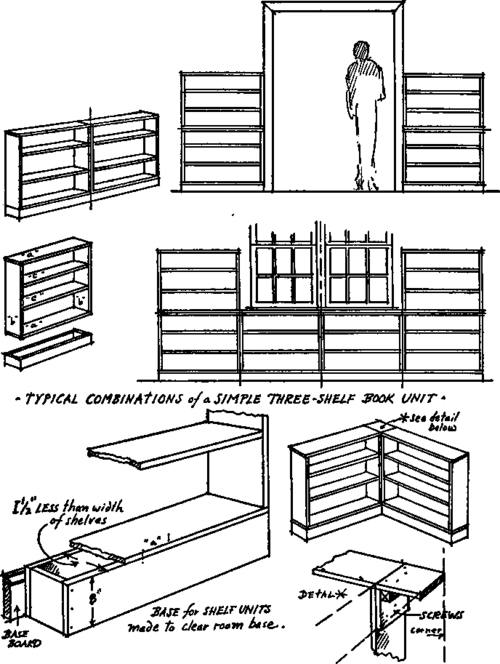
A page of bookshelf units.
An attractive and useful piece to make, and easy, too, is a fairly deep book and magazine shelf to place back of a davenport.
It should be at least 12" deep, and 14" would be even better. As a real piece of furniture, it should be made of wide, clear lumber, but as an expedient we could resort to other structural means.
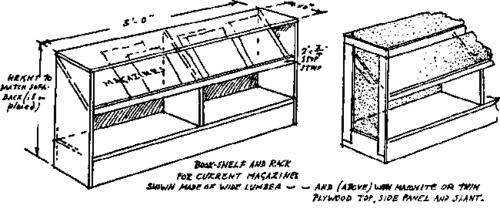
A book and magazine stand not too bard to build.
Here it is, as built of wide lumber, and as made with plywood or masonite.
The idea is to provide an easily accessible, yet neat place for current magazines, as well as files of recent back-numbers, while the reading lamp, ash trays, cigarettes or what have you, adorn the unencumbered top.
If you are building bookshelves on the sectional unit scheme, it is just as well not to have the units too large. The smaller the unit the more flexible in arrangement. This is a job in which absolute uniformity in size is essential, otherwise the units will not build up truly. Also, as you are not working to some tight condition where "fit" is necessary, you can cut up your lumber in advance, on a sort of "quantity production" basis, as is done (by machinery) in furniture factories. And if you count up the number you will need of each piece, and cut all of that piece you need before you tackle the next one, you will be more likely to avoid cutting any of them to a wrong dimension. The book unit on page 35 shows us "a" and "a" are the same, "c" and "c" are shorter, and "b" and "b" are the same. But always use the same piece from which to measure. Never measure from successive pieces.
Generally speaking, it is wiser to avoid overhanging top shelves, and nowadays the plain, square corner is nicely in style with modern furniture. Naturally the plain square corner is necessary when you are building sectional units, because you never know how you may want to combine them.
You will probably use either white pine or cypress, and the technique of fitting and nailing in the shelves, as well as the procedure of figuring your lumber from a scale drawing, or at least a dimensional drawing, will be the same as in the first shelf-building project in Chapter II (Before You Start Sawing).
The only differences will be in the dimensions you may wish to follow, according either to your own personal fancy or to some specific condition to which the work must be fitted.
Certainly bookshelves are easy to make, and if you can't make bookshelves, or utility shelves in closets and elsewhere (as in the next chapter) there isn't much use in going on with the fun of building things.
Continue to:


My Books

