


Chapter XIII. Painting And Finishing
Description
This section is from the book "It's Fun To Build Things", by W. T. R. Price. Also available from Amazon: It's Fun To Build Things.
Chapter XIII. Painting And Finishing
It may not be a consoling reflection, but it's well to remember that even if you build something so neatly and smartly that you surprise yourself, you can have it look like a botchy homemade job if you make a mess of finishing it. Not that painting or finishing need be messy. It's all in how you do it-and it's quite as much fun as building things because it is the final touch-the only thing that stands between the thing you have made and putting it into use.
Most people who have a little job of painting to do seem to go at it too suddenly and impatiently, and without the few simple preparations that make for smooth performance. Remember that a botchy paint job can ruin the effect of your work.
The first thing to do is to go all over the thing you have built to see if any part of it needs a little sandpapering, or if you have overlooked any nails that need to be sunk and filled with plastic wood. Or, you may have sunk all the nails but overlooked filling the holes with plastic wood. It's much better do to all this before you start painting than to run across a bad spot when you have a brush full of paint in one hand and are in the midst of a critical bit of technique.
In preparation for a paint job (which means also lacquer or stain), have plenty of newspapers on hand to spread about under the thing you are going to paint. You are almost certain to have a few drops of paint fall from the brush, and there's no use in having them fall on the floor. Next, have plenty of old rags handy, and have them cut up in quite small pieces, so that when one gets soaked with paint you can throw it away. Part of a large rag soaked with paint merely gets paint on your hands.
The other thing you should have plenty of is turpentine, if you are using paint or oil stain: prepared "thinner," if you are using lacquer. Then you can keep things clean as you go along-including your hands. Also, you can keep your brushes clean.
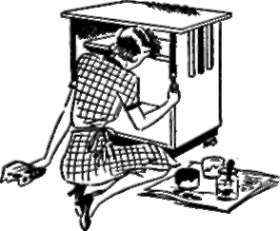
Brushes-cheap ones, are a poor economy, and there's no reason why you should expect to do a beautiful professional looking job of painting with a ten-cent brush that molts hairs in the paint as you apply it. And don't get too large a brush. A brush or x" one is plenty large enough for most work, and you will be glad it isn't a 3" brush when you come to painting into little corners, or painting the face-edge of a built-in bookcase without also painting the adjacent wall. (When you are painting to an edge, by the way, it is wise to turn the brush edgeways. It is all too likely to slop over the edge if you use it flatways.)
The kinds of finish you are likely to use are paint, enamel, brushing lacquer, oil stain, acid stain, shellac, varnish and oil with wax.
It never does any harm to read the directions on the can because the manufacturers, for reasons of their own, like to have you get satisfactory results with their products. And you'd better read the directions before you start work, or you may find them quite obliterated by paint that has run down the side of the can.
All paint stores and departments have color-cards showing all the colors, and if none of the stock colors suits your esthetic fancy (as may be the case) you can always mix the exact color you want.
Paint
If you have ever watched professional painters at work you will have noticed them doing two things: one, they seem to be continually stirring the paint, secondly, they frequently pour some from one can into another. They have a reason for both of these apparently aimless little tricks.
Frequent stirring of paint keeps it smooth and of uniform consistency. Most pigment has a tendency to sink to the bottom of the can, with the result that the top is thin and the bottom is thick. The idea in pouring off some of the paint into another can, is to better control the consistency of the smaller quantity. As this gets thicker, you stir in a little turpentine. As it gets used up you pour back a little of the paint you poured into the second can.
For a good, glossy paint job all new wood should be given a first coat of "flat white." Otherwise most of the paint sinks into the wood and dries uneven-glossy on hard parts of the grain and dull where it has gone into the soft parts.
You are most likely to use paint for built-in work, in which case you are concerned with matching the existing trim in the room. In an old house it isn't a bad idea to repaint the trim in the whole room while you are about it. Among other things, you don't have to bother matching the paint with the paint on your new shelves or window-seat.
Enamel
Enamel, as you know, dries with a hard, glossy surface, and you use it for woodwork in kitchens and bathrooms. You may want to use it, too, for pieces of furniture, though the new brushing lacquers have a rather more pleasing finish. Enamel behaves very much the same as paint, needs an undercoat and should be put on with a very fine brush. You want it to dry with a finish like porcelain-so you put it on with considerable care, smoothing out all the surfaces with full brush strokes. The solvent is turpentine, as with paint, and you use it for cleaning your brushes, wiping up any drops of enamel that may have happened to fall, and removing any enamel that you didn't mean to get on your hands.
Continue to:


My Books

