


Folding Screens. Continued
Description
This section is from the book "It's Fun To Build Things", by W. T. R. Price. Also available from Amazon: It's Fun To Build Things.
Folding Screens. Continued
These are some of the techniques in which a bold, flat design may be executed by resorting to montage, either as the whole technique, or in combination with paint. The obvious advantage of montage is the ease with which you can build a design through the addition of materials and textures you could never paint.
Plain montage simply means gluing various kinds of papers or fabrics to the panels of the screen. Most familiar of all are wallpaper screens, and while this type is undeniably obvious, it can be made handsome and even very special and exclusive in exact proportion as the execution gets away from looking like "just wallpaper." You must do two things in order to achieve this escape: pick an unusual wallpaper, preferably an imported "toile" or a good pictorial, and give it a lot of antiquing and glazing.
Grass-cloth (Japanese) is a good material for paneled screens as it has both color and texture-and it may be enhanced no end by a montage of Japanese prints, properly antiqued.
More formal screens may take a montage of reproductions of Currier & Ives or 19th century floral or fashion prints, set in frames of gold passepartout tape, and the whole antiqued and varnished. (Marble paper is the ideal base for these kinds of prints.)
If formality aims at today's "high-style" (according to our best interior decorators) of the Directoire or the Regency, modern wallpaper offers plenty of Greek key and fret borders, which, with the addition of backgrounds of marble paper, a few stripes of gold passepartout tape, and gold stars (ready made) as required, will ensemble a very satisfactory design.
On the informal side, an amusing montage may be made of magazine covers, particularly such as The New Yorker, Vogue, Harper's
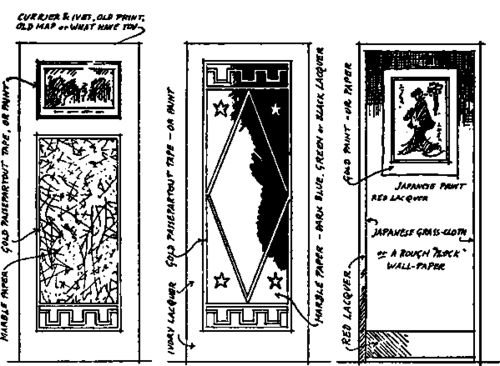
Three suggestions for screen decoration.
There is no end to decorative treatments which may be applied to screens, whether you have the ability to carry out decorative paint treatments or have to rely on mounted material. Certainly there is a boundless range of interesting and decorative things which can be utilized for screen decoration. And decoration is a matter of your individual taste.
Bazaar, or House and Garden, entirely according to your taste. Sometimes it's even worth while to break up a book, especially a large-page one with colored illustrations that you particularly like. A screen for the nursery is easily made from some of the children's books that are nowadays so attractive-and so inexpensive.
Then there's the travel-poster screen-and most modern travel posters are naturals for screen panels, being large in scale and colorful. Special significance, of course, if you've been to the places-but good anyway, and perhaps you'll go to the places some other time.
Maps-don't overlook them as ideal montage material for screens.
They don't need to be either originals or counterfeits of those beautiful antique maps from old copperplate engravings. Ordinary schoolroom maps, antiqued with orange shellac and varnished make beautiful screens (not to speak of the handy reference angle), as also Government Survey maps, particularly if these cover the immediate terrain of the locality in which you live. Even road maps, antiqued and varnished take on highly decorative quality, and may commemorate some adventuresome trip you took.
Lastly, there is the montage of photographs, thrown up very large as in the "photomurals" that are so smart and popular these days. Better not to try to color these. Photomurals are usually (and wisely) left in their natural range of grays, and you can add color in the frames of the three folds of the screen. In making a "photomontage," be sure to dampen the photographs before glueing.
"Lastly," we said-but when it comes to the things you, personally, might want to mount on screens, there's no end to the possibilities.
You might fancy building a screen with tall mirrors, and we're not saying you mightn't successfully do it-but the weight of the mirrors demands stout, heavy construction, with considerable strain on the hinges and a lively chance of breaking one of the mirrors. That's why we wouldn't recommend it to any but resourceful and courageous characters.
One thing we forgot to mention about cover-moldings is the advisability of painting, lacquering, gilding, or whatever you're going to do with them before you nail them in place. This does away with the ever-present probability of getting paint on the map or wallpaper or whatever the molding is to cover. After the nailheads are carefully sunk, plastic wood, put in so neatly as not to need sandpaper, will take a touch of the same finish you are giving the molding.
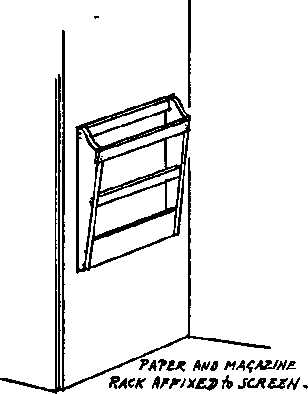
There is an easy-to-build idea that might turn out to be very convenient in a small apartment, and for the person who likes to keep things picked up. On one side of the screen (according, of course, to its decorative scheme) shallow racks may be built for magazines and the day's newspaper. Some people wouldn't like the looks of this, but there's no denying that it makes the screen, which is usually a parasitic article of furniture, work for its living a little, as well as being decorative.
Continue to:


My Books

