


Draperies
Description
This section is from the book "English Furniture", by Frederick S. Robinson. Also available from Amazon: English Furniture.
Draperies
In his sofas Sheraton uses the same style of leg and arm as in his chairs. Consequently these details need not detain us. He has a variety of general shapes. One is of the usual settee type, with an arm at each end. The upholstery is not always continuous along the back. In one design there are three upholstered rectangles divided by wooden pillar and curve work, perhaps a not very comfortable invention. In another, where the upholstery is continuous, he has three rather stiff rectangular cushions arranged at regular intervals along the back. Evidently the sofa with him or his clients was not to be regarded as a lounge. Nor is there much ease in his 'Chaises Longues,' which have a high back at one end, and are either open elsewhere, or else have a back decreasing in height from the head and curling round the foot end. In these designs very much use is made of draperies, and we get a foretaste of that' roll-over' curve which characterised the formidable 'Grecian Couches' of his later style. These painted and gilt sofas show their author's close approximation to the French style of Louis XVI., a resemblance so marked as to have earned for him the position of a chief interpreter of that manner in England. Rather fortunately, however, for the individuality of Sheraton, he had not that ample supply of chasing talent at hand to decorate his woodwork, though, as we have seen, he has expressed a desire for a national brass foundry.
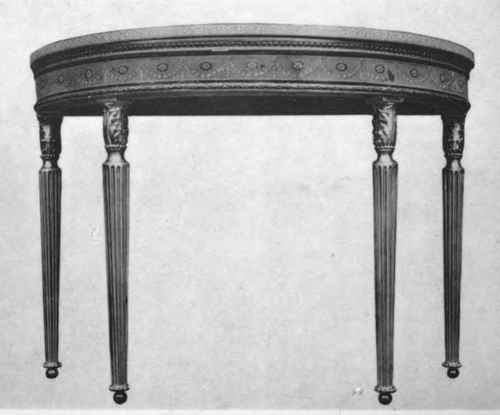
Plate CXXVI. Table, Painted And Gilt
CXXVI. Table, painted and gilt. The top is decorated with a fan-shaped ornament in the centre, medallions with female figures and an urn, and a broad band of festooned flowers. V. & A. M.
Dimensions: Height 32, Length 45¾, Breadth 20¾ inches.
In default of that, Sheraton's brass-work is sparingly used, to the advantage of true art. There is not that conflict to be found in the 'English Louis Seize' of Sheraton between the claims of metal-work and wood which has so often in French furniture led to the ornament of both being overdone.
There is one class of furniture in which he did make a considerable use of comparatively plain brass-work, unlike any of his rivals except the Adams. The main shape of Sheraton's simpler sideboards is very like that of Heppelwhite and Shearer (Plate CXXXIX.I). In his more ambitious efforts he varies the shaping of the front more than they did, as was the rule with his large bookcases. Whilst Heppelwhite makes detached pedestals for his urns to stand on, Sheraton joins them on to each end of a simple sideboard, and thus makes of it one grandiose piece (Plate cxl.). But the chief distinction which marks his sideboards off is the use of brass railing at the back. This is arranged either as two horizontal rails, or a straight lower one, and the upper one curved. They are strengthened in the centre by a perpendicular support, which is made use of as a candelabrum for two or more lights on S-curved brackets (Plate CXXXIX.). Sometimes there are brass arms at each end like the arms of a chair, and the use of all this brass-work is to show off dishes or silver-plate, which may be leaned up against it. Occasionally there is a fair amount of scroll-work besides that which supports the candles. Not very many of these sideboards appear to have survived complete.
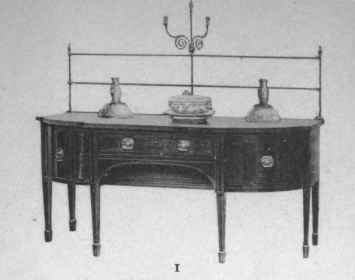
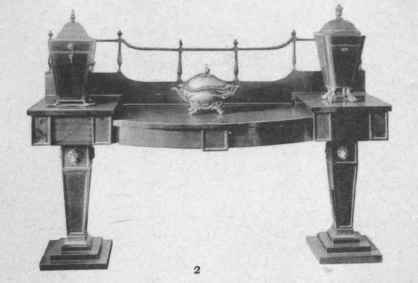
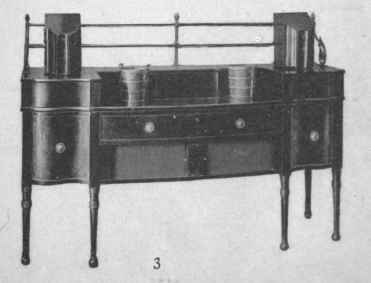
Plate CXXXIX.
I - Sideboard, Mahogany Inlaid Sheraton
2 - „ „ „ Late Sheraton
3 - ,, „ „ Sheraton, Middle Period
CXXXIX. (1) Sideboard, mahogany inlaid. Sheraton.
Mr. Stephen Neate.
(2) Sideboard, mahogany inlaid. Late Sheraton. Messrs. Waring.
(3) Sideboard, mahogany inlaid. Sheraton, middle period. Messrs. Waring.
The brass has got bent and tarnished, and has ultimately disappeared, to the no great loss of the rest of the design (Plates cxxxix., cxl.). In his later fancies the brass-work was of a lattice description, which was not an improvement, tending as it did to remind us of the ordinary brass lattice-work placed over library shelves to ward off the depredations of too enthusiastic book-lovers. Sheraton sometimes recurs to the plain sideboard table without any drawers or cupboards, and in one of his drawings he evinces that tendency to occasional failure in a perfectly absurd ' Mahogany Vase underneath to hold Bottles,' from the mouth of which volcanic flames are being belched forth impossibly. This is to be found in The Drawing-Book, to which we are chiefly confining ourselves at present. It is preferable to show Sheraton at his best and to refer later to those developments which we cannot but deplore.
Continue to:


My Books

