


Gothic Style
Description
This section is from the book "English Furniture", by Frederick S. Robinson. Also available from Amazon: English Furniture.
Gothic Style
The Gothic taste - it never, perhaps, in the eighteenth century attained quite the dimensions of a craze - did not arrive so early as the Chinese. Evelyn had very little to say for it, but he was able to appreciate its merits. Of Haarlem, for instance, he says that the town possesses 'one of the fairest churches of the Gotiq design I had seene,' but when he arrives at Rome in 1644, the first thing he visits is the 'Palace Farnezi,' built 'when Architecture was but newly recovered from the Gotic barbarity.' As late as 1697 he complains of 'monkish piles without any just proportion, use, or beauty.' While allowing them a certain solidity, he objects to the multiplicity of detail, so confounding the sight 'that one cannot consider it with any steadiness.' Addison likewise in 1711 compares a certain class of writers who 'hunt after foreign Ornaments' to 'Goths in poetry, who, like those in Architecture, not being able to come up to the beautiful simplicity of the old Greeks and Romans, have endeavoured to supply its place with all the extravagancies of an irregular Fancy.' Speaking again of 'our general Taste in England for Epigrams, Turns of Wit, and forced conceits, .. I have endeavoured,' he says, 'in several of my speculations to banish this Gothic Taste which has taken possession among us.' It is to be feared that his endeavours were not attended by much success, and if there is any truly existing connection between the tendencies of literature and those of art, Addison's words are symptomatic of a new departure in the latter.
Certainly the reawakened interest in Gothic architecture did not commence with Horace Walpole's building of Strawberry Hill. This he had not thought of till 1750, when, to judge from Chippendale's first edition, the fashion must have been fairly established in furniture. Batty Langley's Principles of Gardening, published in 1728, seems to show that the revival of a taste for Gothic architecture crept in through the use of sham ruins in gardens. In 1742 his Ancient Architecture gave 'a great variety of grand and useful designs entirely new in the Gothic mode for the ornamenting of buildings and gardens,' and Walpole employed him on Strawberry Hill, but never pretended that even between the two of them they had produced a genuine resuscitation.
There is great excuse, then, for Chippendale, if, as we have seen, his Gothic is so remarkably like his Chinese. It has this advantage over the latter, that there are more broad parts in the woodwork of the backs, and that consequently some Gothic chairs are less fragile-looking than the majority of the Chinese. There are instances, however, where in the use of very light and tapering crocketed pinnacles between a pair of ogival arches, the woodwork seems to run almost to nothing. This naturally occurs, it should be said, at the top of the back, where the strain would be the least. The wheel-back or rose-window-backed chair cannot be regarded as a happy invention, unless in the un-Gothic guise of the example on Plate c.2, and it is a relief to turn from chairs to other furniture, such as bookcases, where the Gothic style does not seem quite so out of place.
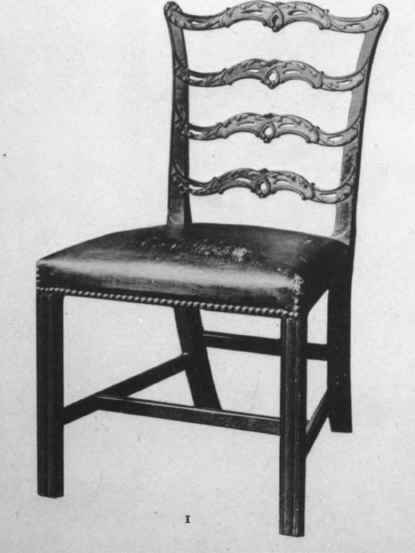

Plate C. I - Four-Bar-Backed Chippendale Chair 2 - Wheel-Backed Chair Chippendale
c. (1) Chair, four-bar-backed mahogany. Chippendale. Mr. G. E. Hemmons.
(2) Chair, wheel-backed mahogany. Chippendale. Messrs. Partridge.
A good instance of the combination of French eighteenth-century, Gothic, and Chinese, is a cabinet set upon a console or base of four terminal legs. These are ornamented below with C-curves and acanthus leafage, exactly as might be found upon any piece of French Louis xv. furniture. The framework below the top slab is decorated with strapwork cut on the solid, of a kind which might well be called Chinese. Only when we get to the lower part of the upper piece, or cabinet proper, do we find the Gothic element in an arcading of sixteen pointed arches, cusped, and with quatrefoils between. The higher we go, the more we return to France and China. Chippendale does not assign any particular inspiration to this cabinet, but another cabinet which is distinctly called Gothic, may well be compared with it. This is of the same general construction, and is actually much less Gothic-looking than the previous example. It rests on the same terminal legs, but this time they have a large pierced opening down the most of their length. The solid feet are worked with C-curves and acanthus. On the centre of the frame, below the top slab, is a large ornament such as Meissonier might have designed, except that it is symmetrical. Its Gothic claim is perhaps based on a quatrefoil opening in the middle.
The top of the upper part rises in a sort of ogival arch very much disguised with French ornament, and at the two ends, where was an opportunity for Gothic pinnacles to save the character of the piece, Chippendale has gone out of his way to place finials of little vases containing naturalistic flowers exactly reminiscent of the Louis xv. ormolu. The main part of the front is festooned with naturalistic leaves and flowers. The only features which give this Gothic cabinet any claim to its title are two little recesses, one on each side of the top, each with a couple of quasi-ogival arches, and a single long slender piece of shafting on each side of the flower-bedecked central panel. In face of such a design, it is impossible to believe that the 'Gothic style' was much more than a label which Chippendale attached to his wares, just as a portmanteau-maker is accustomed to call a certain kind of leather bag a 'Gladstone.'
Two of Chippendale's designs for large bookcases make a greater show of Gothic work, chiefly by means of pinnacles at the top, but the central ornaments, most noticeable parts of the entire scheme, are deliberately French, or Gothic twisted most comically into Chinese by placing a pagoda top above a pseudo-ogival arch. Still it is in these large library bookcase designs that Chippendale's Gothic fantasias are least objectionable, and if he had never mentioned the word Gothic, we should be more free to admire the ingenuity with which he has made his melange into an agreeable whole. The material in which they were to be executed so little recalls either the wood or the stone of Gothic architecture, that his forms might have passed without our noticing the ultimate source from which they were borrowed. His clientele contained but few sticklers for purity of style, we may be sure. Indeed, it is not unlikely that the Gothic in furniture was at first only foisted upon the public by means of its studied approximation to the more familiar Chinese.
Continue to:


My Books

