


H-Shaped Bases
Description
This section is from the book "English Furniture", by Frederick S. Robinson. Also available from Amazon: English Furniture.
H-Shaped Bases
Of the subjects illustrated the origin need scarcely be disputed, whatever the decoration of the more elaborate ones may be. The earliest of these types and the most ornamental is best represented (Plate xlix. I) by the oak table from the Charterhouse (formerly a communion table), even though it dates as late as 1616. It shows the system of a central bearer and end supports which is usual with most of these distinctly architectural tables. In our illustration it will be seen that the frame is heavily cushioned and carved with cherubs' heads and garlands. There are the arms of Thomas Sutton, founder of the Charterhouse Hospital, and the date of 1616. The upper part is supported on thirteen columns with semi-Corinthian capitals and ornamented lower shafts. The H-shaped base is a characteristic of various tables of this kind, the more elaborate of which it is impossible, without a plan, to describe. Mr. J. W. Hurrell has included in his Measured Drawings of Old Oak English Furniture one or two of the sort. A very good one at Chetham's College, Manchester, has the H-shaped base, but its end and centre legs are not classical columns. They partake more of an octagonal and Tudoresque description.


Plate XLIX.
1 - Table, Oak Dated 16l6
2 - Table, Oak First Half Of 17th Century
XLIX. (1) Table, oak, dated 1616, with arms of Thomas Sutton, founder of the Charterhouse Hospital.
Dimensions: Length 49 1/9, Height 33½ inches approximately. By kind permission of the Master of the Charterhouse.
(2) Table, oak, first half of seventeenth century. St. Michael's Church, St. Albans.
Under the table top, and following its length, are round arches, with pendants only between, and unsupported by pillars, as, for instance, may be roughly seen in the octagonal table belonging to Miss Evans of Forde Abbey (Plate l. i). But the Chetham's College table is a very long one; fully twelve feet, with eight of these pendant-divided arches under its top. At each of the four corners of the table are very heavy octagonal pendants. The frame under the table top has a rough species of gadrooning.

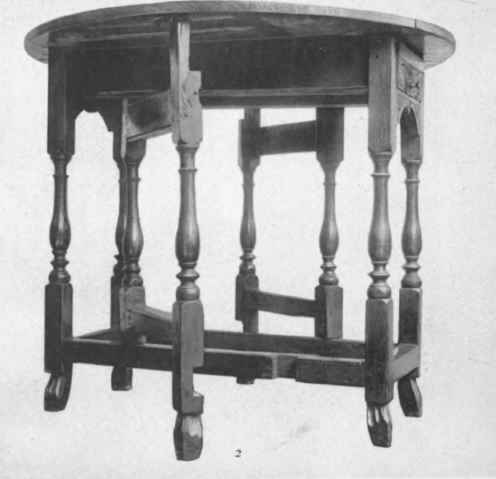
Plate L.
1 - Table, Oak About 1620
2 - Gate Table, Oak 17th Century
l. (1) Table, oak, about 1620. At Forde Abbey. Miss Evans. (2) Gate Table, oak. Seventeenth century. Derbyshire. V. & A. M.
Dimensions : Height 27¾, Breadth 38½ inches.
IX ' Drawing ' Table, oak, inlaid. Late sixteenth century. V. & A. M.
In the same set of drawings from Chetham's College, which are well worthy of examination, is a variant on the H-based shape. The H-shape is there, with four baluster-legs or supports on its central bar instead of the five columns, of the Charterhouse table. Now we must imagine, looking at the Charterhouse table, that from each projecting cross end of the H a morticed stretcher slants towards, and is morticed in under the first pillar at each end of, the central bar. This fills up the angles of the H, and affords an additional platform in the Chetham's College table, upon which a heavy double curved leg is set. There are, naturally, four of these, and their heavy convex curves above, and concave ones below, suggest precursors of the cabriole leg. In the vestry of St. Mary's Church, Wareham, are the remains of a table which has four heavy legs similarly curved. They are roughly carved on their upper parts with lions' heads.
Elsewhere the origin of the cabriole leg is considered. It is a natural shape conventionalised. In a reproduction from a Harleian MS., Knight's Old England, vol. I. p. 69, there is a Saxon table with almond-shaped top (like the form known as vesica piscis) which has similar legs, cabriole in their curves, with variously carved heads, one a lion's or leopard's, above, and lion's paw feet. If we are to be guided by this we may conclude that there is nothing new under the sun in furniture design.
A good H-based table which has three pillars placed as the five of the Charterhouse table, and round arches above them, may be seen at Astbury Church, near Congleton. At the ends, instead of the four of the Charterhouse, there are but three pillars, of which the centre one is slight, like those of the long central bar. This, however, is a much less ornamental table than that of the Charterhouse, most of its decoration being confined to the cushioned frame under the top, which is carved with the usual gadroon and acanthus leaf at the corners.
From St. Michael's Church, St. Albans, is reproduced (Plate XLIX.2) a table in which, though the architectural pillar remains, the H-base has disappeared. The legs and frame are profusely covered with strap-work of an S-curve nature. This table has suffered severely with time. There was no doubt a proper pendant in the centre of the frame, which has obviously been shortened at one end. It is even possible that the table originally had an H-base and more columns, the present legs below the columns forming a very unsatisfactory foundation.
Continue to:


My Books

