


Gate Tables And Table Chairs
Description
This section is from the book "English Furniture", by Frederick S. Robinson. Also available from Amazon: English Furniture.
Gate Tables And Table Chairs
Holding a middle place between chair and table, is a piece of furniture made to serve the purpose of both. These objects seem to have been in comparatively early use. There is an inventory of the Archbishop of Canterbury's goods at Lambeth in 1575, in which a 'Table Chaire' is mentioned, whilst at 'Croiden House' the same ecclesiastic possessed a 'Waynscote Table, chaire-wise.' That of our illustration (Plate liii.i) is the property of Sir Charles Robinson, Newton Manor, Swanage, Dorset. It is an unassuming object, without decoration. There is a flap seat to serve as a box. When the hinged back is lowered to serve as a table-top, a stick or peg was thrust through the holes at the ends of the shaped flanges, and also through corresponding holes at the ends of the arms, to prevent the top from tipping upwards if too much weight were placed on one end. Mr. Litchfield reproduces in his History of Furniture a chair-table which is said to have belonged to Theodore Hook, and is more elaborate. The table-top or chair-back was circular, and made of several planks, strengthened by two rather elaborately shaped cross-pieces which worked on pins through the hinder ends of the arms, as in the example illustrated.
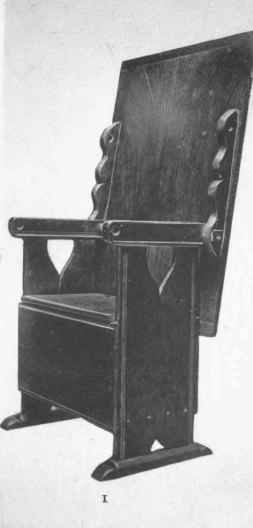

Plate LIII. 1 - Chair-Table, Oak I 7th Century 2 - Table, Inlaid About 1700
LIII. (1) Chair Table, oak. Seventeenth century. Sir Charles Robinson, C.B.
Dimensions: Height as chair 51½ inches, Width of seat 21½ inches, Length of table top 37 inches, Width 25 inches.
(2) Table, inlaid. About 1700. V. & A. M.
Dimensions: Height 31, Length 36, Breadth 31 inches.
When Hook's possession served as a chair, there was to be seen a handsome, irregular, diamond-shaped piece of incised carving. The lower part has the shaped arms, turned supports, and legs of a regular solid-backed oak chair, and the seat frame was carved.
Mr. W. Bliss Sanders, in Half-timbered Houses and Carved Oak-Work, has a drawing of a settle and table combined. This worked upon the same principle, and had a semicircle pattern incised on the frame of the seat. Neither of these two objects described is known to the writer. Chair-tables even of the plain type illustrated are sufficiently uncommon.
The spiral legs and cross stretchers of the somewhat heavy-looking table of our last illustration (Plate liii.2) proclaim its period to be the very end of the seventeenth century, if not the early eighteenth. This table, mentioned elsewhere as probably Tunbridge work, has a top and frame geometrically inlaid with various woods, bone and ebony mosaic borders, and bone and ebony eight-pointed stars.
Continue to:


My Books

