


Chapter VIII. Oak Chairs Of The Sixteenth And Seventeenth Centuries
Description
This section is from the book "English Furniture", by Frederick S. Robinson. Also available from Amazon: English Furniture.
Chapter VIII. Oak Chairs Of The Sixteenth And Seventeenth Centuries
ENGLISH chairs of an earlier date than the seventeenth century, or perhaps the end of the sixteenth, are extremely rare. Before that, in all probability, very few were made. The head of the house was alone accommodated with a chair, and for the rest a bench was considered good enough. Time and usage might be expected to deal more hardly with this more movable piece of furniture than with the solid beds and tables and cabinets which remained as fixtures in one place. Not that the Elizabethan or Jacobean chair was a thing to be taken by one hand and placed conveniently for a tete-a-tete. The time for trifling and 'conversation chairs' had not yet arrived. We have to wait for the eighteenth century, and halfway through it, to see what could be done in the way of minute decoration and grace of outline. In the chair of the old oak period, the uncompromising squareness and stiffness of the main shape is but meagrely disguised by a parsimonious decoration. This is confined chiefly to the upper part of the chair, perhaps because that alone was to be seen above the table-top. It is possible, too, that the economy of lower decoration was due to a traditional avoidance of labour which might be wasted by the dirt and damp of the earlier rush-strewn floor, sometimes suggestively designated 'the marsh.' At any rate, the plainness of the lower part, which is a usual feature of the oak chair, deprives the design to some extent of unity.
The superiority of an Italian or French example, in this respect, is very noticeable. If we compare the French chair, No. 7211, from the Soulages Collection in the Victoria and Albert Museum, dating perhaps from 1580, with our English ones, we can observe in it a greater sense of completeness. Its back is open, with two round arches which are repeated on the front, below the seat. The same shaped brackets appear above and below, and there is just sufficient addition of ornamental beading of edges, incised work, and applied prism-shaped blocks, to take away all suspicion of thinness, without rendering the design too 'busy.' Not a little inlay, of ebony and mother-of-pearl, in leaf and triangular shapes, adorns this chair, whose carving is good and in considerable relief. It would be difficult to find amongst English chairs one of such quality as this, which probably comes from the south of France, where a magnificent school of carving existed.
Nearest to it of our examples is the arm-chair of oak (Plate liv.i), with panelled back inlaid with floral scroll-work and birds, No. 229 in the Victoria and Albert Museum. This might be late sixteenth century, and with its fluted legs inlaid above, and the inlaid line of diamond-shapes on the front of the seat, is a decidedly exceptional chair. It should be compared with No. 22 in the same place, which is in many respects similar, but is not inlaid. The turned legs and arm-supports of this latter, with clumsy rings at equal intervals, are vastly inferior to the fluted pillars of the earlier chair. Both have those S-curved bracket-pieces on each side of the upper part of the back, which are so frequent an accompaniment of the heads of beds. In both the Courtenay bed, No. 404, and No. 316, which is of the same date (1593), these S-curves are to be seen. In the inlaid chair of our illustration the curves are more graceful than in its companion of perhaps ninety-years after (Plate lv.2), if the date carved upon it, 1670, is an authentic one. Here they are flattened, as we are to find them on the sides of many a subsequent mirror-frame, chimneypiece, or stone monument.
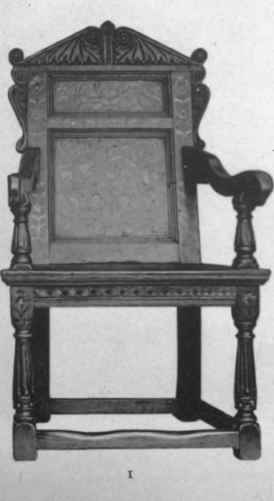
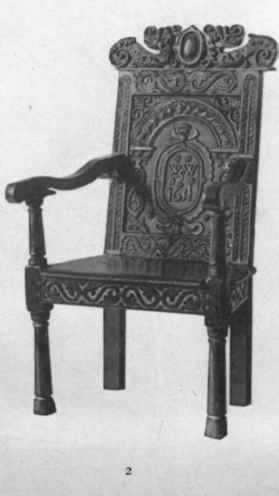
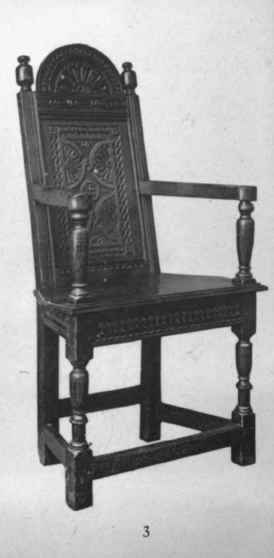
Plate LIV. 1 - Arm-Chair, Oak Late 16th Or Early 17th Century 2 - Arm-Chair, Oak 1631
LIV. (1) Armchair, oak, inlaid. Late sixteenth or early seventeenth century. V. & A. M. (2) Armchair, oak, 1631. William and Sarah Wiggle. The top of back shows S-curves shaped as dragons. A. J. James, Esq.
(3) Armchair, oak. Early seventeenth century. ' Caqueteuse' shape. J. E. Clifton, Esq.
Dimensions: Height 51, Breadth 27, Depth from front to back 17¼ inches.
The more graceful side-shape is to be seen on another chair, No. 231 in the Victoria and Albert Museum, but in this case the top rail curves are flattened like those of No. 22. A dated chair of 1668, lent by Violet, Lady Beaumont, to the Bethnal Green Exhibition of Furniture, had side-pieces with somewhat slighter S-curves, and these were pierced through with an opening resembling the half of a kite-shaped shield.
Continue to:


My Books

