


Turned Legs And Wired-Work
Description
This section is from the book "English Furniture", by Frederick S. Robinson. Also available from Amazon: English Furniture.
Turned Legs And Wired-Work
We may complete our notice of Heppelwhite's letterpress with the observation that 'stuffed headboards' to beds are recommended, and that what Heppelwhite calls cabriole chairs have stuffed backs, sometimes shield-shaped, but, strangely enough, have not the cabriole leg. The legs are straight and tapering, and in section either rectangular or round. Chairs with cabriole legs are given in the plates, but are not so described. That also which we should call a shield-back settee, he describes as a 'bar-back sofa.'
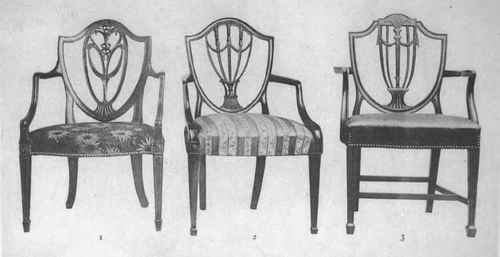
Plate CXXXI.
I - Shield-Back Arm-Chair, Mahogany Hepplewhite
2 ., ., ,, .
CXXXI. (1) Shield-back Armchair, mahogany. Heppelwhite. Henry Willett, Esq. (the late).
(2) Shield-back chair, mahogany.
Heppelwhite. W. H. Spottiswoode, Esq.
(3) Shield-back Armchair, mahogany.
Heppelwhite. Henry Willett, Esq. (the late).
One of the obvious differences between the styles of Chippendale and Heppelwhite consists in the fact that the former seldom used turned work for his furniture, whereas Heppelwhite employs it frequently for the legs of his chairs, pier-tables, window-seats, and sofas. It serves indeed very often merely as a basis for decoration with flutes and reeds, and his favourite narrow leaf; but as Heppelwhite's scheme of decoration is seldom so profuse as Chippendale's, the influence of the lathe is very apparent.
A second peculiarity of Heppelwhite is a habit of replacing a solid wood pediment upon his library bookcases and bureau bookcases with very slim, open scrollwork or wreath adornments which depended upon wires for what small durability they possessed. This flimsy work is found even on the centre of sofa backs in his designs, and also below the frames of side-tables. Its utter want of permanence is proved by the fact that furniture in the style of Heppelwhite with these ornaments still existing upon it is rarely to be met with. It is fortunate that these excrescences are scarcely missed from the more solid elements of the design. The mouldings of Heppelwhite's cornices are often extremely well proportioned and elegant, and form a very adequate completion of his furniture even without a pediment. On girandoles and pier-glasses this open work assumes an even larger part of the scheme, so that it is sometimes difficult to understand how it could have been carried out at all. Yet in the designs of the Adams, open work was used to an enormous extent.
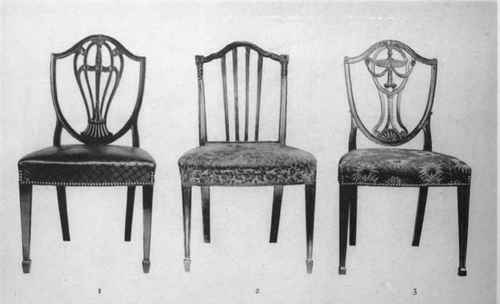
Plate CXXX. I - Shield-Back Chair, Mahogany 2 - Chair, Mahogany Hepplewhite
CXXX. (1) Shield-back Chair, mahogany. Heppelwhite. Henry Willett, Esq. (the late).
(2) Chair, mahogany. Heppelwhite. Sir
Charles Robinson, C.B.
Dimensions: Height 36½, Width 21 inches.
(3) Shield-back Chair, mahogany. Heppelwhite. Henry Willett, Esq. (the late).
It is time now to point to those classes of furniture in which Heppelwhite achieved unmistakable success, and perhaps he would himself have preferred his shield-back and other chairs in carved mahogany to the painted 'banister back' with its flowers or Prince of Wales's feathers. There are three main classes into which his designs may be divided: the shield-back, the square-back, either open or solid, and the oval-back. The shield shape fits on to two short pieces of wood, which are practically prolongations of the back legs. Hardly ever does the splat in a chair by Heppelwhite come down to the seat. There are one or two instances to be found, but they are exceptions, and this difference of construction between him and Chippendale is very particularly to be noticed. Chippendale's four cross-bar type (Plate C.I) is almost the only one in which by the nature of the design he is compelled to break through his rule. In some cases the bottom of the shield comes nearer to the stuffed seat than in others, and those chairs which show the least gap, and have the largest shield, are perhaps the happiest in design. The square-backed class is treated with upright bars, either straight or shaped.
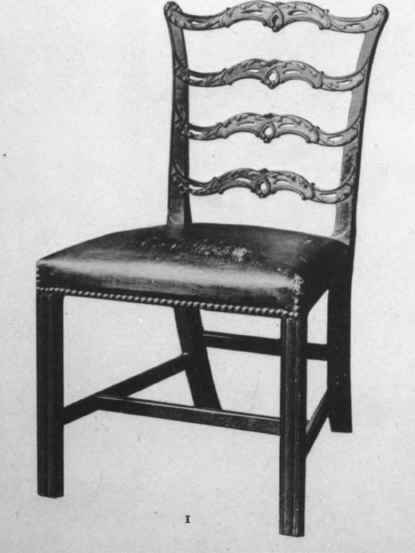

Plate C. I - Four-Bar-Backed Chippendale Chair 2 - Wheel-Backed Chair Chippendale
c. (1) Chair, four-bar-backed mahogany. Chippendale. Mr. G. E. Hemmons.
(2) Chair, wheel-backed mahogany. Chippendale. Messrs. Partridge.
Counting in the outer uprights, there may be either four - arranged at equal intervals - or five, in which case the centre three are often lighter and closer together than the two outside pieces; or seven, when generally the five centre bars are grouped somewhat closely together. There are exceptional instances where a comparatively straight bar alternates with a shaped one, but one and all, as we have seen, fit, not into the frame of the seat, but into a light horizontal piece which is two or three inches above it. This seems an inherently weaker system of construction than that of Chippendale, but the fact remains that Heppelwhite's chairs have stood the test of time, and are really stronger than they look (Plates CXXX., CXXXI., CXXXII.). He differentiates himself from Chippendale entirely in his treatment of the legs. The former's straight parallel-sided leg is never used by Heppelwhite. His chair legs taper from the top either to a plain thinner end, or terminate in the 'spade' shape formed by a thicker section or shoulder an inch or two above the floor. The spade shape itself also tapers from its top to the ground. Variations are found in a ball foot of small dimensions, or a club foot which is the same as if the spade foot were cut off short just below its broadest part.
In his turned legs Heppelwhite is fond of an astragal moulding about three inches below the top, and a similar one a little less above the bottom. Flutes are frequent with him, often three down the front of a rectangular leg; but the commonest treatment is to have a thin raised moulding edging the leg on both sides. The centre part, in consequence, is a slightly sunken field upon which the pendent husks are found carved in relief. Round legs may be fluted or reeded, and in the latter case a continuous riband may run round from top to bottom. Flutes and reeds, or both together, one above, the other below, and the encircling riband, are also found in his bed-posts.
Continue to:


My Books

