


Bureaus
Description
This section is from the book "English Furniture", by Frederick S. Robinson. Also available from Amazon: English Furniture.
Bureaus
A mahogany 'tall-boy' chest of drawers from Chippendale's design is a most desirable possession. In his first edition they appear both extremely plain and also with ornamental legs and frets. These last run along architraves and between the upper and lower parts. They are found upon the blunted or canted corners with excellent effect, and also, on a smaller scale, run round the drawers. Sometimes the front consists of plain drawers. In the more ornate there are doors with fancy lattices similar to those of bookcases and china cabinets (Plate CIX.).

Plate CIX. I And 2 - Chippendale Tallboys, Mahogany 3 - Heppelwhite Tallboy „
XC. Breakfast-Table, mahogany. Chippendale. Sir Charles Robinson, C.B.
Dimensions : Height 27⅜, Length of top 36, Width 27 inches.
The bureau and bookcase, or 'desk and bookcase,' as he calls it, affords Chippendale an ample field for decoration. It is to be found with lion's feet or feet made of Louis xv. C-curves and 'coquillage.' It may be either plain drawer-fronted, or fitted with a knee-hole below its sloping top. Sometimes double doors take the place of the drawers. The design of Chippendale, which is before me, from the first edition, though decked out with French flower ornament, is in its general severity of shape a distinct reminiscence of the plainer furniture of the Queen Anne period. It has a broken swan-necked pediment finished with three busts. Its feet, too, are of the ogee moulded shape,1 which belongs to that earlier time. In place of the pediment there is sometimes a pierced lattice rail at the top of the upper part, and in the design which shows this, the lower rail between the feet is Cupid bow-shaped and decked with 'coquillage,' just sufficient to break successfully the strict perpendicular lines of the piece.
1 The 'scroll' foot.
The cornices of the plainer furniture are often very-happy in proportion. Small denticulations, combined with straps on the solid, are the chief ingredients of the cornice of the tall-boy (illustrated on Plate CIX.) in the possession of Mr. Arthur Edwards, 61 Wigmore Street. Nothing could have been better considered.
Though it is necessary to condemn most of Chippendale's elaborate designs for Chinese and Gothic beds, there is a saving grace to be found in his simpler four-posters. Of these the pillars are often extremely graceful. Sometimes they are reeded and crossed with ribbons, sometimes they are twined round with continuous ribbons and scrolls. Less attractive are those which imitate the slender shafts of Gothic architecture, and were calculated to give the occupant of a bed the impression that he was camping in a cathedral. Vast numbers of these pillars of four-posters, which have been destroyed, are now serving the purposes of lamp and fern stands. The cornices of these beds are sometimes in open pierced work, as is the case with a specimen at present in the possession of Mr. R. W. Partridge, 19 St. James Street. The main cornice ornaments are of upstanding acanthus-leaf shape. The pillars are fluted, and the hangings, of crimson and white in broad stripes, still remain. The Victoria and Albert Museum possesses a fair specimen.
It would be difficult to surpass that which is illustrated here, with its elegant pierced top, embroidered hangings, and fluted and acanthus-carved pillars, from a photograph communicated by Messrs. Waring (Plate CXIV.). Such beds as these are far more satisfactory than the design for a state-bed with gadrooned dome surrounded with amorini, eagles, and doves, and topped by Venus, Cupid, and a lion upon clouds, which Chippendale submits 'to the judicious and candid for their approbation; and there are found Magnificence, Proportion, and Harmony. .. A Workman of genius will easily comprehend the Design. But I would advise him, in order to prevent mistakes, to make first a model of the same at large, which will save both time and expense.' There is no record of this fifteen-foot monument ever having been ventured upon. Two classes of objects remain to be considered which are of importance to the subject - long clocks and mirrors. To both of these Chippendale devotes many designs, and to the latter most naturally, as became the son of a mirror-frame carver (Plate cxv.). Unfortunately, in his mirrors Chippendale runs to the extreme of French rocaille work. We find over and over again the long-beaked bird, the Chinese figure, and the C-curve dropping water.
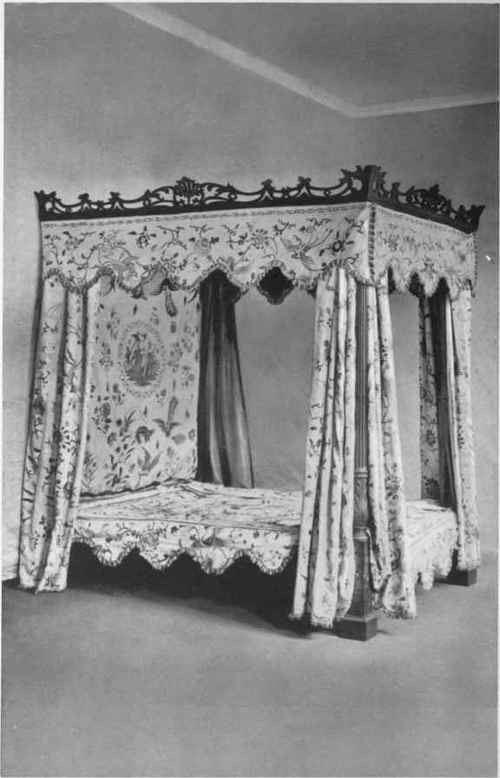
Plate CXIV. Chippendale Bedstead
CXIV. Bedstead, mahogany. Chippendale. Messrs. Waring.
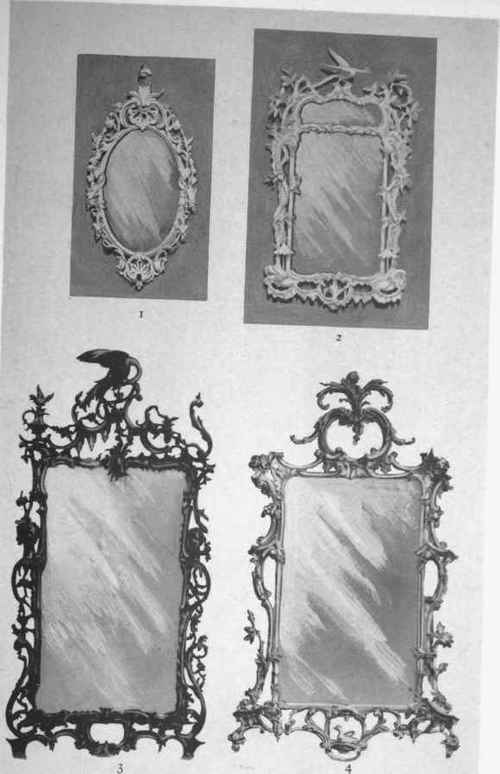
Plate CXV.
I - Mirror, Wood, Painted White
2 - ,, Pine Frame ,, ,, Chippendale
3 - Chippendale Mirror And Gilt
4 " " "
cxv. (1) Mirror, wood, painted white. Chippendale. The Hon. Sir S. Ponsonby-Fane, K.C.B.
(2) Mirror, pine frame, painted white. Chippendale. The Hon. Sir S. Ponsonby-Fane, K.C.B.
(3) Mirror, gilt. Chippendale. Mr. Stephen Neate.
(4) Mirror, gilt, Chippendale. Mr. Stephen Neate.
There are fragile and outlying leaves and flowers which seem almost, if not entirely, impossible of execution. The bird is bigger than the tree upon which he perches, and in one case hugely outspans the maiden crossing a bridge which is thrown across the lake of plate-glass. Sophisticated ruins, consisting of a column or two, appear on his girandoles, and it is difficult to find anything simple in these, or any of his frames. Those for pictures deal much in trophies of war, music, and the chase, and are borrowed somewhat from the grandiose style of Charles Lebrun, Louis XIV.'s director of art. A favourite combination is that of a chimneypiece with cabriole side uprights, and upper part with oval-shaped glass. Most of these designs run riot to such an extent with their multiplicity of ornament, that the eye and the mind refuse to dwell upon them with contentment. To them might precisely be applied the criticism which Evelyn, in a carping mood, expressed of Gothic architecture. We are better able to appreciate Chippendale's skill in the French style if we consider it as exemplified in the smallest and simplest articles which he drew. Many of his little wall-brackets are very charming, especially those which are most symmetrical.
Their main outline is triangular - the apex, of course, beneath - and their details may consist of a pair of winged cherubs with fish-tail extremities intertwined, or a couple of grotesque eagle-like heads as the tops of long C-curves which are joined at the bottom. Two pretty fancies are to be seen in a satyr peeping through somewhat irregular C-curves and coquillage, and a long-tailed dragon flying through an opening similarly composed, but rather more symmetrical.
Continue to:


My Books

