


Chapter XX. Heppelwhite: II
Description
This section is from the book "English Furniture", by Frederick S. Robinson. Also available from Amazon: English Furniture.
Chapter XX. Heppelwhite: II
THE book published by Heppelwhite is worthy to be compared in its style of printing with the fine folio of Chippendale. The Cabinet-Maker and Upholsterer's Guide, or Repository of Designs for every Article of Household Furniture in the newest and most approved Taste, by A. Heppelwhite and Co. (so he spells his name), is a folio containing 125 copper-plates, published first in 1788, with a second edition in 1789, and a third in 1794. I refer to the edition of 1789. The Preface commences: 'To unite elegance and utility, and blend the useful with the agreeable, has ever been considered a difficult but an honourable task.' The authors go on to say they have tried to produce a work 'useful to the mechanic and serviceable to the gentleman.' 'English taste and workmanship,' they add, 'have of late years been much sought for by surrounding nations; and the mutability of all things, but more especially of fashions, has rendered the labours of our predecessors in this line of little use.' We shall see presently that Sheraton says exactly the same of Heppelwhite as Heppelwhite of Chippendale and his contemporaries. The claim that English taste is being 'sought for by surrounding nations' is interesting.
To the American colonies, of course, much furniture was exported, but the phrase used by Heppelwhite seems scarcely applicable to the Americans, who in 1788 were but just ratifying their new constitution as the United States. Does Heppelwhite claim that England is leading the way in front of France? That, as regards his own furniture, can scarcely be maintained, for the truth has to be admitted that the main lines of much of his work, and of course those of Shearer also, are to be found in many a piece of French furniture made some years previously.
The long tapering legs and the concave curves upon the sides of the superstructure in Shearer's writing-table with semi-circular top, evince his debt to France. The double plinth with concave sides and a space for the swing of the mirror in his dressing-table can also be found in French furniture, which was being made by Riesener and his rivals before either Shearer's or Heppelwhite's books were published. We must turn, then, to other countries for that extraneous demand to which Heppelwhite refers. From Spain have recently arrived chairs of Chippendale style, which have most probably remained in that country ever since they were ordered from England. It is reasonable perhaps to suppose that a considerable trade in English furniture was being done with that and other nations. The monumental cabinet to which I refer later on (see Plate clvii.), made by Shackleton and Seddon for Charles IV. of Spain, is a case in point.
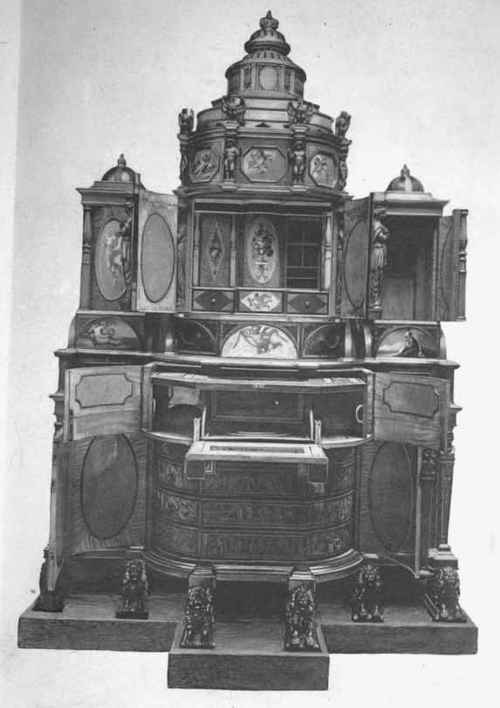
Plate CLVII. Cabinet, Satinwood, Veneered, With Paintings
CLVII. Cabinet, satin-wood veneered, with paintings. Messrs. Partridge.
Dimensions : Height 108, Breadth 72, Depth from front to back 36 inches.
It is further stated in the preface that the book is meant to help those who, living far from London, are behind the times, and the authors end with the words, 'Though we lay no claim to extraordinary merit in our designs' (this is perhaps a hit at Chippendale's pretensions, as, for instance, regards his riband-back chairs), 'we flatter ourselves they will be found serviceable to young workmen in general, and occasionally to more experienced ones.' Posterity has thoroughly endorsed the modest aspirations of Heppelwhite and Company.
Theirs is a businesslike book, and does not waste many words. Let us quote part of their brief for painted chairs. 'For chairs a new and very elegant fashion has arisen within these few years of finishing them with painted or japanned work, which gives a rich and splendid appearance to the minuter parts of the ornaments, which are generally thrown in by the painter. . . . This style . . . allows a framework less massy than is required for mahogany; and by assorting the prevailing colour to the furniture and light of the room, affords opportunity, by the variety of grounds which may be introduced, to make the whole accord in harmony with a pleasing and striking effect to the eye. Japanned chairs should always have linen or cotton cases or cushions to accord with the general hue of the chair. . . . This kind of chair in general is called banister back chair.'
It would be idle to deny a certain attractiveness to this style of decoration, but a moment's consideration of a popular pattern is sufficient to destroy its claim to a very high artistic place. The Prince of Wales's feathers appear in chair backs either set separately as the three upright splats, or joined together at the bottom after their usual fashion. For carving in wood they are unsuitable enough; 'thrown in by the painter' with realistic light and shade they are preposterous. Critics of French furniture take exception to the animals and landscapes of Beauvais tapestry for chair and sofa seats. As little can be said for the invention which crushes feathers behind a sitter's back. The explanation of the fashion, no doubt, resides in the patronage which Heppelwhite obtained from the Prince of Wales and his friends. Whatever the details of the painting, it is obvious that gradual friction, though at the very first it might improve by toning down the crudeness of new paint, is bound to result in ultimate ruin of the delicate surface. In carved woodwork the opposite is the case.
Every hour of legitimate wear lends an additional charm of 'patina,' and if carved oak, walnut, or mahogany had no other claim over painted furniture, this would be sufficient to establish their superiority.
Acknowledgment of the debt of England to France is to be found in such passages as the following: - ' An elegant drawing-room with modern furniture is scarce complete without a confidante. . . . This .. is sometimes so constructed that the ends take away and leave a regular sofa; the ends may be used as Barjier chairs.' The plate represents a sofa with waved top and two ends partitioned off, but not detachable. It is curious to observe that though the designs of most chairs, window-seats and tables generally have their back legs drawn on the plate, those of sideboards and sofas are omitted, though in the perspective views chosen they could easily be seen. If properly introduced they would certainly not interfere with the lines of the design any more than they do in the case of tables and chairs. Those chair designs which omit the back legs impress the beholder with a decided sense of incompleteness.
France, again, is responsible for the Duchesse. 'This piece of furniture also is derived from the French. Two Barjier chairs . . . with a stool in the middle form the Duchesse.'
We get a hint that the sideboard l is of no great antiquity, from the remark that 'the great utility of this piece of furniture has procured it a very general reception.' Heppelwhite's designs for these, as we have seen, are so similar to those in Shearer's book already mentioned, that they do not call for further notice.
That very elusive term of 'Pembroke table' is shown once for all to be a comprehensive one, for Heppelwhite says they 'may be of various shapes.' We shall see later that Sheraton's Pembroke table is indeed different from Heppelwhite's, which is on four slim tapering legs adorned with urns or husks, and has a rectangular or oval top consisting of a central piece and two flaps. As the Pembroke table is supposed to have been called after the lady for whom it was first made, so is the case with Rudd's, or the reflecting dressing-table. 'This is the most complete dressing-table made, possessing every convenience which can be wanted, or mechanism and ingenuity supply. It derives its name from a once popular character for whom it is reported it was first invented.' There is a lifting glass concealed in a drawer on either side of the person who uses the table.
1 The sideboard of the oak period was of different shape. See pages 94-95.
Continue to:


My Books

