


Inlay, Marquetry, Veneer
Description
This section is from the book "English Furniture", by Frederick S. Robinson. Also available from Amazon: English Furniture.
Inlay, Marquetry, Veneer
In many cases, although but one wood is used to cover the surface, the sheets cut from one log are so placed in relation to each other as to make patterns out of the grain. It is obvious that the grain of very thin sheets cut from the same piece of wood would be very similar. By taking two of these and placing the first one way, and the second the other, as the pages of an open book, beautiful effects of opposition of grain are to be obtained. This process, however, was not common, except perhaps in the case of walnut-veneered furniture, until the mahogany period, which may be placed after 1720. Large pieces of this fine-grained wood could be treated in this manner to advantage, as it will take a polish infinitely superior to that of the coarser-grained woods. The distinctions of 'inlay' and 'marquetry' are not very strictly kept. The terms have a tendency to be used rather promiscuously, according to the amount of pattern in proportion to ground. Where very little ground shows, it is the practice to speak of marquetry; where the ground predominates, we use the term inlay.
The old oak furniture was cut into nearly one-eighth of an inch, that it might hold fast its inlaid decoration, and this, of course, is essentially different from laying on to a substructure a pattern made of thin pieces of different coloured woods, to which the words marquetry and veneer are more strictly applicable.
It is reasonable to suppose that the first efforts of inlayers (or onlayers) were humble, and to expect simple geometrical shapes easy of cutting and manipulation, before complicated curves and figures. Upon old oak chests and chairs, as we have seen, triangles and oblongs and rhomboidal shapes are frequent, and the flower and leaf designs growing out of a vase are perhaps the latest and highest result. In the period at which we have arrived we find two styles in use - geometrical, and what may be called freehand. A good example of the first in the Victoria and Albert Museum is the table (No. 4620) of pine inlaid with lignum vitce and other woods. This (Plate LIII.2) is a heavy object about four feet long only, upon massive spiral legs, joined by curved stretchers forming a species of X shape. To quote some of Mr. J. H. Pollen's description: 'The top is of marquetry . . . formed of slices or sections of laurel, arbutus, and other rare native woods, showing the concentric circles of the grain. The centre is a panel with a border of ebony and ivory; circles with large ebony and ivory stars fill this panel, and stars are placed on the four corners of the table. . . . Rosewood, box, walnut, and holly are also employed in the inlaying.
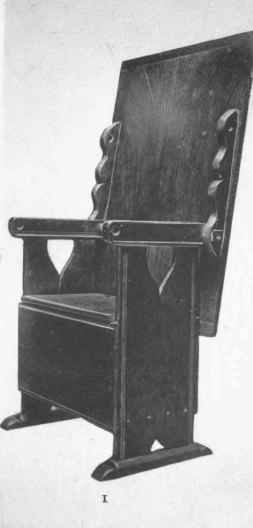

Plate LIII. 1 - Chair-Table, Oak I 7th Century 2 - Table, Inlaid About 1700
LIII. (1) Chair Table, oak. Seventeenth century. Sir Charles Robinson, C.B.
Dimensions: Height as chair 51½ inches, Width of seat 21½ inches, Length of table top 37 inches, Width 25 inches.
(2) Table, inlaid. About 1700. V. & A. M.
Dimensions: Height 31, Length 36, Breadth 31 inches.
Probably a piece of Tonbridge work of the last [eighteenth] century, before mahogany had been introduced into the manufacture of furniture by Chippendale and other contemporary makers.'
Not much is known about the earlier productions of Tunbridge, which is still a centre for the manufacture of inlaid wooden objects. It may be gathered from an article upon the subject in the Sussex Advertiser, quoted in Pelton's Guide to Tunbridge Wells, that the industry can be traced back in some form or other to 1685, 'when, however, only plain articles were manufactured. Later it became usual to burn figures, such as shells, into the wood before varnishing. Next came the painting of flowers.' Later, about 1830, came the peculiar mosaic work which is still practised, either for expensive picture mosaics of which only one is made, or for wholesale production by means of patterns cut thin - as a cucumber is sliced - from variously shaped and coloured sticks of wood put together and glued beforehand. It is quite probable that this process was employed in earlier times, and for the purposes of geometrical ornaments, such as stars and chequers in tables, like that described above. More elaborate inlaid work of birds and figures must be regarded as of French or Dutch origin, in default of any evidence that such ornament was made at Tunbridge.
Continue to:


My Books

