


Chapter XXIV. Notes On The Materials, Manufacture, And Care Of Furniture
Description
This section is from the book "English Furniture", by Frederick S. Robinson. Also available from Amazon: English Furniture.
Chapter XXIV. Notes On The Materials, Manufacture, And Care Of Furniture
THE periods of English furniture might roughly be named after the woods of which at different epochs it was mainly constructed. It would naturally De found that just as the style of one period overlaps that of another, the materials popular in an early time continue to be frequently used at later dates. Making this very broad allowance, we may divide our field into three main portions and call them after Oak, Walnut, and Mahogany. This last class may be understood to include furniture veneered or inlaid with satin and other woods, made in the late eighteenth and early nineteenth centuries.
The room in which I am writing contains examples of all three, and also specimens of the overlap. There is, first of all, an oak chest belonging to what has been referred to in these pages as the old oak period. It extends from the earliest date, of which there are any examples remaining, down to the later Stuart epoch. Of the later Stuart, and William and Anne, or 'Walnut Period,' a child's arm-chair is evidence, and that also contains a material - cane - which may be said never to belong to the oak period proper. Be it remembered, however, that oak chairs of the Stuart style are common enough. The third, or mahogany period, dating from about 1720, is exemplified by chairs in the style of Chippendale, and a bureau bookcase. Instances of the overlap are excellently afforded by a Welsh dresser which is mainly constructed of oak, but is inlaid or cross-banded with mahogany, and also by a bureau with sloping top - a shape which belongs entirely to the mahogany period - made altogether of oak. Such a thing as an old oak bureau with sloping top, and carved and panelled in the old oak style, would be an extreme rarity. I have seen what purported to be such an object, but cannot regard it as genuine.
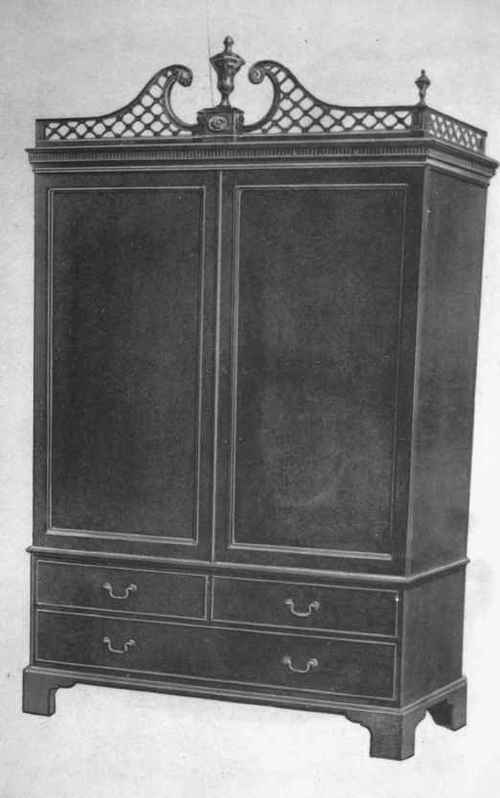
Plate XCI. Press Bedstead, Style Of Chippendale
XCI. Press Bedstead, style of Chippendale, mahogany. Mr. Stephen Neate.
Its forerunner is no doubt the desk with slanting top placed upon a frame of baluster-shaped or spiral-turned legs, with cross stretchers. Such things, though uncommon, are to be found. Later, in the mahogany period, small and slender examples in the style, of Heppelwhite and Sheraton were made for ladies, delicate inlay supplying the place of incised carving and turning. Walnut bureaux with slanting tops - especially those made of burr walnut showing a remarkably knotted grain, and of a lighter yellower colour than the usual walnut of a Stuart chair, are common enough. They are, of course, in shape absolutely allied to the mahogany period. Sets of chairs in the Chippendale style made of oak are also frequently to be found - very often with rush seats; and there will always occur instances of pieces of furniture made in woods unusual to the particular shape, whether old chest or cabinet, Stuart chair or chair of the mahogany period, to which they belong. I have lately seen a Charles II. arm-chair made entirely of ebony, a simple Queen Anne chair made of some equally heavy and extraneous wood, and Chippendale chairs of pear, walnut, and elm.
An authentic case of a Sheraton sideboard in elm has also been communicated to me.
Continue to:


My Books

