


Cane And Wood Splat-Backed Chairs
Description
This section is from the book "English Furniture", by Frederick S. Robinson. Also available from Amazon: English Furniture.
Cane And Wood Splat-Backed Chairs
The motive for this angle so near the junction of the back with the seat is not that of gaining extra thickness where the chief strain is felt to be. Greater variety of outline is obtained by it, but the thickening of the upright, if any, is small. In Chippendale's first book of 1753 the angle is still to be traced in some few chairs, but it is the exception in his case. His usual custom is to broaden the upright gradually, if it is of a plain description, until it reaches the seat.
It is not very easy to find an obvious connecting-link between the caned chairs of the end of the seventeenth century and the wooden splatted chairs which fill up the interval ensuing before the rise of Chippendale. Perhaps the cane-backed and seated example illustrated (Plate lxxxiii.i) may be taken as such. It has the rather spreading top of a chair of Louis XIV. type at Hardwick Hall, to which I have referred, and which is reproduced by Mr. F. Litchfield opposite page 116 of his History of Furniture. A similar chair appears on page 161 of Mr. T. A. Strange's French Interiors, Furniture, etc., during the Seventeenth and Eighteenth Centuries. This projecting corner of the back may be seen also on a tall chair belonging to Mr. E. Hockliffe (Plate lxix.2), with the carving of the back rounded at the ends. The arms and their supports strongly resemble those of the typical ' convex and concave' chairs in the same ownership (Plate LXVIII.3). Here, however, resemblance ends. Not one of the chairs of the last half of the seventeenth century has anything but a straight-sided seat. That of the one in question is shaped into curves in what may be taken as the Dutch manner of most of the chairs and settees which illustrate this chapter.


Plate LXVIII.
I - Chair, Oak 1660 Circa 3 - Arm-Chair, Oak 1690 Circa
4 - " " &Raquo;&Raquo;
lxviii. (1) Armchair, oak, 1660 circa.
Dimensions: Height 46¼, Breadth 23⅜, Depth from front to back 24½ inches.
(2) Chair, oak, 1660 circa.
Dimensions: Height 43¾, Breadth 19¾, Depth from front to back 21⅝ inches.
(3) Armchair, oak, 1690 circa.
Dimensions: Height 51⅛, Breadth 26, Depth from front to back 26½ inches.
(4) Armchair, oak, 1690 circa. E. Hockliffe, Esq.
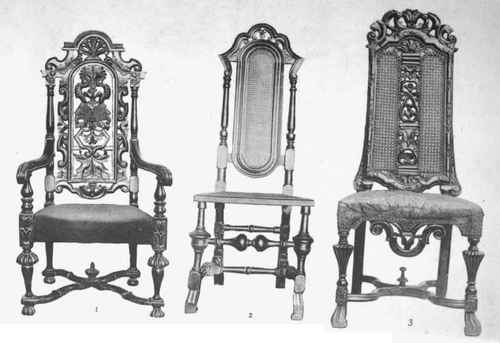
Plate LXIX.
I - Arm-Chair, Oak End Of 17th Century
2 - Chair, Walnut Late 17th Century 3 - „ ,. 1700 Circa
LXIX. (1) Armchair, oak. End of seventeenth century. Kingsbridge Church, Devon.
Height 51½ inches. By kind permission of the Vicar.
(2) Chair, walnut. Late seventeenth century.
E. Hockliffe, Esq.
Dimensions: Height 49¼, Breadth 18½, Depth from front to back 19 inches.
(3) Chair, walnut, 1700 circa. Vincent J.
Robinson, Esq.
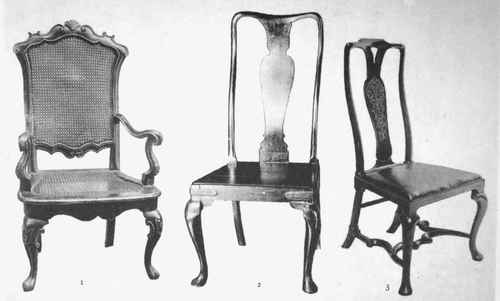
Plate LXXXIII.
I - Arm-Chair, Late 17th Or Early 18th Century
2 - Chair, Heavy Wood, Species Uncertain Late 17th Or Early 18th Century
3 - Chair, Walnut Inlaid Late 17th Or Early 18th Century
LXXXIIIi. (1) Armchair. Late seventeenth or early eighteenth century. Messrs. Waring.
(2) Chair, heavy wood, species uncertain. Late seventeenth or early eighteenth century. Sir Charles Robinson, C.B.
Dimensions : Height 40, Breadth 20, Depth from front to back 20¼ inches.
(3) Chair, walnut inlaid. Late seventeenth or early eighteenth century. One of a set. Messrs. Partridge.
Also, it has the cabriole leg, and upon that leg at the back, towards the top, appears the C-curve which marks an approximation to the mahogany period.
If we bear in mind that the interval to be filled is a bare thirty or forty years, for Chippendale had certainly made much furniture before he published his folio in 1753, we need not be surprised to find a chair composed of such different elements, or wonder if the sweep from the top of the back down to the bottom of the hind legs is distinctly Chippendalean.
Two other chairs of much simpler outline may now be adduced. These have baluster-shaped splats and undecorated uprights to their backs, such as are associated with the name of Queen Anne. The first, belonging to Sir Charles Robinson (Plate lxxxiii.2), is very plain and without stretchers. It is made of some heavy and dark wood, which is not mahogany, and it is noticeable that it has a straight-sided seat, a detail which may approximate it to the period of the cane-backed chair. The next example, one of a fine set of walnut-wood belonging to Mr. R. W. Partridge, St. James's Street (Plate LXXXIII.3), has a very similar back, the same straight-sided seat, and not very heavy cabriole legs. In addition it has elegantly shaped leg-stretchers and a beautifully inlaid back. This inlay is in the French style of Marot and similar in quality, though not in design, to that upon the long clocks which date from about 1680. Perhaps to date this chair from 1700 to 1710 would be near the mark, though it might be a decade earlier.
At least six of the remaining illustrations of this chapter show that angle some few inches above the seat in the outer edges of the back, to which attention has already been drawn. It appears to be a very marked characteristic of the Hogarthian period. Somewhere between 1720 and 1740 was the period in which this fashion reigned. Early Georgian should be its name. The scallop shell is a favourite form of decoration upon the tops of backs and legs and the fronts of seats, and walnut is the favourite wood. Not till 1720, be it remembered, is mahogany said to have been used, and even after that some time must have elapsed before a large supply came over. In any case, the chair in two positions (Plate lxxxiv.) belonging to Mr. J. Denham Smith, of Peveril Point, Swanage, Dorset, is one of a pair of a light wood of unascertained species. The Victoria and Albert Museum specimens, an arm-chair, No. 630, which is inlaid on the splat, and No. 677, are of walnut wood veneered, and walnut wood respectively (Plate Lxxxv.2). The acanthus-leaf carving on each of these is of the same quality as that of Chippendale's chairs, but the shaped fronts of their seats are typical of the kind of chair which preceded him.
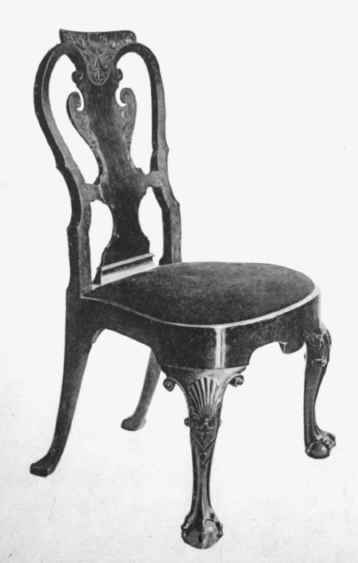

Plate LXXXIV. Two Views Of A Chair, Exotic Wood Early 18th Century
LXXXIV. Two Views of a Chair, exotic wood. Early eighteenth century. J. Denham-Smith, Esq.
The two settees (Plate lxxxvii.2, 3) in the same Museum are also of walnut wood (No. 629) and walnut wood veneered (No. 676). The first is inlaid on its splats with flowers in lighter wood. The second is noticeable for the eagles' heads at the ends of the arms. The chair (Plate lxxxv.i) and settee (Plate lxxxvii.i) decorated with lions' heads and feet are part of a splendid and numerous set, also in walnut wood, belonging to Mr. R. W. Partridge. Most of these examples have the pad-footed back legs, which may be described as pre-Chippendalean. They are not a common characteristic of his style. We are, however, approaching it very obviously in the chairs belonging to the Earl of Ancaster, and especially the one owned by Mr. W. R. Phelips, of Montacute, and No. 216 from the Victoria and Albert Museum. In all of these, however, the pad-footed back leg persists (Plate lxxxvi.). Two ordinary but useful types remain to be considered. The first is the corner chair, sometimes called 'roundabout.' Its peculiarity is that the front of the seat is not a straight line but an angle, under which projects, beyond the rest, the front leg.
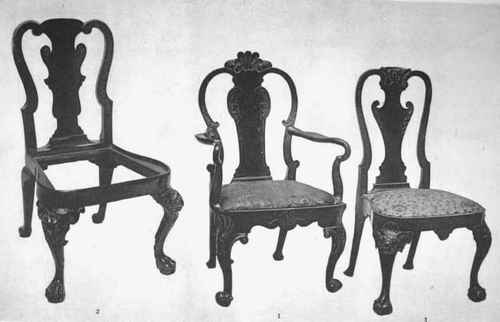
Plate LXXXV.
1 - Arm-Chair, Walnut Wood 2 - Chair,
3 - " " " 1720 . 1730 Circa
LXXXV. (1) Armchair, walnut wood. 1720-1730 circa. The back inlaid with a vase of flowers. Upholstered in crimson damask. V. & A. M.
Dimensions: Height 42, Breadth 24 inches.
(2) Chair, walnut wood. 1720-1730 circa.
Lion masks on the top of the front legs. One of a set of sixteen. Messrs. Partridge.
(3) Chair, walnut wood. 1720-1730 circa.
V. & A. M.
Dimensions: Height 40⅜, Breadth 23 inches.
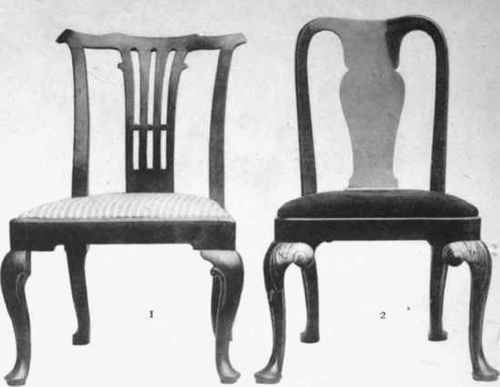
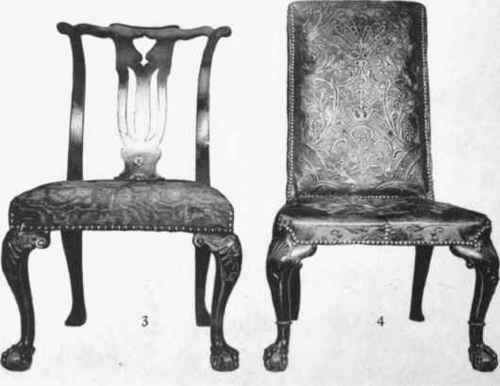
Plate LXXXVI.
I - Chair, Maple 2 - ,, Walnut
3 " "
4 - " "
Early Georgian
LXXXVI. (1) Chair, maple. Early Georgian. W. R. Phelips, Esq.
(2) Chair, walnut. Early Georgian. The
Earl of Ancaster.
(3) Chair, walnut. Early Georgian. V. & A. M.
(4) Chair, walnut. Early Georgian. Upholstered in French stamped leather. V. & A. M.

Plate LXXXVII.
I - Settee, Walnut Veneer Or Walnut Early 18th Century
2 - ,, „ 1st Half 18th Century
3 ≫&Raquo; " " "
LXXXVII. (1) Settee, walnut veneer and walnut. Early eighteenth century. With lion masks, en suite with lxxxv. (2). Messrs. Partridge. (2) Settee, walnut. First half of eighteenth century. The back is inlaid with vases of flowers. V. & A. M.
Dimensions: Height 42, Length 52 inches.
(3) Settee, walnut, veneered. First half of eighteenth century. V. & A. M.
Dimensions : Height 42¼, Length 50¼.
The example illustrated is one of a remarkably good pair, of mahogany, in the Victoria and Albert Museum, No. 312. It is assigned to the second half of the eighteenth century, but from its splat and finialled cross-stretchers and other peculiarities, it may safely be assigned to the first half. Plainer oaken specimens are common enough in the country (Plate XCII.2).


Plate XCII
I - Arm-Chair, Mahogany, Chippendale About 1745
2 - Arm-Chair, One Of A Pair, Mahogany First Half Of 18th Century
XCII. (1) Armchair, mahogany. Chippendale. About 1745. Used by the Master of the Grocers' Company, and carrying their arms and badge. Upholstered in green morocco. The Worshipful Company of Grocers.
(2) Armchair, one of a pair, mahogany. First half of eighteenth century. V. & A. M.
Continue to:


My Books

