


Dutch Shape
Description
This section is from the book "English Furniture", by Frederick S. Robinson. Also available from Amazon: English Furniture.
Dutch Shape
The seat is extra broad and rounded at the side, or if the sides are flat the front is considerably wider than the back. It is a playful habit to ascribe this to the peculiarities of the Dutchman's build, but whether there was a difference or not in that respect between the two nations, our forefathers seem to have adopted the Dutch proportion or 'line of beauty' with equanimity.
The cabriole legs are broad across the top, and end either in claw-and-ball or pad feet, as the case may be, whilst leg-rails, as we have seen, have ceased to be a necessity.
To return to the back, the splat is seldom pierced. An extremely common form of ornament at the top of the back, and one considered pre-eminently Dutch, is a scallop shell, which also often appears upon the top of the cabriole legs (Plates lxxxiii.i, LXXXVI.4, lxxxvii.2). All crowns and cherubs' heads have disappeared,but the acanthus-leaf is still in use to edge the top of the back, the sides of the splat, and the front of the seat, occasionally.
As to the shape of the splat, there is an austere type of chair in which it has perfectly parallel sides. One of these, in oak with a rush seat - all very plain - is to be seen at Hampton Court. The most typical shape, however, is that which may be described as spoon or fiddle-backed. A great bulged shape, like the lower part of a fiddle held uppermost, makes the top of the splat; this hollows in like the waist of the fiddle at the centre of the splat; spreads out again to an angle or a curve at the small of the back; and finishes with a concave towards the junction with the seat (Plates lxxxiv., lxxxvii.i, 2). Sometimes the splat ends on a cross-rail, but in the great majority of cases it joins the seat exactly as does the splat of the Chippendale chair. The one is in fact the forerunner and first model of the other.
In some chairs the splat may be described as approaching rather to the baluster shape (Plate Lxxxv.2) than to the fiddle, especially when the mouldings across the bottom where it joins the seat are of an architectural character. Later on a 'vase' shape (Plate Lxxxv.3) is a more appropriate description, as in many of the chairs described as 'Hogarth' chairs, perhaps because in the artist's portrait of himself painting the comic muse he is seated upon a very clumsy and pronounced specimen of the class. This vase shape is formed by the broader part of the splat being decorated on the edge with acanthus-leaf carving. The end of the stalk is uppermost, and finishes in a volute suggestive of a pair of rudimentary handles on the shoulders of a vase (Plates lxxxiv. and Lxxxv.3). Sometimes, as in Plate lxxxiv., the splat is joined to the outer uprights of the back by horizontal cross-pieces.
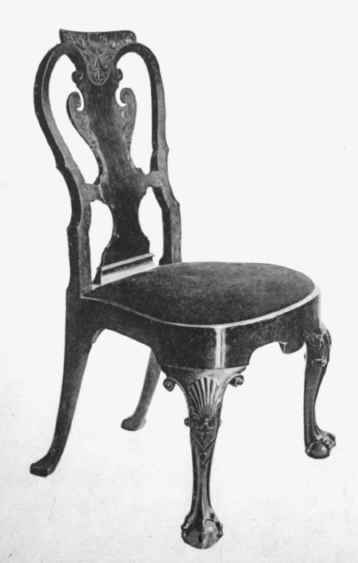

Plate LXXXIV. Two Views Of A Chair, Exotic Wood Early 18th Century
LXXXIV. Two Views of a Chair, exotic wood. Early eighteenth century. J. Denham-Smith, Esq.
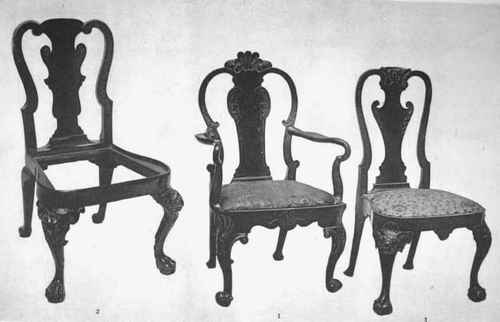
Plate LXXXV.
1 - Arm-Chair, Walnut Wood 2 - Chair,
3 - " " " 1720 . 1730 Circa
LXXXV. (1) Armchair, walnut wood. 1720-1730 circa. The back inlaid with a vase of flowers. Upholstered in crimson damask. V. & A. M.
Dimensions: Height 42, Breadth 24 inches.
(2) Chair, walnut wood. 1720-1730 circa.
Lion masks on the top of the front legs. One of a set of sixteen. Messrs. Partridge.
(3) Chair, walnut wood. 1720-1730 circa.
V. & A. M.
Dimensions: Height 40⅜, Breadth 23 inches.
In these latter chairs there is an almost invariable shape for the lower parts of the two outer uprights of the back. For a few inches above the seat there is nearly always a straight piece with an angular outside shoulder. This is formed by the junction of the straight with the longish shallow concave of the outline in the upper part of the uprights. Hogarth flourished from about 1720 to 1764, so that this detailed description embraces a rather long period. As, however, this particular angle in the outline of the upright is to be found on the much earlier Hampton Court chair before mentioned, we are justified in considering the chairs of the end of the seventeenth and first half of the eighteenth century as very much of one type. The resemblances are indeed striking, both in general shape and in detail of ornamentation.
Continue to:


My Books

