


Kensington And Hampton Court
Description
This section is from the book "English Furniture", by Frederick S. Robinson. Also available from Amazon: English Furniture.
Kensington And Hampton Court
Kensington Palace and Hampton Court Palace are two of the most convenient instances of the combined efforts of Sir Christopher Wren and Grinling Gibbons. The same moulding is to be found in the orangery at Kensington as in many of the palace rooms. One of the great differences between the earlier seventeenth century details and those of Wren lies in his use of 'bolection mouldings' - mouldings, that is, which project beyond the stile upon which they are placed. Among the specimens in Plate x., a rough sketch will be found to explain the change. The typical seventeenth-century moulding does not project in front of the stile. Wren's panels are raised and splayed, that is, they have a central parallelogram surrounded by a bevelled edge, like that of a plate-glass mirror, but with the addition of a step down from the parallelogram to the bevel. The ovolo and the ogee, with fillets, are used to compose the mouldings. It is interesting to compare Wren's rooms, decorated by Gibbons, with those of the vastly inferior Kent. Queen Caroline's drawing-room by the latter has much plainer panelling, the stile and the panel being very much on the same level, and edged with the same moulding, a round and a fillet. The inferiority of Kent is apparent in this and in his style of overdoor arrangement.
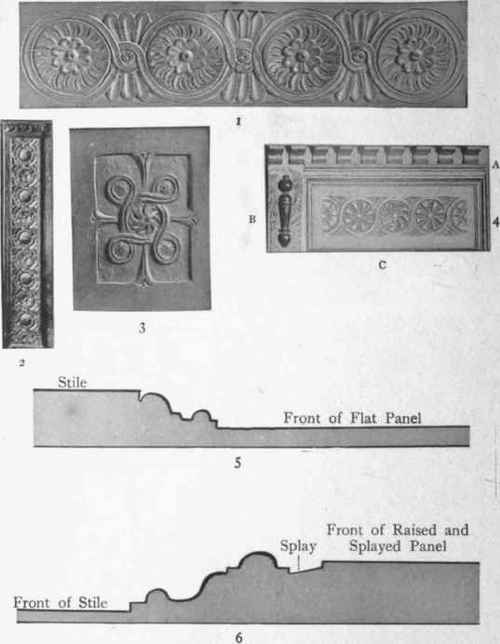
Plate X.
I - Guilloche, With A "Faggot" Shape Between The Circles
2 - Variety Of The Guilloche
3 - "Guilloched Quincunx" As A Panel Ornament
4 - A - Dental Course, Ogee Moulded
B - "Turned Half-Pendant," Applied
C - Panel With Plain Guilloche - No Small Intervening Circle 5 - Typical Moulding On Edge Of A Stile; And Flat Panel. Stile In Front Of Panel, Early Part Of The 17th Century 6 - Typical Bolection Moulding, I.E. Moulding Projecting In Front Of Stile. Panel "Raised And Splayed," And In Front Of Stile. Wren's Mouldings, Hampton Court, End Of 17th And Early 18th Century
x. Specimens - the Guilloche and Typical Mouldings.
(1) Guilloche, with a ' faggot'-shape between the circles.
(2) Variety of the guilloche.
(3) ' Guilloched quincunx' as a panel ornament.
(4) a. Dental course, ogee moulded.
b. ' Turned half-pendant,' applied.
c. Panel with plain guilloche - no small intervening circle.
(5) Typical moulding on edge of a stile ; and flat panel. Stile in front of panel. Early part of the seventeenth century.
(6) Typical ' Bolection' moulding, i.e. moulding projecting in front of stile. Panel, ' raised and splayed,' and in front of stile. Wren's mouldings, Hampton Court. End of seventeenth and early eighteenth century.
In the King's Gallery, 1691 -1696, the overdoor of Wren and Gibbons is beautiful. The mouldings are carved with egg and dart and leafage, and the general outline is well composed. If there is a fault, it lies in the extreme elaboration of the high-placed cornice of the room as compared with the less intricacy of the door-tops. The turn-down of the acanthus-leaves of the cornice is in full relief. Kent's style of doorway is an upright parallelogram, with a narrow one crossing it like the top of a T, - a very jejune affair in comparison with those of his predecessors.
Turned balusters for staircases with Wren are more complicated than those of a previous period, if we leave the spiral turning out of account. On the queen's staircase examples are to be seen, which if compared with the bulbous legs of the chair belonging to Mr. E. Hockliffe (Plate LXIX.3) will give a pretty conclusive idea of its date. In the presence-chamber is a chimneypiece by Gibbons, with hanging draperies and cherubs in the style of the table illustrated, belonging to Mr. Seymour Lucas, R.A. This is a convenient instance for observing the wonderful technique of Gibbons ; the draperies are absolutely hollow. Standing beneath, it is possible to look up into and through their folds. Also, where the effects of time have dealt unkindly with the flower-work, may be noticed his system of pinning outlying pieces, a method often necessary in such intricate overlay of leafage, flowers, and fruit.
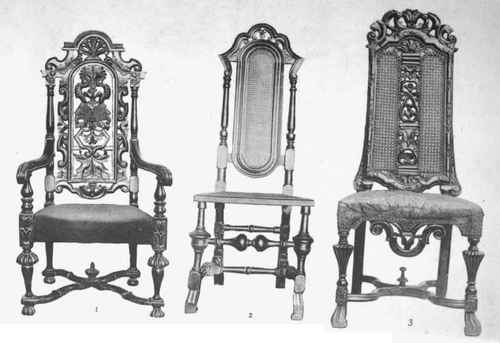
Plate LXIX.
I - Arm-Chair, Oak End Of 17th Century
2 - Chair, Walnut Late 17th Century 3 - „ ,. 1700 Circa
LXIX. (1) Armchair, oak. End of seventeenth century. Kingsbridge Church, Devon.
Height 51½ inches. By kind permission of the Vicar.
(2) Chair, walnut. Late seventeenth century.
E. Hockliffe, Esq.
Dimensions: Height 49¼, Breadth 18½, Depth from front to back 19 inches.
(3) Chair, walnut, 1700 circa. Vincent J.
Robinson, Esq.
Practically the same panel mouldings, with slight variations, will be found in Wren's and Gibbons's work at Hampton Court Palace. In the guard-chamber, on the doors, one round and fillet is omitted, but in the audience-chamber the Kensington Palace moulding will be found. The doorways of the queen's gallery have the same shape as that described in the king's gallery at Kensington.
Many mirrors are here to be seen. In the king's first presence-chamber are three gilt ones between the windows, with tops recalling the tops of chairs. In the audience-chamber the mirrors are entirely of glass, which is cut with a flower pattern on the borders. Outside of these is a flat frame of glass, with scalloped edges. In the king's bedroom is another entirely of glass, with a blue border and William's monogram. The writing-closet has a gilt mirror surmounted by an eagle, and strap-work on its side pilasters in the style of Marot. In the queen's gallery are six curious mirrors, rectangular in shape, in very thin black frames with modern oak edgings. They are painted with flower-trails in red, green, yellow, and white.
Continue to:


My Books

