


The Guilloche
Description
This section is from the book "English Furniture", by Frederick S. Robinson. Also available from Amazon: English Furniture.
The Guilloche
It has to be admitted that many of the easily copied common patterns, which from their presence on simply carved furniture appearing to be typically English, we might fancy to be indigenous, come straight from Italy. Widest spread of all is perhaps the 'guilloche,' which may be described as a continuous strap ornament, forming a succession of circles. The series may be single, double, or even triple, but a very usual shape on English furniture is a single line of large circles, with smaller ones intervening. An illustration of it is included amongst our 'Specimens.'2 This particular example from the front of a box in the writer's possession has three loops on each side of the small circle, filling up the space between the larger ones. A better example still is in the possession of Mr. J. E. Clifton, Swanage, Dorset, also on a box. Now this pattern, in which the loops might suggest a faggot shape, when taken by themselves, tied up by the small circles, is found on an Italian cross reproduced in Libonis' Specimens of Crosses. It is probably one of those votive crosses of some size to be found hung up in Venetian churches.
The guilloche without the small intervening circle, and twisted so tight as to leave very little open centre, is common in England and Italy, and is to be found in Byzantine ornament, whence it was borrowed at the Renaissance.1 Such simple patterns furnish out the decorative scheme of much English provincial oak furniture, to the exclusion of others upon the Italian cassone mentioned before, which our workmen in the long run appear not to have approved. This abnegation of certain patterns may be attributed either to our want of sculpturesque carving skill, or to the reticence and soberness of English ideas, or finally to the hardness of our English oak. Italian and French chefs-d'oeuvre are mostly in the more amenable walnut. Perhaps our workmen avoided such things as the boldly carved lions of the cassone because they preferred not to blunt their chisels in ambitious efforts which might have been unsuccessful.
1 'Terminal' - a word which the writer begs leave to use to express the tapering form only of the classical * term' or pedestal of a bust.
2 Plate x.
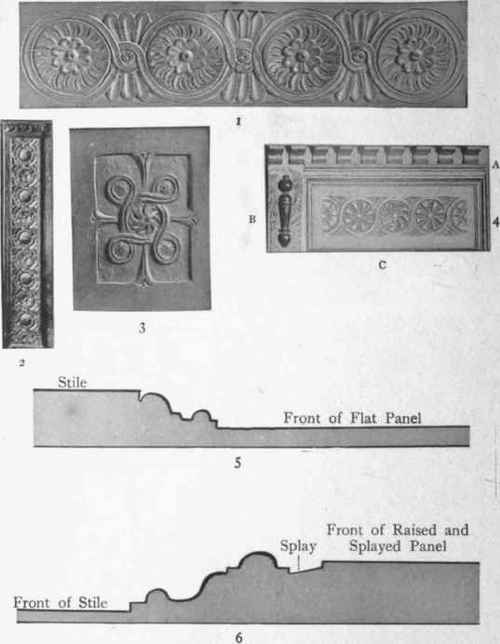
Plate X.
I - Guilloche, With A "Faggot" Shape Between The Circles
2 - Variety Of The Guilloche
3 - "Guilloched Quincunx" As A Panel Ornament
4 - A - Dental Course, Ogee Moulded
B - "Turned Half-Pendant," Applied
C - Panel With Plain Guilloche - No Small Intervening Circle 5 - Typical Moulding On Edge Of A Stile; And Flat Panel. Stile In Front Of Panel, Early Part Of The 17th Century 6 - Typical Bolection Moulding, I.E. Moulding Projecting In Front Of Stile. Panel "Raised And Splayed," And In Front Of Stile. Wren's Mouldings, Hampton Court, End Of 17th And Early 18th Century
x. Specimens - the Guilloche and Typical Mouldings.
(1) Guilloche, with a ' faggot'-shape between the circles.
(2) Variety of the guilloche.
(3) ' Guilloched quincunx' as a panel ornament.
(4) a. Dental course, ogee moulded.
b. ' Turned half-pendant,' applied.
c. Panel with plain guilloche - no small intervening circle.
(5) Typical moulding on edge of a stile ; and flat panel. Stile in front of panel. Early part of the seventeenth century.
(6) Typical ' Bolection' moulding, i.e. moulding projecting in front of stile. Panel, ' raised and splayed,' and in front of stile. Wren's mouldings, Hampton Court. End of seventeenth and early eighteenth century.
The change of religion in 1536, and the impoverishment consequent upon Henry VIII.'s enormous expenditure, left, as we have seen, the Italians after a time little to do in England. The field was occupied by the Germans and Flemings, and with their aid the great Elizabethan houses, of which Charlecote, Warwickshire, 1556, is the earliest, were built. Burghley was built and ornamented by Germans in the years 1577 to 1587. Whereas the Italians had favoured our South Coasts, the Flemish influence had always been strong upon the East. There began a great importation from Flanders of ornamental cabinet fronts and other such things, to be made up in England, and these were the successors of the 'Flanders chests' of the Gothic period which are still to be found in some of our parish churches. These successors to the Italian coarsened the Renaissance inspiration. Their influence may be found in the male and female figures with strapwork on their fronts in lieu of clothes, the 'round and square' strapwork of table-borders, and the gadroon which appears on bed-posts and the fronts of cabinet drawers.
The use of much formal strapwork, either cut in the solid or applied to panels, is characteristic of the North European influence which followed that of the Italians. To the Flemings also we may attribute the increased heaviness of great diamond shapes superimposed upon square panels, and the numerous jutting or 'returning' angles and circles formed by applied mouldings set in all directions upon the panels of cabinets, so as sometimes almost to suggest a resemblance to the ground-plan of a fortress. They, too, are responsible perhaps for the excessive use of turned work, glued to stiles of panels on beds, cabinets, and chairs - generally in pillar or pilaster shapes; of round applied buttons, facetted shapes, and heavy ovals set in relief upon panels; of drop ornaments added below table frames, and the centre of arches in arched panels.
1 The close-twisted guilloche is found in Assyrian art, e.g. on part of a glazed brick in the British Museum.
Continue to:


My Books

