


Arms Of Oak Chairs
Description
This section is from the book "English Furniture", by Frederick S. Robinson. Also available from Amazon: English Furniture.
Arms Of Oak Chairs
Every one of the five chairs mentioned has the same type of arm. It slopes downwards from the back, and has a concave curve in the middle, with a more or less emphasised curve on the lower side of the arm to correspond. There is often at the ends of the lower side-curve a very decided notch. This may be best seen in the reproduction (Plate LIV.2) of an arm-chair belonging to Mr. A. J. James, of Edgeworth Manor, Cirencester. This chair, dated 1631, and initialled W. S. W., has suffered from the effects of time. Its S side-pieces are missing, the abutment of one being plainly visible. It also wants its rails and the lower part of its legs. Even as it is, the bold and vigorous manner in which the S-curves at the top of the back are fashioned into dragons' heads on each side of a cartouche, and the rather exceptional elaboration of its main panel, make it a handsome relic. It has been up to the present time in the family which originally owned it, W. S. W. standing for William and Sarah Wiggle.
In this chair it may be noticed that the supports of the arms are rather higher than those of the chair in Plate liii.2, which is fifty years later, and than those of LIII.3, also a late seventeenth-century chair. Those of the chair in LIV.3 are also higher in proportion than most. This is of the earlier and rare ' caqueteuse' or 'conversational' type. It is generally supposed that higher arm-supports imply an earlier chair, but it stands to reason that considerations of convenience preclude any very marked differences of height. As for judging by the slant of the arms, it was probably a question of taste, as the variation between Nos. liii.2 and L111.3 seems to suggest.
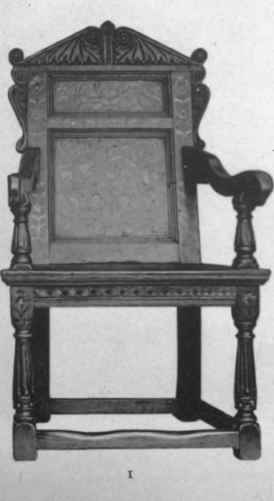
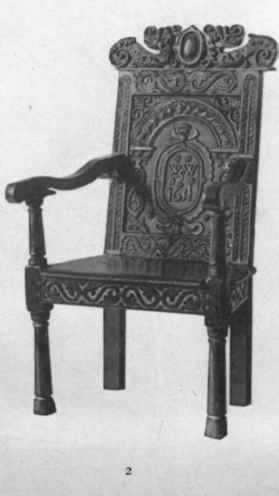
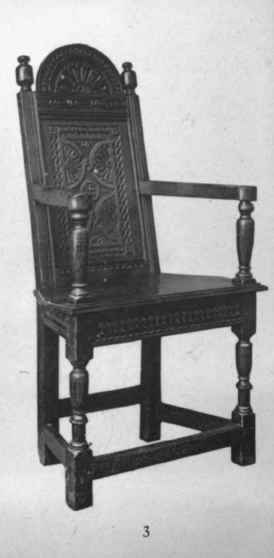
Plate LIV. 1 - Arm-Chair, Oak Late 16th Or Early 17th Century 2 - Arm-Chair, Oak 1631
LIV. (1) Armchair, oak, inlaid. Late sixteenth or early seventeenth century. V. & A. M. (2) Armchair, oak, 1631. William and Sarah Wiggle. The top of back shows S-curves shaped as dragons. A. J. James, Esq.
(3) Armchair, oak. Early seventeenth century. ' Caqueteuse' shape. J. E. Clifton, Esq.
Dimensions: Height 51, Breadth 27, Depth from front to back 17¼ inches.
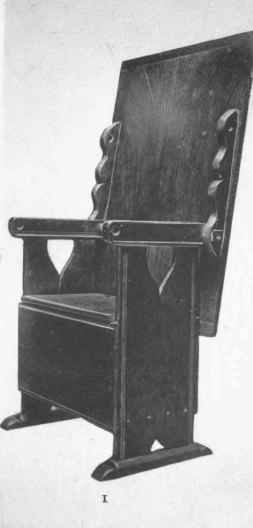

Plate LIII. 1 - Chair-Table, Oak I 7th Century 2 - Table, Inlaid About 1700
LIII. (1) Chair Table, oak. Seventeenth century. Sir Charles Robinson, C.B.
Dimensions: Height as chair 51½ inches, Width of seat 21½ inches, Length of table top 37 inches, Width 25 inches.
(2) Table, inlaid. About 1700. V. & A. M.
Dimensions: Height 31, Length 36, Breadth 31 inches.
An entirely different shape of arm is to be seen in the 'caqueteuse' chair belonging to Mr. J. E. Clifton, of Old Bank House, Swanage, Dorset. This example (Plate Liv.3), with a fan-patterned semicircle at the top of its back and heavy finials on each side, has arms practically without any slope, and flat on the top. To make up, they are sawn so as to spread out and form obtuse angles, thus making the chair much wider at the front than at the back. Consequently the back panel is a narrow one. The fan above is bordered with small circles overlapping, so as to form imbrications. The panel is carved with the fan pattern in a guilloched strap. There is a border of a close oblique guilloche or cable shape, and the same appears under the seat. All the planks of this chair vary in thickness, and show, perhaps, the results of splitting with a 'river.' It comes from Luke's Farm, near Romsey, Hants, whence also was taken the interesting bed in Mr. Clifton's possession, which has been described and reproduced. This type of chair may be compared with certain French chairs in the Victoria and Albert Museum. No. 740 is a walnut-wood chair with seat boxed in. Its back, like that of Mr. Clifton's chair, is narrow, and the arms curve to fit on to a broader front.
Except for a coat of arms in the back panel, the leaf, circle, and other ornamentation might be English. This chair is assigned to the second half of the sixteenth century, at the end of which Mr. Clifton's chair was very probably made. A very fine example of this bent-arm type may be seen in the chancel of the church near Athelhampton, close to Puddletown, Dorset. On the top of the back are two dogs leashed, and facing each other; and the back panel contains very good strap-work. A curious effect has been produced by the attempt to make a Charles II. open-backed chair and this 'caqueteuse 'more of a pair. The angulated arms have been copied and added to the Charles II. example, with most incongruous results.
Continue to:


My Books

