


Incongruities
Description
This section is from the book "English Furniture", by Frederick S. Robinson. Also available from Amazon: English Furniture.
Incongruities
A somewhat exceptional chair (Plate lv.i) is in St. Michael's Church, St. Albans. This has a heavy semi-circular top-piece carved with a cherub's head and wings. The central panel is rather ingeniously filled with a kneeling cherub with extremely conventional folds in its gown.


Plate LV.
1 - Arm-Chair, Oak 17th Century
2 - Arm-Chair, Oak " I.P. 1670"
3 - Arm-Chair, Oak I 7th Century
lv. (1) Armchair, oak. Seventeenth century. St. Michael's Church, St. Albans.
By kind permission of the Rector.
(2) Armchair, oak. 'LP. 1670.' Shows flattened
S-curves as top and side pieces. V. & A. M.
Dimensions : Height 53, Breadth 27 inches.
(3) Armchair, oak. Seventeenth century. Shows
S-curves in an arch. V. & A. M.
The want of unity between the top and bottom of the oak chair to which I have referred, is well exemplified in an example (Plate LV.3) from the Victoria and Albert Museum, No. 230. The turning of the legs and arm-supports suggests that it was made not very long before, or after, the spiral-turned chair of Charles 11. came into fashion. There appears to be a want of harmony between the turned work and the incised carving which that particular combination inherently entails.
The decorated front stretcher of the Charles 11. chair was indeed a great invention for carrying out the scheme of the back design. It is to be noticed that in the chair dated 1670, which is mentioned earlier in this chapter, there is a more or less successful effort to adorn both the front of the seat and the front stretcher or rail, which is exactly what might be expected in a chair made at so late a date, when the cane-backed, spiral-turned Charles 11. chair was well introduced.
Our series would be most incomplete without specimens of the chairs made for children. They are, of course, longer in the leg, proportionately, than the adults' oak chair, and another peculiarity which their special use entails is very apparent in some examples. The base is made, for increase of stability, considerably broader than the top. No. 397 in the Victoria and Albert Museum (Plate lvi.i) is a very good instance, with a conventional flower-carved panel, and a semicircle on the upper and lower rails of the back. The round bosses on the lower back rail, and at each end of the seat, are somewhat peculiar. A stouter, more squat example (Plate lvi.2) was exhibited for some time in the Museum, and is reproduced in Mr. E. Chancellor's book of specimens of furniture. It has two acorn finials on the top of the back, and between them three small semicircles projecting above the top rail. Upon this is a guilloche. On the uprights are the upright leaf pattern, and on the lower rail a cable. The under side of the seat front is nicely shaped.
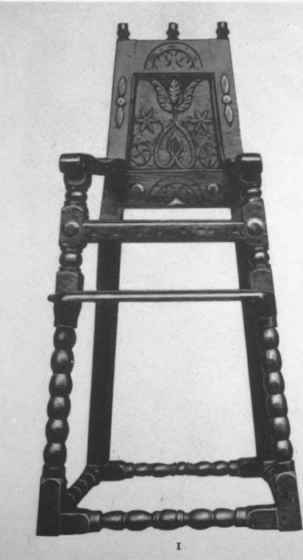
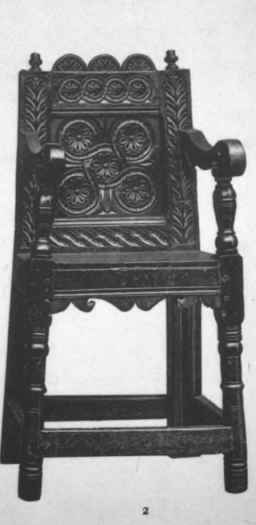
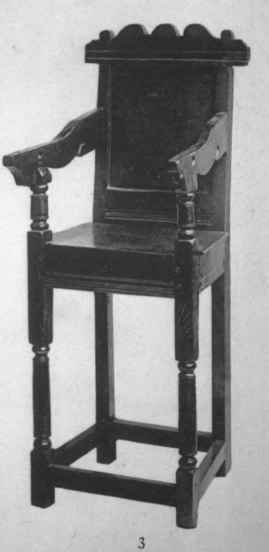
Plate LVI.
1 - Child's Arm-Chair, Oak Early 17th Century 2 - Child's Arm-Chair, Oak Early 17th Century 3 - Child's Arm-Chair, Oak 17th Century
LVI. (1) Armchair, child's, oak. Early seventeenth century. V. & A. M.
Dimensions: Height 40½, Breadth 19½ inches.
(2) Armchair, child's, oak. Early seventeenth century. V. & A. M.
(3) Armchair, child's, oak. Seventeenth century.
From an old house at Stoke Albany, near Market Harborough. Mr. W. H. Bliss.
Much plainer, but still interesting, as being of a rather different type, is the example (Plate LVI.3) belonging to Mr. W. H. Bliss of Easton, Stamford. This is a straight-sided chair, and resembles more closely the children's chairs of the Charles 11. period, which are no more remarkable for breadth of base.
The settle may conveniently here be mentioned. It will be seen from our illustration (Plate lvii.i) that its ornamentation and general shape are very similar to that of the chair. There are the side brackets which, in this particular instance, are not S-curves. The arms are exactly of the curved and notched type, and the lower part well exemplifies the objection which I have made to the chair design of this period, that it tends to ornament the upper at the expense of the lower part.
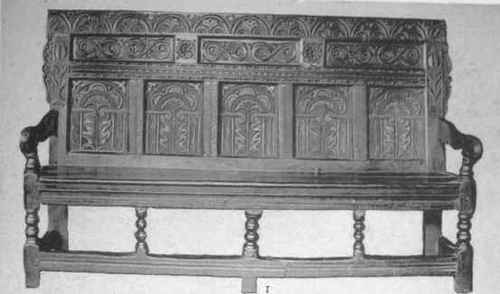
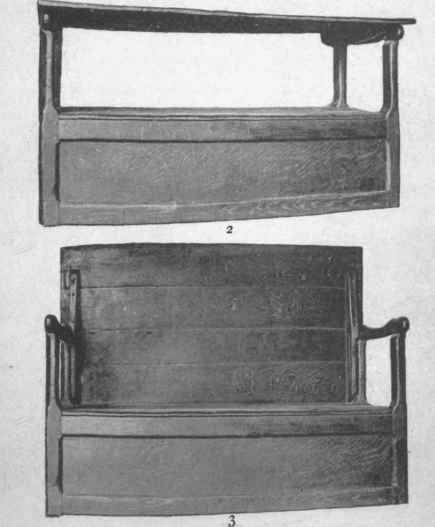
Plate LVII. I - Oak Settle 17th Century 2 And 3 - Oak Settle And Table Combined 17th Century
LVII. (1) Settle, oak. Seventeenth century. Sir Charles Robinson, C.B.
Dimensions: Length 70, Height 41½, Depth from front to back 23 inches.
(2) Settle, oak, and table combined.
(3) The same. Rev. F. Meyrick-Jones.
Dimensions: Length 54, Height as table 29½, Width 28f inches.
This specimen is in the possession of Sir Charles Robinson, Newton Manor, Swanage, Dorset. A good one of the same type is illustrated by Mr. Litchfield in his History of Furniture, and is there said to be probably from Yorkshire. We hear occasionally of elaborate specimens of oak settles with very tall backs, and sometimes a cupboard in them, and a box under the seat. Those who refer to them like to call them 'Monks' settles.' In that case they should be Pre-Reformation objects. The writer has never had the good fortune to come across one or even to see an illustration of any authentic specimen. In the south transept of Winchester Cathedral are two settles of early date, but they do not answer the description of the 'Monks' settle,' though monks may have sat on them. One is very long and massive, with a back formed of two uprights and a cross-piece. The uprights are finished with what once were crosses. The ends of the arms are circular, and carved each with a flower of six slender-pointed petals. The back is filled in with shingles, after the fashion of a clinch-built boat. The other settle is shorter and of later date, without ornament of any kind.
It is impossible to attribute a decided genuineness to the only example of a settle which is at present in the Victoria and Albert Museum. The writer is inclined to the opinion that most 'Monks' settles,' so called, would turn out to be concoctions made out of old bedsteads.
Continue to:


My Books

