


Meyrick And Shaw
Description
This section is from the book "English Furniture", by Frederick S. Robinson. Also available from Amazon: English Furniture.
Meyrick And Shaw
In 1236 the king's treasurer is commanded 'to have the great chamber of the king at Westminster painted with good green colour in imitation of a curtain, and in the great gable of the same chamber, near the door, to have painted the following game, Qui ne donne ce qu'il tient, ne prend ce qu'il desire, and also the little wardrobe of the king to have painted with green colour in the fashion of a curtain.'
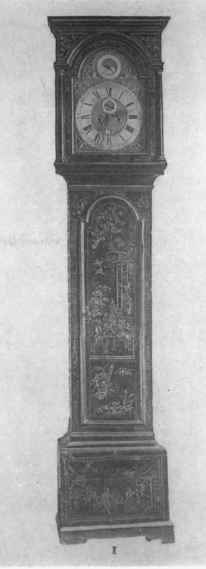
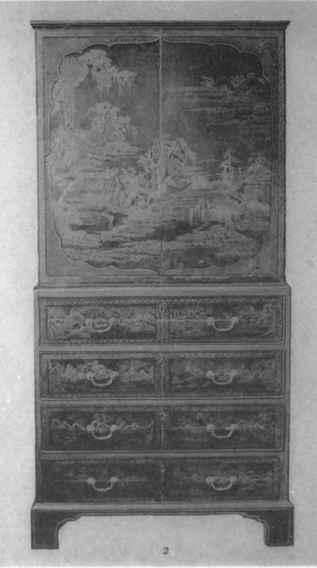
Plate CLIX.
I - Clock And
2 - Wardrobe, Lacquered In Japanese Style, 18th Century
CLIX. (1) Clock, lacquered in Japanese style. Eighteenth century. C. K. Morris, Esq. (the late).
(2) Wardrobe, lacquered perhaps in Japan and made up in England. Eighteenth century. Sir Charles Robinson, C.B.
Dimensions : Height 67½, Breadth 32⅝, Depth from front to back 21⅞ inches.
The representation of a curtain is the precursor of the actual and movable tapestry hanging. By the motto called a game' is probably implied a maxim or favourite quotation in some round game popular at the time.1
Another order of 1239 commands that money be paid ' for oil varnish and colours, and for making pictures in the chamber of our queen at Westminster. If we may infer from this that there the paintings were in oil colours, it is unnecessary to defer the date of their use in England until the invention, whatever it may have been, of H. Van Eyck. In his book upon Ancient Coffers and Cupboards, Mr. Fred Roe has illustrated a coffer from Newport Church, Essex, dating from the thirteenth century, the painting of which, he says, 'proves conclusively that oil was used as a vehicle in England at this early period. It may be regarded as the earliest national specimen of that art remaining.'
1 ' The chamber and its paintings were wholly destroyed after the fire of 1834.' See the article by Mr. W. R. Lethaby in the Burlington Magazine, July 1905.
An order of 1252 shows that coloured glass was used in such places as the castle of Northampton, and was not confined to ecclesiastical buildings. Henry III. orders the sheriff of Nottingham 'to have painted in the chamber of our queen at Nottingham the history of Alexander round about it.' Again, in 1260, the king's pictures at Windsor are to be restored, and the sheriff of Surrey is commanded to repair those 'in our great hall at Guldeford, and in our great chamber there, on the blank wall at the head of our bed, to have painted the resemblance of a curtain or hanging.' From this we learn the persistence of an evil fashion, and the fact that bedrooms were ornamented besides great halls.
Subjects from contemporary history appear, besides legends. Langton, Bishop of Lichfield, commanded in 1312 the coronation, marriages, wars, and funeral of his patron Edward 1. to be painted in the great hall of his new palace; and Symeon, a friar and doctor in theology, in an itinerary of 1322, mentions that near 'this monastery' (Westminster Abbey) 'is the royal palace of England in which is that well-known chamber on whose walls all the warlike histories of the Bible are painted with inexpressible skill, and explained by a regular series of texts beautifully written in French over each battle. . . .'
From these extracts we derive a more definite notion of the furnishing of the walls of a room. We learn that they were wainscotted and painted - probably in oil colours. Considerable sums were paid for this painting, but we must agree with Horace Walpole that though it may have excited the admiration of Symeon the friar, its realism would not impose upon modern discernment.
Continue to:


My Books

