


Settles
Description
This section is from the book "English Furniture", by Frederick S. Robinson. Also available from Amazon: English Furniture.
Settles
A settle and table combined is reproduced here (Plate lvii.2, 3) from the collection of the Rev. F. Meyrick-Jones, 292 Lancaster Road, Notting Hill. This is uncarved, and has a boxed-in seat. The flanges in the back have a long slit in the lower half, into which fits a peg on the inside of the back of the arm. The back is raised and drawn forwards to serve as a table top as far as the play of the peg in the slit allows. It would not be easy to say precisely at what time in the seventeenth century this interesting example was made.
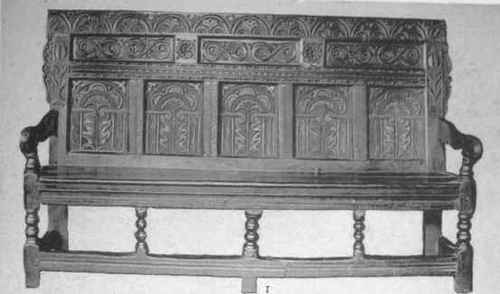
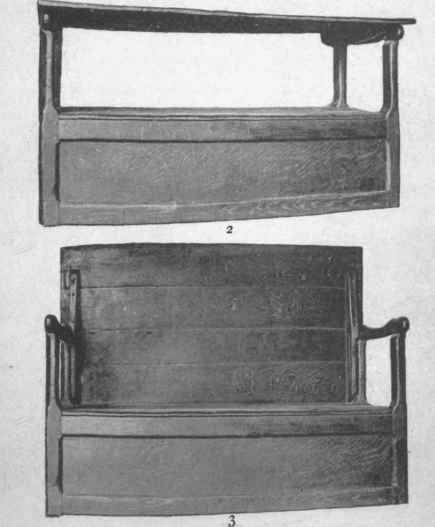
Plate LVII. I - Oak Settle 17th Century 2 And 3 - Oak Settle And Table Combined 17th Century
LVII. (1) Settle, oak. Seventeenth century. Sir Charles Robinson, C.B.
Dimensions: Length 70, Height 41½, Depth from front to back 23 inches.
(2) Settle, oak, and table combined.
(3) The same. Rev. F. Meyrick-Jones.
Dimensions: Length 54, Height as table 29½, Width 28f inches.
It is probable that the step from solid-backed chairs to those with open backs and rails was not made all at once. There seems to be an intermediate stage, in which arms first disappear, and then the back, left solid above, is opened below. Good examples are reproduced from the Victoria and Albert Museum. No. 244 (Plate lviii.) is an armless solid-backed chair with its upper rail shaped in a fashion which appears to have been popular in the northern counties, especially Lancashire.
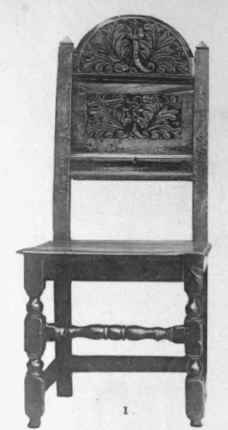
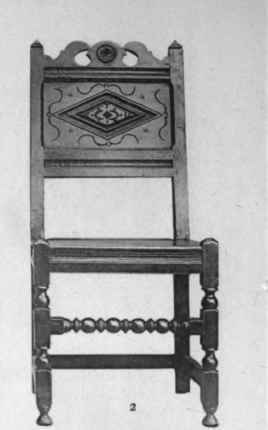
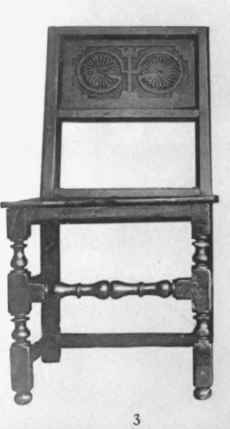
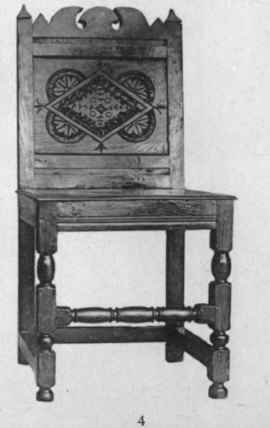
Plate LVIII. 1 - Chair, Oak 17th Century
lviii. (1) Chair, oak, seventeenth century, from Lancashire.
(2) Chair, oak, seventeenth century, from Lancashire.
(3) Chair, oak, seventeenth century, from Lancashire.
(4) Chair, oak, seventeenth century, from Lancashire. All in V. & A. M.
The next stage is very well shown by another Lancashire chair, No. 248 (Plate lviii.), with extremely similar top rail, which in this case has a central incised ornament. In this chair two-fifths of the back have disappeared, and the field for the carver is considerably restricted. Neither example nor their companions, Nos. 243 and 2471, show very much to boast of on the panel at which in solid-backed chairs we are accustomed first to look, in order to judge how the carver has acquitted himself where he has widest scope. With the disappearance of opportunities, the inventiveness of the carver perhaps diminished, until a different style presented itself in the cane-backed chair, with possibilities of something fresh. We cannot but regret the abandonment of those broad surfaces roughened with ridgy carving which catch the light in a manner so delightful to the eye as they project from their ground. Yet this rough-hewn, solid, weighty style, after a long day, had said its last word. Something new was required, more in keeping with a wide increase in the amenities of life.
Those monumental chairs were suited to what John Evelyn in his diary describes as the 'old English hospitality,' which, he says, was matched by the character of the houses of the period of Henry VIII. and Elizabeth. Heavy, rough furniture which would stand unlimited wear and tear was necessary to such house-keeping as that - a real habit of life - not a mere empty phrase. Under date of October 4, 1699, Evelyn mentions the death of his brother at Wotton, 'of so hospitable a nature, that no family in the county maintained that antient custom of keeping, as it were, open house the whole yeare in the same manner, or gave more noble or free entertainment to the county on all occasions, so that his house was never free. There were sometimes 20 persons more than his family, and some that staid there all the summer, to his no small expence; by this he gain'd the universal love of the county' - and small wonder too. Nor was he an entirely exceptional instance, for Evelyn mentions but a few pages further on the Carews of Beddington, who used to practise that same liberality which was 'now decaying with the house itself.'
Continue to:


My Books

