


Insular Prejudice
Description
This section is from the book "English Furniture", by Frederick S. Robinson. Also available from Amazon: English Furniture.
Insular Prejudice
A leather-backed and seated oak chair (No. 94, Victoria and Albert Museum) is reproduced in Plate lxvi. 1, and answers to the description, except in one particular. It has a carved front stretcher rudely imitating a cherub's head and wings, and those successors to the S-curve of the old oak period, which we shall find are a special characteristic of the chair of about 1690. The cherub's head we may assign, perhaps, to about 1670, and the general shape of the chair to the time of the Commonwealth. It well shows the connection which must have existed between one fashion and another.


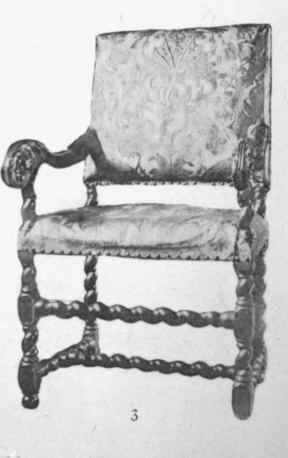
Plate LXVI. I - Chair, Oak 1640 Circa
2 - Chair, Walnut Late I 7th Century
LXVI. (1) Chair, oak, 1640 circa. Leather-backed and seated. Transitional from the Crom-wellian type. V. & A. M.
Dimensions: Height 39, Breadth 18¾ inches.
(2) Chair, walnut. Late seventeenth century.
V. & A. M.
(3) Chair, 1660 circa. Upholstered with stamped leather. At Rockingham Castle. Rev. Canon Wentworth Watson.
If we next look at the very tall-backed chairs in the Victoria and Albert Museum which belonged to the Earl of Strafford (Plate lx.i), and which must be approximately dated 1630, we shall find that on them, too, is a semicircular front stretcher, which is much more in keeping with the style of the Charles 11. cane-backed chair than with that of the solid oak period, to which it actually belongs. The abnormal tallness and narrowness of general shape will also suggest a relationship to the taller of our illustrations of cane-backed chairs. That, for instance, which belongs to Sir Charles Robinson (Plate lxvii.i), happens to have a carved front stretcher which, though it is pierced and more elaborate, is of the same semicircular outline as that of the Strafford chairs. As it is the narrowest of our types, and therein most resembles the Strafford chair, so it is the only cane chair which has so semicircular a stretcher. Mrs. Morse, Furniture of the Olden Time, p. 144, says that cane furniture was introduced about 1678. It would be interesting to learn upon what authority so precise a date may rest.
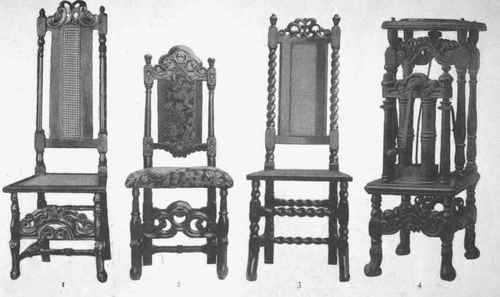
Plate LXVII.
I - Chair 1650 Circa
2 - Chair, Walnut 1660 Circa
3 " " "
4 - Air-Pump Of Robert Boyle 1650 Circa
LXVII. (1) Chair, beech, 1650 circa. Sir Charles Robinson, C.B.
Dimensions: Height 49½, Breadth 17⅜ inches.
(2) Chair, walnut, 1660 circa. The Hon.
Sir S. Ponsonby-Fane, K.C.B.
(3) Chair, walnut, 1660 circa. Forde Abbey.
Miss Evans.
(4) Air-Pump of Robert Boyle, 1650 circa.
The Royal Society.
In default of definite information as to the time at which cane was imported into England, and in the presence of numerous chairs, with cane backs and seats, and with similar details to those which appear upon an object of which the date can be approximately stated, it seems fairly certain that cane was known twenty, perhaps thirty, years earlier. The object to which I refer is the air-pump (Plate lxvii.2) used by Robert Boyle in his experiments, and presented by him to the Royal Society in 1660. This was lent by the Royal Society to the exhibition of furniture at Bethnal Green in 1896. If the date of its presentation is authentic, it will be somewhat of a surprise for many to learn that cross stretchers of the quality and shape of the carving on this pump were made so early. The pillars at the back are turned with practically the same shape as those in the back of the handsome chair reproduced (Plate lxix.i) from Kingsbridge Church, South Devon, which would be dated by most, perhaps, as late as 1690. Small resemblances such as these, of a part of an object, say of 1660, to a part of another presumably of 1690, tend to show that fashions changed slowly, and that a matter of thirty years brought very little difference in its course.
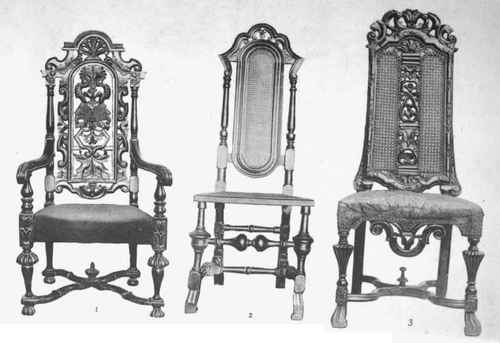
Plate LXIX.
I - Arm-Chair, Oak End Of 17th Century
2 - Chair, Walnut Late 17th Century 3 - „ ,. 1700 Circa
LXIX. (1) Armchair, oak. End of seventeenth century. Kingsbridge Church, Devon.
Height 51½ inches. By kind permission of the Vicar.
(2) Chair, walnut. Late seventeenth century.
E. Hockliffe, Esq.
Dimensions: Height 49¼, Breadth 18½, Depth from front to back 19 inches.
(3) Chair, walnut, 1700 circa. Vincent J.
Robinson, Esq.
It enables us also to understand how, when the style of the town was that of cane-backed chairs, that of the country may still have been one of solid-backed examples.
Continue to:


My Books

