


Royal Emblems
Description
This section is from the book "English Furniture", by Frederick S. Robinson. Also available from Amazon: English Furniture.
Royal Emblems
There are various interesting specimens in the Victoria and Albert Museum. To No. 94 (Plate lxvi.i) I have already referred as an apparent transition from the Cromwellian chair to the later style, by reason of its carved front stretcher with rough cherub's head and curves. Also reproduced (Plate LXVI.2) is an ungainly chair, No. 96. The shape is very squat, the back being too low for the arms. The material is walnut wood, and the arms and cross rails are horizontal spirals. The back and seat are in red velvet with a fringe between the bottom of the back and the seat, which do not meet. The horizontal arms are supported at their ends by figures described in the catalogue as being dressed like ladies of the court of Mary of Modena, who married James II. in 1673. For once, it is perhaps possible to be more exact. Panniers worn over the skirt appear in Hollar's prints of 1640, but panniers and the low-falling collar cut straight across the bosom date, in prints of Hollar and of Sylvester, 1664. Now this straight collar, with the loose sleeves tied at the elbow and continued with lawn, the massive but short side-ringlets of hair, and the large necklace, are found exactly reproduced in a print by Jeaurat, after Lebrun, representing the marriage of Louis XIV. and Maria Theresa in 1660. There appears also an upholstered chair of exactly the same general shape, though without the figures or spiral turning.


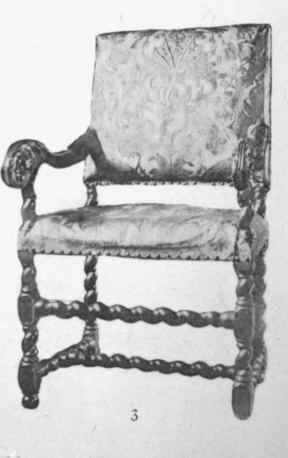
Plate LXVI. I - Chair, Oak 1640 Circa
2 - Chair, Walnut Late I 7th Century
LXVI. (1) Chair, oak, 1640 circa. Leather-backed and seated. Transitional from the Crom-wellian type. V. & A. M.
Dimensions: Height 39, Breadth 18¾ inches.
(2) Chair, walnut. Late seventeenth century.
V. & A. M.
(3) Chair, 1660 circa. Upholstered with stamped leather. At Rockingham Castle. Rev. Canon Wentworth Watson.
It has a very deep cushion, which raises the sitter above the low arms. This evidence of a costume and chair in the same print may be regarded as fairly conclusive of the date of this chair, 1660 circa. The affectation of some writers for precisely dating undated furniture is merely calculated to amuse.
Continue to:


My Books

